Florida Adult Supervision Rules on Public Land
A child may be allowed to ride an ATV or UTV on one Florida public riding area but face different conditions at another. The key is to separate statewide youth-safety requirements from the rules set by the land manager. Here’s how adult supervision, safety courses, permits, and local checks fit together before you unload.
What adult supervision means on Florida public land
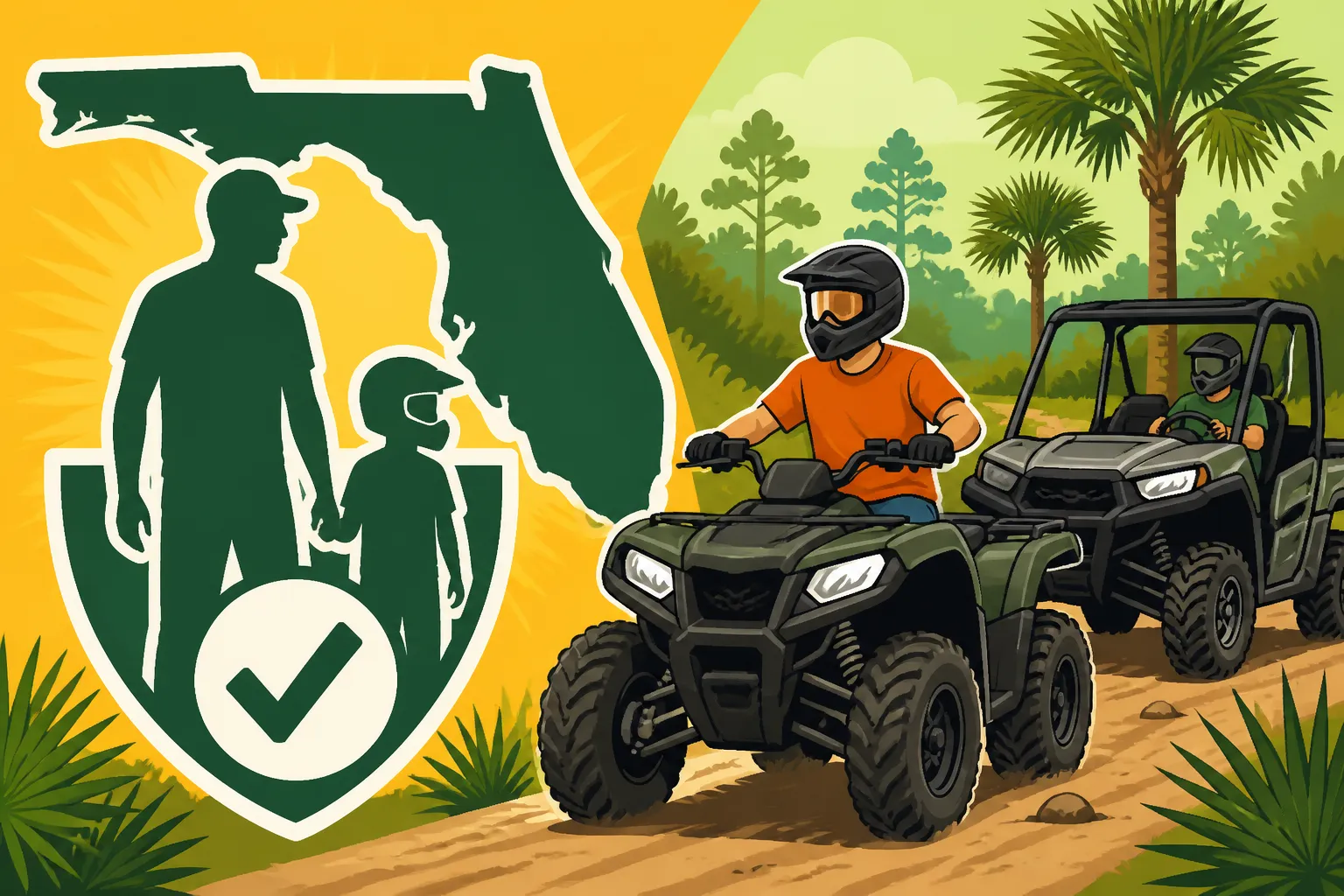
For riders under 16, adult supervision is an important part of riding safely on public land. In practice, the supervising adult should be present, attentive, and able to step in if a young rider needs help. A child riding far ahead or out of sight is not meaningfully supervised, even if an adult is somewhere on the property.
That practical standard is useful, but it is not a substitute for checking the exact rule that applies at your destination. Florida public riding areas are managed by different agencies, and the requirements can vary by land unit, trail system, and machine type. The word “public” does not mean there is one set of rules for every forest, wildlife management area, or designated OHV trail.
For planning purposes, assume that a rider under 16 needs an adult’s active oversight unless the responsible land manager confirms otherwise. Before riding, find out whether the area also requires a safety course, a pass, a particular type of safety equipment, or other conditions for young riders.
Who can supervise
An adult accompanying the child should be capable of keeping track of the child and responding if something goes wrong. The adult may be a parent, guardian, relative, or another responsible adult; do not assume that only a parent can supervise. If an area defines who qualifies or sets a minimum age for the supervisor, follow that site-specific rule.
Supervision is more than arriving at the trailhead together. A practical supervising adult should:
- Know which trails the child is using and what level of difficulty is suitable.
- Stay close enough to maintain contact and respond promptly.
- Make sure the child understands trail signs, closures, and riding instructions.
- Watch for fatigue, heat stress, unsafe speed, and other hazards.
- Avoid becoming separated from the child at intersections, staging areas, or busy trails.
A parent riding a separate machine can supervise, but only if they can maintain effective contact and control the pace of the ride. An adult who is riding far ahead, is distracted, or cannot intervene should not be treated as providing useful supervision.
A UTV passenger is not automatically supervised
A child riding as a passenger in a side-by-side is different from a child operating an ATV. Having an adult driver does not automatically satisfy every requirement that may apply to a young passenger. Check the land manager’s passenger rules, the machine’s seating and restraint instructions, and the age or size restrictions for the specific area.
Never assume a child can ride in a seat simply because it is available. Use the seat and restraint system as designed, and do not carry more passengers than the machine is built to carry. For rules that apply on roads rather than trails, see Florida ATV Passenger Rules and Florida Rules for Riding Two Up on a Quad.
Safety courses and supervision are separate requirements
Adult supervision and safety training solve different problems. An adult can help oversee a ride, but that does not replace any required course. Likewise, completing a course does not necessarily remove a supervision requirement for a rider under 16.
Florida’s public-land OHV requirements can involve more than one set of rules. State law, a land manager’s operating rules, and the specific riding area’s conditions may all matter. This is why a course rule that applies to one kind of public land should not automatically be treated as the complete rule for another.
Before visiting, check whether the child must complete an approved course before riding, whether the course is accepted at that particular area, and whether the rider must carry proof of completion. The details are covered in Florida ATV Safety Course Requirements for Riders Under 16 and Florida ATV Safety Course for Public Land Riding. National forest requirements may need a separate check; see Florida National Forest Under-16 Course Requirement.
| Question | What to check | Why it matters |
|---|---|---|
| Does the child need a course? | The land manager’s current youth-rider requirements | A course may be required even when an adult is present |
| Does the course qualify? | The manager’s list of accepted courses | Course acceptance can differ by land unit |
| Must the certificate be carried? | Whether proof must be shown or kept available | A completed course may not be enough if proof is required at the site |
| Is an adult required to accompany the rider? | The rule for the specific forest, trail, or riding area | Course completion and supervision are separate questions |
| Does the rule cover ATVs and UTVs? | The definition of covered off-highway vehicles | Requirements may depend on the machine and how it is being used |
A certificate stored at home may be difficult to produce when staff ask for it. If the site requires riders to carry proof, bring it in the requested format and keep it protected from water and damage. Avoid relying on a phone signal at a remote trailhead to retrieve a document.
Course requirements can also be confused with rules for riding on roads. A public trail and a public roadway are not the same setting. Road rules may have different age, license, supervision, equipment, and access conditions. Do not use a road-riding rule to decide whether a child may ride on an OHV trail, or the reverse. Two Different Florida Safety Course Rules explains why it is important to identify which requirement applies to the activity.
Public land does not always mean riding is allowed
A common mistake is to assume that any government-owned land is open to ATV or UTV riding. It is not. Public ownership alone does not grant permission to ride. Access may be limited to designated trails, approved roads, certain seasons, or specific vehicle classes. Some public areas do not allow OHV riding at all.
The managing agency matters. National forests, state forests, wildlife management areas, and other public lands can have different access rules. Even within the same broad category, a particular trail or unit may be closed, restricted, or subject to a pass requirement.
Before setting out, confirm all of the following:
- The land unit is open to your type of machine.
- The specific route is open to ATV or UTV use.
- The child’s age and supervision arrangements meet the site’s rules.
- Required safety training and equipment are in order.
- Any pass, permit, or proof of ownership requirements are met.
- Seasonal closures, temporary notices, and local restrictions have been checked.
Wildlife management areas deserve particular care. A WMA may be managed for hunting and conservation, and motorized access can be restricted or seasonal. Do not infer that a vehicle is allowed because a road appears on a map or because other riders have used it. Check Florida WMA Rules for ATV Riders and confirm the rules for the exact area and date.
State forest riding also has its own pass and access conditions. A state forest pass does not grant access to every road or trail, and it does not override youth-safety requirements. Review Florida State Forest OHV Day Use and Annual Passes for pass details, then check the forest’s current notices.
National forest riding may require its own pass, and trail access can be limited to designated routes. Information about pass options is available in Florida National Forest OHV Pass: 3-Day, 7-Day or Annual. A pass is not permission to ride wherever you choose; follow posted boundaries, maps, closures, and vehicle restrictions.
For a broader checklist of permits and proof to prepare, see Florida Riding on Public Land: Permits and Proof. It helps to treat the pass, safety course, title or ownership documents, and site access rules as separate items rather than assuming one document covers everything.
How to supervise a young rider on the trail
The purpose of supervision is not just to satisfy a rule. It is to reduce predictable risks while still giving the young rider room to build skills. A good plan keeps the child on appropriate terrain, makes it easy to stay together, and leaves time to stop when conditions change.
Choose a route that fits the rider
Match the route to the child’s experience, not just their confidence. Sand, mud, ruts, steep grades, water, and tight turns can make a trail much harder than it looks from the staging area. A route that is manageable for an adult may be too demanding for a smaller or less experienced rider.
Start with a short, familiar, lower-difficulty route when possible. Explain trail markers and intersections before setting off. Agree on what the child should do if they lose sight of the adult: stop in a safe place, stay on the marked route, and avoid trying to catch up by taking an unfamiliar trail.
Do not let a group’s pace set the child’s pace. If other riders move faster, the supervising adult should remain with the young rider rather than expecting the child to keep up. Take breaks before the child becomes tired or overheated; fatigue can affect judgment and control.
Keep contact and set clear limits
Before riding, agree on simple rules: where the child may ride, how far ahead they may go, what to do at trail junctions, and when everyone will stop. Use clear hand signals or another communication method that works in the area. If phone service is unreliable, do not make a phone the only way to communicate.
The adult should keep the child in sight or close enough to maintain reliable contact. If terrain, dust, vegetation, or other riders make that impossible, slow down or regroup. The goal is not to follow a child at a distance while hoping the trail remains predictable.
Supervision also means being willing to end the ride. Turn back if the child is tired, uncomfortable, having difficulty controlling the machine, or facing conditions beyond their ability. A planned ride is not a reason to continue when the situation changes.
Prepare for common trail problems
Heat, dehydration, sudden weather, mechanical trouble, and minor injuries can become serious when riders are far from a trailhead. Carry enough water and basic supplies for the planned outing, and know how to reach the area’s staff or emergency services. Give someone outside the ride a general plan if you are heading into a remote area.
Check the machine before riding. Make sure controls work, tires are in suitable condition, and the vehicle is appropriate for the child’s size and experience. Use a helmet and other protective equipment that fits correctly, and follow the site’s specific equipment rules. If purchasing child-sized gear through a retailer such as Amazon, verify the exact product specifications and fit rather than relying only on a listing’s general description.
An adult’s machine should be capable of handling the route too. If the adult is on a vehicle that cannot safely follow the child’s route, the adult may not be able to provide effective support. Choose a route and group arrangement that lets the supervisor remain with the young rider.
A practical pre-ride check for families
A few minutes of checking can prevent a wasted trip or an avoidable rule violation. Rules and closures can change, so use the official information for the land unit rather than relying only on an old map, social media post, or a friend’s past visit.
Use this sequence:
- Identify the exact riding area. Confirm the name of the forest, trail system, WMA, or other public property—not just the nearest town.
- Confirm that the area allows your machine. Check whether ATVs, UTVs, or both are permitted and whether vehicle dimensions or other limits apply.
- Check the child’s requirements. Verify the supervision rule, course requirement, required protective equipment, and any proof that must be carried.
- Check passes and access conditions. Find out whether each machine needs a pass and whether the pass covers the intended riding location.
- Review maps and closures. Use current official maps and notices. A trail shown on an older map may be closed or restricted.
- Plan the ride around the child. Choose a manageable route, agree on contact rules, and identify places to stop or turn back.
- Carry required documents. Keep course proof, passes, or other requested documents accessible and protected.
- Recheck before departure. Weather, closures, and operating conditions can change between planning and riding.
If agency information is unclear, contact the land manager or the area’s visitor office before driving to the trailhead. Ask specifically about a rider under 16, adult supervision, the machine type, accepted safety courses, and current access. A general question such as “Can kids ride here?” may not get a complete answer if the staff member does not know the child’s age or the type of vehicle.
Keep the paperwork in perspective. A title or proof of ownership can help establish who owns a machine, but it does not grant trail access. A pass may allow entry to a designated riding area but does not replace a course or supervision rule. Review the relevant requirements separately and carry what the site says you need.
Frequently Asked Questions
Does completing a safety course let a rider under 16 ride without an adult?
Not necessarily. A course and adult supervision are separate requirements. Check the rules for the specific public land unit and do not assume that completing a course removes a supervision condition.
Does every Florida public land area have the same supervision rule?
No. Public lands are managed by different agencies, and not every public property is open to OHV riding. Confirm the current rules for the exact trail or unit before you go.
Does an adult have to be the child’s parent?
Do not assume that only a parent or guardian can supervise. Check whether the land manager defines who qualifies as an adult supervisor, and make sure the accompanying adult can actively oversee the rider.
Is an adult riding somewhere in the group enough?
Being in the same group is not necessarily effective supervision. The adult should stay close enough to keep track of the child and respond promptly, following any more specific site rule.
Do these rules apply to riding on public roads too?
Trail access and roadway use are different. Road-riding requirements can differ from public-land trail rules, so check the rules for the actual location and activity.
Disclaimer
This article is for general informational purposes only and does not constitute professional advice. Laws, prices and regulations vary by location and change over time. Consult a qualified professional for guidance on your specific situation.