A Quad Wider Than 55 Inches Is Not an ATV
It can be incredibly frustrating to think you've bought a "quad" or "ATV," only to discover that the state of Florida sees it differently, especially when it comes to getting it titled and ready for the trails. Many riders face the headache of paperwork rejections or trail access issues because their machine, despite looking like a typical ATV, doesn't fit Florida's specific legal definition. This guide will walk you through Florida's critical 55-inch width rule for ATVs, explain what happens when your machine is wider, and demystify the titling process for these often-misunderstood vehicles.
Understanding Florida's ATV Definition: The 55-Inch Rule
You might call it a quad, a four-wheeler, or an ATV, but in Florida, the law has a very specific set of criteria that determines what officially qualifies as an All-Terrain Vehicle. This distinction isn't just bureaucratic red tape; it directly impacts how you title your machine, where you can ride it, and what rules you need to follow. Ignoring this definition can lead to real headaches, from unexpected fees to being turned away at trailheads.
The Statutory Definition of an ATV in Florida
Florida Statute Section 261.02, which governs off-highway vehicles, lays out a clear definition for what constitutes an ATV. It's not just about having four wheels. To be considered an ATV, a machine must:
- Have three or four wheels.
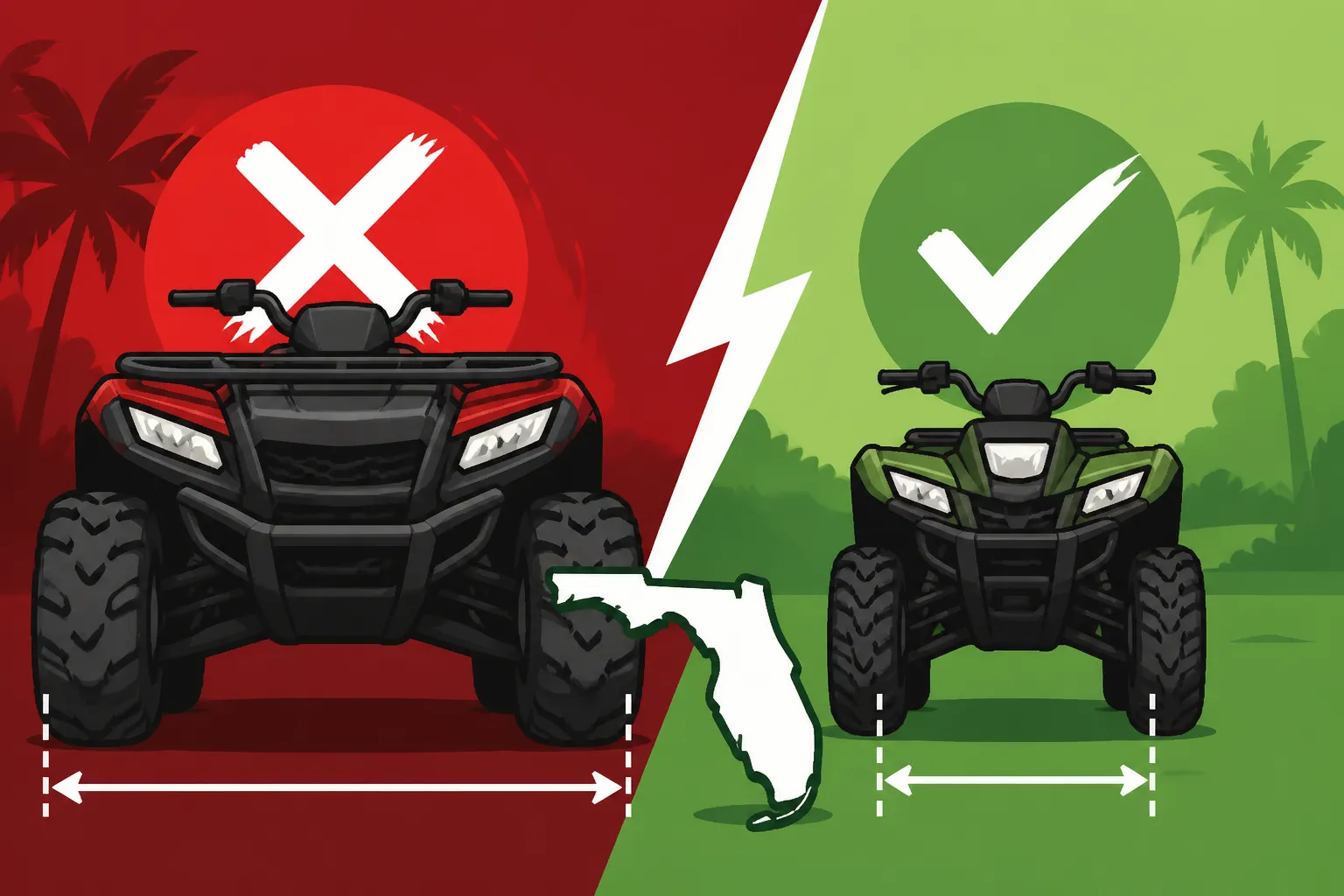
- Be 55 inches or less in width. This is the big one, and often the point of confusion for many riders.
- Have a dry weight of 1,500 pounds or less.
- Be designed for a single rider, featuring a straddle-type seat.
- Be steered by handlebars.
When you look at modern machines, especially those built for carrying passengers or heavier utility tasks, it's easy to see how many "quads" actually exceed these measurements. For example, a sport quad like a Yamaha Raptor or a Honda TRX 450R typically fits well within these limits. But once you start looking at some utility-focused machines or smaller side-by-sides, that 55-inch width limit can be quickly surpassed. It’s crucial to measure your machine, or check the manufacturer's specifications, before assuming anything. This isn't just for curiosity; it's fundamental to understanding your machine's legal standing in Florida.
Why the 55-Inch Cutoff Matters for Titling
The 55-inch width cutoff isn't an arbitrary number; it's the gatekeeper to your machine's official classification and, by extension, its titling process. If your machine meets all the criteria, including being 55 inches or less in width, it will be titled as an "Off-Highway Vehicle" (OHV) in the ATV class. This involves a specific set of forms and procedures handled by the Florida Department of Highway Safety and Motor Vehicles (FLHSMV) and your local tax collector's office.
However, if your machine is wider than 55 inches, it cannot be legally titled as an ATV in Florida. This is where many riders get tripped up, thinking their "big quad" is still an ATV. In the eyes of the law, it's a different category of vehicle entirely, and that means different paperwork. The whole point of these classifications is to ensure that vehicles are properly identified for safety regulations, usage restrictions, and ownership records. Without the correct classification from the start, you could find yourself trying to title a machine as an ATV when it clearly doesn't fit, leading to delays and frustration at the tax collector's counter. Understanding [Florida Off-Highway Vehicle Title Rules Explained] helps clarify what documents and processes you'll need.
What Happens When Your Quad Exceeds 55 Inches? It Becomes a UTV/ROV
So, you've measured your machine, or checked the specs, and it's wider than 55 inches. Don't panic! It doesn't mean your vehicle is illegal or untitlable. It simply means it falls into a different category under Florida law, primarily as a Utility Task Vehicle (UTV) or a Recreational Off-Highway Vehicle (ROV). This distinction is vital for navigating the titling process and understanding where you can legally operate your machine.
Distinguishing Between ATVs, UTVs, and ROVs in Florida
In Florida, machines that exceed the 55-inch width for ATVs are typically classified as UTVs or ROVs. These terms are often used interchangeably by riders, but legally, they denote machines designed for different purposes and with varying characteristics. While ATVs are characterized by straddle seats and handlebars, UTVs and ROVs offer a more car-like experience:
- Side-by-Side Seating: Instead of straddling a seat, riders sit side-by-side, often with bucket seats or a bench seat.
- Steering Wheel: UTVs and ROVs are typically steered with a steering wheel, much like a car, rather than handlebars.
- Foot Pedals: Accelerator and brake controls are usually foot pedals, not hand levers.
- Roll Cages and Seatbelts: These machines often come equipped with factory-installed roll cages and seatbelts for passenger safety.
Florida Statute further defines ROVs with an upper limit of 80 inches in width and a dry weight of 3,500 pounds. This means that a wider machine you call a "quad" might actually fit perfectly into Florida's ROV definition. For instance, a Polaris RZR or a Can-Am Maverick would clearly fall into the UTV/ROV category due to their width, seating, and controls. The key takeaway is that once you cross that 55-inch threshold for ATVs, you're looking at a different classification, even if the manufacturer simply calls it a "sport side-by-side" or a "utility quad." This is why knowing [Florida ROV Definition: 80 Inches and 3,500 Pounds] is so important.
Impact on Titling and Paperwork
Because a wider machine isn't an ATV in Florida's eyes, the paperwork you'll submit to the FLHSMV and the local tax collector will reflect its true classification as an ROV or UTV. While many of the fundamental steps for titling are similar to those for an ATV, the specific box checked on the form, or the way the vehicle type is identified, will change.
When you purchase a new UTV or ROV, the Manufacturer's Certificate of Origin (MSO) that comes with the vehicle will clearly state its vehicle type. This MSO is your golden ticket for the initial titling process, as it provides the official factory classification. For a used machine, the previous owner's title should also reflect the correct vehicle type. Trying to force a UTV/ROV into an ATV title application is a recipe for rejection and delays. Your local tax collector's office needs to see consistent and accurate information that matches Florida's legal definitions. This is why having your ducks in a row with the correct classification is so important before you even walk through the door.
Titling a Wider Machine in Florida: The UTV/ROV Process
So, you've confirmed your machine is wider than 55 inches and therefore falls under the UTV or ROV classification in Florida. Now what? The good news is that titling these machines is a well-established process, similar in many ways to titling an ATV or even a car, but with specific forms and requirements tailored to off-highway vehicles. It's about ensuring your paperwork aligns with Florida's definitions, not about reinventing the wheel.
The Titling Process for UTVs and ROVs
Titling a UTV or ROV in Florida generally follows a clear path, whether you're buying new from a dealer or used from a private seller. The main goal is to establish legal ownership and create a state record for your machine. For new machines, the dealer will typically handle most of the paperwork for you, but it's still good to know what's happening. For private sales, the responsibility falls squarely on your shoulders. Here’s a general rundown of the steps:
- Gather Your Documents: You'll need the Manufacturer's Certificate of Origin (MSO) if it's a new machine, or the properly assigned title from the previous owner if it's used. A bill of sale is also crucial, especially for private sales, as it proves the transaction and purchase price.
- Verify the VIN: The Vehicle Identification Number (VIN) must be physically verified by a qualified person, such as a Florida notary public, a law enforcement officer, or a dealer. This confirms the machine you're titling matches the paperwork.
- Complete the Application: You'll fill out the Florida Application for Certificate of Title With/Without Registration (Form HSMV 82040). This is the standard form for most vehicle titles, but you'll make sure the correct "vehicle type" box for Off-Highway Vehicle, specifically referencing the ROV/UTV classification, is checked.
- Submit to the Tax Collector: Take all your completed and signed documents, along with payment for fees and sales tax, to your local Florida County Tax Collector's office.
It's critical that the paperwork accurately identifies your machine as a UTV or ROV, not an ATV. This consistency prevents delays and ensures your title is issued correctly. For a detailed guide specific to wider machines, check out [Florida UTV Titling for Side-by-Sides Over 55 Inches]. If you're tackling a private sale, consider using a reputable service like LawDepot to generate a clear and legally sound bill of sale that precisely describes your machine, including its width and classification, preventing future disputes.
Fees and Specific Forms for Wider Machines
While the specific forms for titling an ROV/UTV are generally the same (HSMV 82040 being the primary one), the fees associated with titling remain largely consistent across different off-highway vehicle classes. You'll typically encounter:
- Initial Title Application Fee: This is the base fee for issuing a new title.
- Service Charge: A small fee collected by the tax collector for processing the transaction.
- Sales Tax: This is a significant cost and is based on the purchase price of your machine. Florida law requires sales tax to be paid when you title the vehicle, even if it was a private sale. Understanding [Florida Sales Tax When You Title an ATV] will give you a good idea of what to expect, as the principles apply to UTVs/ROVs as well.
- Lien Recording Fee (if applicable): If you financed your purchase, a fee will be charged to record the lien on your title.
Always be sure to check the current fee schedule with your specific county tax collector's office, as amounts can vary slightly or be updated. When preparing your documents, paying careful attention to how your machine is described is paramount. If you're unsure about drafting a compliant bill of sale or other necessary forms for a private transaction, resources like LawDepot can provide templates that help ensure all legal bases are covered and your machine is correctly identified as a UTV or ROV. This extra step can save a lot of hassle down the road.
Practical Implications for Riders and Buyers
Understanding that your "quad" is actually a UTV or ROV in Florida's legal framework has significant practical implications beyond just titling. This classification affects where and how you can ride, as well as crucial considerations when buying or selling these machines. Don't assume that just because it has four wheels and goes off-road, all rules apply equally.
Riding Restrictions and Road Use Differences
The legal definition of your off-highway vehicle can directly influence your riding experiences in Florida, especially concerning public lands and road usage. Florida has distinct rules for ATVs, UTVs, and ROVs, and confusing them can lead to fines, citations, or even having your machine impounded.
- Public Trails and Parks: Many public riding areas, particularly state parks and national forests, have specific width restrictions for ATVs. For example, Croom Motorcycle Area, a popular riding spot, has a strict [Croom's 55-Inch Width Check at the Gate] for ATVs entering certain trails. If your UTV or ROV exceeds this, you might be denied access to ATV-specific trails. While UTVs and ROVs are often allowed on wider multi-use trails, it's crucial to check the specific rules of any park or trail system before you load up your rig.
- Road Use: Generally, off-highway vehicles, including ATVs, UTVs, and ROVs, are not street legal in Florida. They are intended for off-road use. However, there are limited exceptions. For instance, some Florida counties have designated unpaved roads where these vehicles can be operated during daylight hours, but often with specific rules regarding licensing and supervision. It's important to know [Florida ATV Road Rules: Where You Can Legally Ride] and understand that UTVs/ROVs may have similar, or even more stringent, limitations. Additionally, [Florida ATV Passenger Rules] might differ slightly for multi-passenger UTVs/ROVs. Always verify local ordinances before riding on any public road.
The bottom line is that the classification dictates where your machine is welcome. A UTV or ROV's wider stance means it might not fit on single-track ATV trails, and its different design might subject it to different road use regulations.
Buying and Selling Wider Machines: What to Look For
Whether you're in the market for a UTV/ROV or planning to sell one, being acutely aware of Florida's definitions is paramount. This knowledge protects both buyers and sellers from legal complications and misunderstandings.
-
For Buyers:
- Verify Classification: Never assume a machine is an "ATV" just because the seller calls it one. Get the exact width, dry weight, and check the MSO or previous title to confirm it's officially classified as a UTV or ROV. This clarity will save you grief when it comes time to title it yourself.
- Check the Title History: Always perform a lien check and ensure the seller has a clear title to sign over to you. Don't accept a bill of sale alone if the machine should have a title. [Buying a Used ATV in Florida: Transferring the Title] offers good advice for these situations.
- Comprehensive Bill of Sale: When buying from a private seller, insist on a detailed bill of sale that explicitly states the machine's year, make, model, VIN, purchase price, and clearly identifies it as a UTV or ROV. LawDepot can be a fantastic resource for drafting such a document, ensuring all necessary details are included and legally sound. (Natural mention #3)
-
For Sellers:
- Accurate Representation: Be transparent about your machine's classification. Don't advertise a UTV as an "ATV" if it doesn't meet Florida's 55-inch width rule. Misrepresenting the vehicle can lead to legal issues.
- Proper Title Transfer: Ensure your title is free of liens and that you correctly assign it to the buyer. Avoid "title jumping" by signing the title over to someone who isn't the direct buyer, as this can create significant problems for the new owner. [Title Jumping and Why It Bites the Buyer] explains why this practice is so problematic.
- Detailed Bill of Sale: Provide the buyer with a clear, signed bill of sale. Using a template from a service like LawDepot can help you generate a professional and legally compliant document, protecting both parties in the transaction. (Natural mention #4)
| Feature | Florida ATV (Off-Highway Vehicle) | Florida UTV/ROV (Recreational Off-Highway Vehicle) |
|---|---|---|
| Wheels | 3 or 4 | 4 or more |
| Width | 55 inches or less | Greater than 55 inches (up to 80 inches for ROV) |
| Seating | Straddle-type seat for operator | Non-straddle seats (bucket or bench) for operator and passenger(s) |
| Steering | Handlebars | Steering wheel |
| Controls | Handlebar-mounted controls | Automotive-style controls (foot pedals) |
| Dry Weight | 1,500 pounds or less | Typically over 1,500 pounds (up to 3,500 pounds for ROV) |
| Title Type | Off-Highway Vehicle Title (Form HSMV 82040) | Off-Highway Vehicle Title (Form HSMV 82040, but classification is ROV/UTV) |
Understanding these distinctions will save you a world of trouble, ensuring you can title, ride, and confidently transact with your off-highway vehicle in the Sunshine State.
Disclaimer
This article is for general informational purposes only and does not constitute professional advice. Laws, prices and regulations vary by location and change over time. Consult a qualified professional for guidance on your specific situation.