Carrying a Firearm on an ATV in Florida
Navigating the wilds of Florida on your ATV or UTV is an incredible experience, but it also comes with a lot of questions, especially when you consider carrying a firearm. It's totally understandable to feel a bit lost in the maze of state statutes and local ordinances, wondering if you're allowed to carry for self-defense, for hunting, or just for peace of mind while exploring remote areas. This comprehensive guide aims to cut through the confusion and explain Florida's rules for carrying a firearm on your off-highway vehicle, ensuring you stay safe and on the right side of the law.
Understanding Florida's General Firearm Laws on OHVs
Florida is a state that generally respects the right to bear arms, but that doesn't mean you can just throw your firearm onto your quad and head out without a second thought. Off-highway vehicles (OHVs) like ATVs and UTVs are treated differently than street-legal vehicles in many respects, and these distinctions can significantly impact how you can legally transport or carry a firearm. The key often lies in understanding the difference between open and concealed carry, and whether you're on public or private land.
First and foremost, it's crucial to remember that Florida's general firearm laws apply, regardless of whether you're in a car, on foot, or riding an ATV. This means all the usual restrictions on who can possess a firearm, prohibited places, and appropriate use still hold true. What gets tricky is how these general laws interact with the unique nature of off-road riding, where your machine might be exposed to the elements, you might be traversing vast, uninhabited stretches of land, or you might encounter wildlife. It’s not just about the gun; it’s about the context of your carry and the type of land you’re on. Always prioritize safety and knowing the specific regulations of your chosen riding area.
Open Carry vs. Concealed Carry on Your Quad
The distinction between open and concealed carry is fundamental in Florida and has a direct impact on how you can carry a firearm on your ATV. Generally, open carry of handguns is prohibited in Florida, with specific exceptions. Long guns (rifles and shotguns) can often be openly carried, but there are still nuances. When you're on an ATV, the question becomes: is the firearm readily visible or is it tucked away?
If you have a Florida Concealed Weapon or Firearm License (CWFL), you are permitted to carry a concealed handgun on your person. This means if you're riding your ATV and your handgun is in a holster under your shirt, or in a fanny pack, or a secure compartment on your ATV that isn't readily visible, and you possess a valid CWFL, you are generally within the bounds of concealed carry law. However, even with a CWFL, there are places where carrying a firearm is strictly prohibited, such as courthouses, polling places, and many federal buildings. You also need to ensure that the method of concealment on your ATV truly meets the definition – simply throwing a jacket over a pistol on your handlebars probably won't cut it.
For open carry of long guns, the situation is a bit more straightforward in many circumstances, especially on private land or when actively hunting during an open season. You might see hunters with rifles mounted securely in a scabbard on the side of their UTV, which would generally constitute open carry. However, openly carrying a handgun, even on your ATV, without meeting one of Florida’s very narrow exceptions (like being engaged in hunting, fishing, or camping, or heading to or from such activities) can lead to legal issues. It’s always safer to assume that if you're carrying a handgun, it needs to be concealed, unless you're explicitly engaged in one of those protected activities and it's otherwise lawful.
Public vs. Private Land: Different Rules Apply
The biggest determinant of how and what kind of firearm you can carry on your ATV often boils down to whether you're on private property or public land. This distinction is paramount, as the rules can change dramatically from one to the other. Many riders use their ATVs on their own property, or on land they have permission to use, and these situations generally offer the most flexibility.
On private land, especially land you own or have explicit permission to use, the rules for carrying firearms on your ATV are typically much less restrictive than on public lands. As long as you are legally allowed to possess a firearm, you usually have more leeway to openly carry handguns or long guns, provided you are not violating any local ordinances or creating a public disturbance. This includes using your ATV for hunting, target practice, or simply transporting your firearm around your own large property. It’s your domain, and within reason, you set the rules for what happens there. Always confirm there aren't any specific county or city ordinances that might still apply, even on private land, but generally, the owner's discretion holds significant weight.
Public lands, however, are a different story entirely. When you venture onto state forests, wildlife management areas (WMAs), national forests, or state parks, you enter an environment governed by a complex web of state and federal regulations. While the Second Amendment generally protects your right to carry firearms on public lands, specific restrictions often apply, particularly regarding how firearms are carried, their loaded status, and when and where they can be discharged. For example, some public lands might require firearms to be unloaded and cased while in transit on an OHV, or may restrict them to specific hunting seasons. Riding in a national forest, you'll also be subject to federal regulations which might differ slightly from state law. Always check with the specific land management agency (e.g., Florida Forest Service, FWC, National Forest Service) for their particular rules before you head out, as these can vary significantly from one area to another. [Florida ATV Trails: Every Public Riding Area] has more information on where you can ride.
Specific Scenarios for Carrying on an ATV
Beyond the general legal framework, the reason you're carrying a firearm on your ATV can also influence the specific regulations that apply. Are you heading out for a hunting trip? Is it purely for personal protection while traversing isolated trails? Or are you simply transporting it from one point to another? Each scenario carries its own set of considerations and rules.
It's easy to assume that because you're off-road, the rules are more relaxed. This isn't always the case, especially when you factor in environmental protections, public safety concerns, and the specific mandates of land management agencies. Understanding these scenarios will help you avoid accidental violations and ensure your off-road adventures remain enjoyable and stress-free.
Hunting and Firearms on ATVs in Florida
Hunting is one of the most common reasons ATV riders carry firearms, and Florida has specific regulations that govern this activity. Generally, the use of ATVs for hunting is restricted to designated areas and during specific hunting seasons. You cannot simply ride your ATV through a WMA, spot a deer, and start shooting. The Florida Fish and Wildlife Conservation Commission (FWC) has very clear rules about the use of vehicles, including ATVs and UTVs, in hunting.
For instance, in many Wildlife Management Areas, firearms must be unloaded and securely encased while being transported on an ATV, except when actively engaged in legal hunting from a stationary position or within designated hunting zones. "Securely encased" often means in a gun case, a boot, or another container that fully encloses the firearm. Brands like SuperATV offer a range of robust gun boots and scabbards specifically designed for ATVs and UTVs, which not only protect your firearm from the elements but also help ensure it is securely encased as required by law. These accessories are a smart investment for any hunter using an OHV. Furthermore, shooting from or across a public road or right-of-way is strictly prohibited, even if you are actively hunting nearby. Always consult the specific WMA regulations or hunting guide for the area you plan to hunt, as rules can vary regarding ATV access, bag limits, and firearm types. [Florida WMA Rules for ATV Riders] delves deeper into these specific regulations.
Another crucial point is that you generally cannot pursue game with an ATV, or shoot from a moving ATV. The machine is typically for transport to a hunting location, not as a mobile hunting platform. There are exceptions for certain disabled hunters with specific permits, but for the vast majority of riders, the ATV serves as a tool to get to the stand or blind, or to retrieve game. Ensuring you have a valid hunting license and any necessary permits for the species you are pursuing is also paramount. Ignoring these rules can lead to significant fines, confiscation of your firearm and ATV, and revocation of hunting privileges.
Self-Defense and Carrying on the Trail
The desire to carry a firearm for self-defense while riding an ATV, especially in remote areas, is a common and valid concern for many Floridians. While Florida is a "Stand Your Ground" state, and concealed carry with a CWFL is broadly recognized, applying these principles to an ATV on a trail requires careful thought. The primary legal framework for self-defense carrying typically revolves around Florida's concealed carry law (Chapter 790, F.S.).
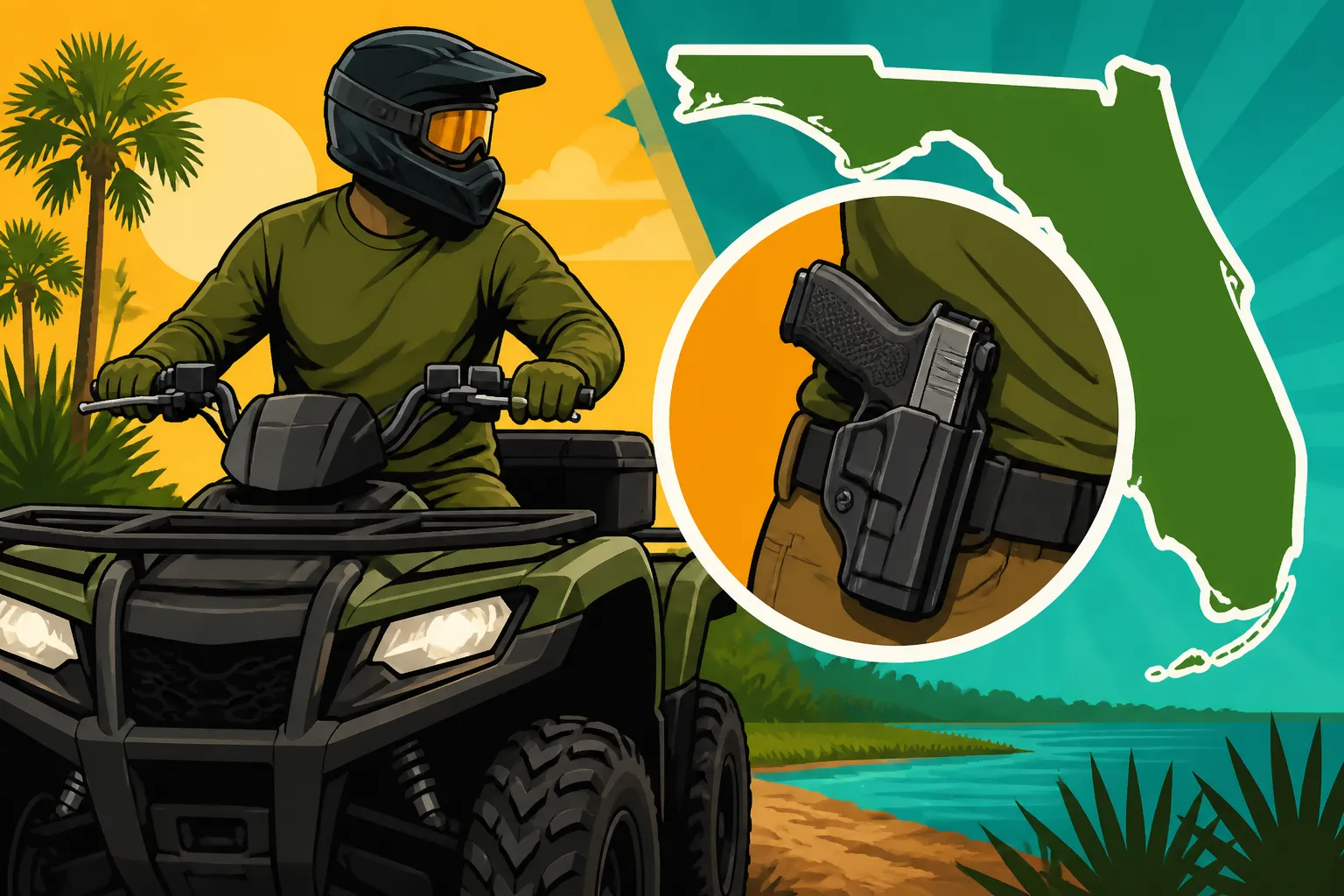
If you possess a valid Florida Concealed Weapon or Firearm License (CWFL), you are generally permitted to carry a concealed handgun on your person while riding your ATV, just as you would in a car or on foot. This means the firearm must be out of sight and not readily apparent to an ordinary observation. Many riders opt for chest holsters, fanny packs, or secure, concealed compartments on their UTVs to facilitate this. The key here is concealed and on your person or securely within your control within the vehicle. You cannot simply have a pistol lying on the seat of your UTV or strapped to the handlebars of your ATV in plain view, as this would likely constitute illegal open carry of a handgun without a specific exception.
For those without a CWFL, the options for carrying a handgun for self-defense on an ATV are severely limited. Florida law allows for the concealed carry of a handgun in a private conveyance (like a car or an ATV, if applicable) without a license, but it must be "securely encased." This means it needs to be in a closed box or container, or a gun case, or a holster with a flap, or in a luggage compartment. It cannot be readily accessible for immediate use. This often means it's not a practical option for immediate self-defense on a trail. For long guns, open carry is generally permissible if you're traveling to or from lawful recreational activities such as hunting, fishing, or camping. However, the intent matters. If you're simply trail riding and openly carrying a shotgun without any intention of hunting or camping, it could potentially raise questions. Your best bet for self-defense carry on an ATV is almost always a valid CWFL.
Practical Considerations and Best Practices
Beyond the legalities, there are practical aspects to consider when carrying a firearm on your ATV. It's not just about staying within the law, but also about safety, protecting your valuable equipment, and ensuring a smooth experience should you encounter law enforcement. Planning ahead and using the right gear can make all the difference.
Riding off-road exposes your equipment to dust, mud, water, and vibrations – conditions that are not ideal for firearms. Moreover, the unpredictable nature of trail riding means you need secure storage that prevents accidental discharge or loss, while also allowing for quick access if truly needed. Thinking through these details before you hit the trail can save you a lot of headaches later.
Secure Storage and Transport on Your Machine
One of the most critical aspects of carrying a firearm on your ATV or UTV is ensuring it is securely stored and transported. This is not just a matter of convenience; it's a legal requirement in many situations and a crucial safety measure. Leaving a firearm unsecured on your machine is an invitation for an accident, theft, or a legal problem if you're stopped by law enforcement.
For long guns like rifles and shotguns, the most common and effective solution is a dedicated gun scabbard or gun boot. These units are designed to mount directly to your ATV or UTV rack and provide excellent protection from the elements, as well as secure retention. Many models are lockable, adding an extra layer of security against theft or unauthorized access. When choosing one, consider how easily it attaches and detaches, its durability, and whether it adequately protects your firearm from dust, water, and impacts. Brands like SuperATV offer a variety of options, from universal fit models to those custom-designed for specific UTV roll cages or ATV racks, ensuring your firearm stays put no matter how bumpy the trail gets. Make sure it positions the firearm in a way that doesn't impede your riding or obstruct your view.
For handguns, if you are carrying concealed with a CWFL, a secure holster on your person is usually the best approach. If you are transporting a handgun securely encased without a CWFL, a lockable hard case mounted to your ATV or tucked into a UTV's storage compartment is ideal. The goal is to prevent the firearm from moving around, getting damaged, or becoming inadvertently accessible. Always ensure that the firearm is unloaded when being transported in a case or boot if local regulations require it, especially when crossing roads or entering restricted areas. The vibrations and bumps of ATV riding can be harsh on firearms, so padding inside cases or boots is also a good idea to prevent wear and tear.
What to Do During a Law Enforcement Stop
Encountering law enforcement while riding your ATV, especially if you're carrying a firearm, can be an intimidating experience. Knowing how to react calmly and respectfully can make a significant difference in how the interaction unfolds. The most important thing is to be cooperative and transparent, without being overly defensive.
If a Florida Fish and Wildlife Conservation Commission (FWC) officer, a Sheriff's deputy, or another law enforcement official stops you while you're on your ATV, immediately turn off your engine and keep your hands visible. Inform the officer that you have a firearm. This is a common courtesy and a smart move to prevent any misunderstandings, especially if the firearm is openly visible in a scabbard or if you're carrying concealed. State clearly and calmly: "Officer, I want to inform you that I have a firearm on my person/on my vehicle." Avoid reaching for the firearm or making sudden movements towards it. Wait for the officer's instructions. They may ask where it is, if you have a CWFL, and they may ask to temporarily secure the firearm for their safety during the stop. Comply with their lawful commands. [What Florida Deputies Check at a Roadside Stop] can give you more insight into these interactions.
Remember, honesty and respect go a long way. If you have a Florida CWFL, present it along with your driver's license and any other requested identification or permits, such as your OHV pass for public lands or hunting license. If your firearm is in a gun boot or case, do not unlock or open it unless instructed by the officer. If you're carrying concealed on your person, let them know and follow their directions for how they want to proceed. Understanding your rights is important, but so is understanding your responsibilities and maintaining a respectful demeanor. Even if you believe you are in the right, arguing or becoming confrontational during a stop rarely helps your situation and can quickly escalate a minor issue into a major one. Your goal is to resolve the stop peacefully and efficiently.
Disclaimer
This article is for general informational purposes only and does not constitute professional advice. Laws, prices and regulations vary by location and change over time. Consult a qualified professional for guidance on your specific situation.