Florida ATV Trails Near Pensacola
Pensacola riders often expect a long list of public ATV parks nearby, then discover that forest roads, walking trails, and OHV routes are not interchangeable. This guide explains the closest Florida trail option, how to check whether your machine can use it, what to bring, and when a farther destination may make more sense.
The closest public riding option near Pensacola
Clear Creek OHV Trail in Blackwater River State Forest
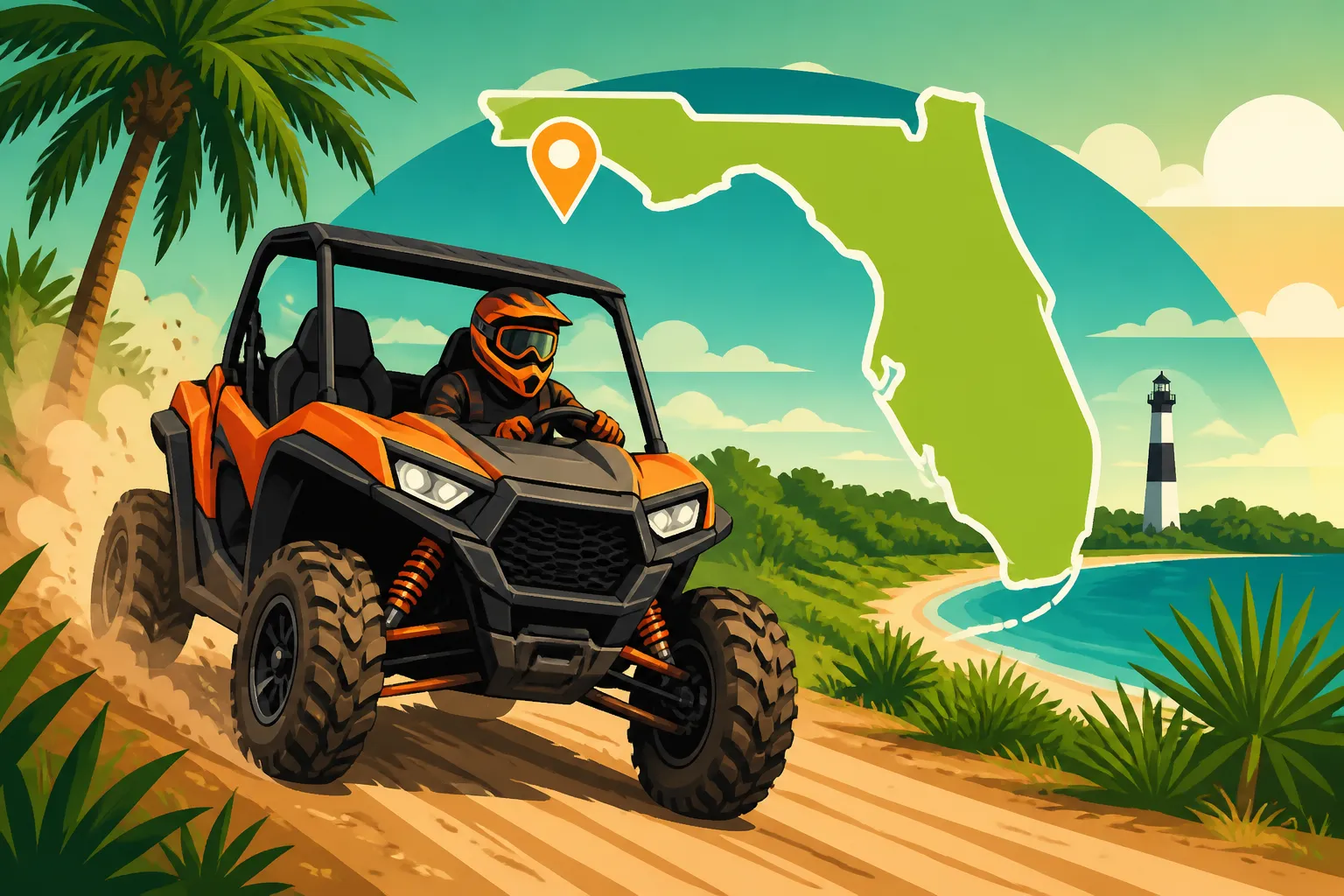
For a Florida ride near Pensacola, start by looking at Clear Creek OHV Trail in Blackwater River State Forest. The forest is in the Panhandle, with access in the wider Milton and Baker area, so it is a practical place to investigate before planning a longer trip across the state. Check the official forest information for the current trailhead location and access instructions before you leave; a large forest can make a vague map pin surprisingly unhelpful.
Clear Creek is a designated OHV riding area, not a green light to ride any track or sandy road you happen to find in the forest. Stay on routes marked as open to your type of vehicle, and follow signs at trail entrances and intersections. A forest road that looks inviting on a map may be intended for other traffic, closed temporarily, or outside the designated riding system.
For a broader look at what the area offers, see [Clear Creek OHV Area at Blackwater River State Forest] and [Riding Clear Creek in the Blackwater River Forest]. Those guides can help you build a more detailed plan, but treat posted signs and official forest updates as the final word for the day. Trail access and conditions can change, so it pays to check shortly before heading out rather than relying on a saved route from a previous visit.
What to expect from a forest trail area
A forest OHV ride is a different outing from a private mud park with a staffed entrance, a central staging area, and a concentration of marked obstacles. Expect a more natural setting, with sandy ground, wooded sections, changing trail conditions, and stretches where route-finding and awareness matter. That can be a big part of the appeal, but it also means you need to arrive prepared rather than assuming amenities or help will be close at hand.
Blackwater River State Forest is large, and the name of the forest alone does not tell you where you are allowed to ride. Don’t treat every forest road as an ATV trail, and don’t ride onto hiking, equestrian, or other recreation routes unless signs specifically allow it. If a route is closed, blocked, or unclear, stop and check instead of going around a barrier. A detour can lead to an unauthorized road or damage sensitive ground.
It helps to set expectations with your group before you arrive. If someone is picturing a day of deep mud and hill climbs, while another rider wants an easy scenic loop, you may be imagining two different kinds of trip. Use the trail information to choose a route suited to your machines and experience, and be willing to turn around if the ground, traffic, or conditions are beyond what your group planned for.
Check access rules before loading the trailer
Confirm trail access, permits, and machine eligibility
A ride plan should begin with three separate questions: Is the area open? Is your machine allowed on the route? Do you have the required pass or other paperwork? These questions are related, but one answer does not automatically settle the others. A pass does not make a closed trail open, and a machine that is legal to own is not automatically permitted on every public trail.
Check the current requirements for the forest and the specific riding area before travelling. Requirements may depend on whether you are riding an ATV or UTV, the machine’s dimensions, and whether the route is designated for that class of vehicle. Florida public-land riding may also involve permit and safety requirements. For a starting point, read [Florida OHV Permits: What You Need Before You Ride] and [Florida OHV Trail Pass for Out-of-State Riders]. Then confirm details with the relevant land manager, especially if you are visiting from Alabama or another state.
Keep the vehicle’s ownership and identification documents in order, and carry whatever proof the riding area requires. These documents are not substitutes for an OHV pass, but they can help avoid a frustrating conversation if a ranger or staff member asks about the machine. For related public-land planning, [Florida Riding on Public Land: Permits and Proof] explains why checking paperwork is part of preparing for a ride, not just a task for the trailhead.
Check closures and route information before you drive
A trail that was open on your last visit may not be open today. Heavy rain, maintenance, fire conditions, timber operations, hunting activity, or other land-management needs can affect access. Before setting out from Pensacola, check official updates for closures and restrictions, then make a backup plan in case the trail you hoped to ride is unavailable. [Florida Trail Closures You Should Check First] and [Florida Riding Areas That Close for Hunting Season] are useful reminders to make this a routine part of trip planning.
Use a current official map or trail information to identify the designated routes and trailhead. Navigation apps can help you understand the wider area, but a GPS line is not proof that a route is open to OHVs. If you use onX Offroad to plan, compare the mapped route with the official forest information and signs on the ground. App layers can be useful for orientation, but they should not override a closure notice or a posted restriction.
A simple pre-trip check can prevent a long, disappointing drive: verify the operating status, confirm the trailhead and allowed vehicle types, check the pass rules, and make sure the group agrees on a backup option. If you cannot confirm a detail, contact the land manager before loading up. It is much easier to change plans at home than to arrive at a closed gate with a trailer full of machines.
Choose a ride that suits your machine and group
ATVs and UTVs may not share every route
It is tempting to assume that an OHV area accepts any off-road machine, but that is not a safe assumption. Trails can have width or vehicle-class restrictions, and access can vary between an ATV and a wider side-by-side. Check the requirements for your specific machine rather than relying on a general label such as “OHV area.” If you ride a UTV, confirm its width and any other relevant limits before making the trip.
This matters especially when a group mixes machines. One rider may arrive on a narrow quad while another brings a side-by-side that cannot fit on the same trail or through a restricted entrance. If you are organizing a group, verify that the route works for the largest or widest machine, and confirm whether the entire group can stay together legally. [Florida ATV Trails That Allow Side-by-Sides] is a useful companion when comparing options.
Before you leave, measure or check your machine’s specifications if the rules use a width limit. Don’t guess based on how it looks beside another vehicle. If a gate check or posted sign rules out your machine, do not attempt to squeeze through or continue onto a route marked for smaller vehicles. A little homework can save a wasted drive and avoid putting other riders in an awkward position.
Match the route to riders’ experience
A family ride with young or inexperienced riders calls for a different plan from a day of fast group riding. Choose a route and pace that allow everyone to stay comfortable, and make sure each rider understands basic trail etiquette before the group rolls out. New riders often need more time to judge soft sand, manage braking, and keep a safe distance from the machine ahead.
For children, check age, supervision, safety-course, and protective-equipment requirements that apply to the riding area and the type of ride. Don’t assume that a child who is confident on private property is automatically ready for a public trail. A short practice session in a controlled setting can reveal whether the child can stop, turn, and respond to instructions without pressure from a group waiting behind them.
Agree on simple group rules: no passing without permission, stop at intersections, and wait at planned regrouping points. Make sure every rider knows what to do if the group gets separated. A paper map or downloaded offline route can help, but it is also worth setting a clear meeting point and carrying a charged phone where service is available. onX Offroad may help riders compare their position with a planned route, but no app replaces keeping the group together and obeying posted signs.
Plan for Panhandle weather and trail conditions
Rain, sand, and seasonal changes
The Panhandle can deliver very different riding conditions from one visit to the next. A sandy route that felt easy in one set of conditions may become more demanding after rain, while wet or saturated areas can be vulnerable to ruts and other damage. If a trail is muddy, don’t assume that means it is open for aggressive riding. Respect closures, avoid damaging soft ground, and turn back if conditions make the route unsafe.
Before a rainy-season outing, check the forecast and trail status, and think through what you will do if storms arrive while you are riding. Florida downpours can change visibility and traction quickly. If thunder is approaching or water is accumulating on the route, find a safe way to stop and reassess rather than pushing on to finish a loop. [Florida Trail Riding in the Rainy Season] covers the kinds of conditions riders should consider.
Heat is another part of the planning, especially for visitors used to cooler-weather riding. Bring enough drinking water, take breaks, and avoid assuming that a shaded forest trail will feel cool once you are geared up and moving. Check your machine before leaving and again during longer rides: look for debris, loose straps, and anything that could become a problem far from the trailhead.
Pack for a day away from town
A good ride kit is practical, not complicated. Bring helmets and protective gear that meet the riding area’s rules, closed-toe footwear, eye protection, water, basic first aid supplies, and a way to contact your group. Carry food and any personal medication you may need. If you are riding with children or less experienced guests, pack with extra margin; small delays can feel much longer when someone is thirsty, tired, or uncomfortable.
Prepare your trailer and towing vehicle as carefully as the ATV. Check tie-downs, lights, tires, and the loading area before driving away. At the trailhead, keep the staging area orderly, secure loose gear, and avoid blocking access for other visitors. [Florida ATV Trailheads With Parking for Trailers] offers more planning context for riders who are hauling machines rather than riding directly from nearby accommodation.
Download the information you will need before you leave reliable cell coverage. Save the trailhead location, official map, closure details, and emergency contacts. onX Offroad can be one way to keep a planned route handy, but download what you need in advance and carry a backup map if you are depending on navigation. Don’t count on being able to search for directions or call for help from every part of a forest.
Compare nearby alternatives and set expectations
When to look beyond Clear Creek
If Clear Creek is closed, does not fit your machine, or is not the kind of ride you want, decide whether to change the activity or travel farther. The Panhandle has public forests and conservation lands, but that does not mean each one has a recreational ATV trail system. A forest road, hunting access route, or unpaved track should not be treated as an OHV route unless the land manager explicitly permits it.
Some riders choose to make a longer trip to another designated area rather than improvising on land that is not open to recreational riding. [Florida Panhandle ATV Riding Areas] can help you compare the broader region, while [Florida ATV Trails Open Year-Round] is a reminder to check actual operating status instead of assuming a destination is available whenever you have a free weekend. Distance matters: a place that appears close on a map may take longer once you account for towing, rural roads, check-in, and the return drive.
If you are considering a private park or a destination across the state line, check its own admission, machine, passenger, age, gear, and operating rules. Policies vary by property, and a public-forest pass will not necessarily meet a private park’s requirements. For an out-of-state destination, account for the extra drive and verify that your group understands the park’s rules before leaving Florida.
Make the outing enjoyable for the whole group
The best trail plan is not necessarily the longest one. For a first visit, build in time to find the correct entrance, check in, unload safely, and orient yourself before riding. Let the group start with a manageable route and decide later whether to continue. That approach is much less stressful than trying to fit an ambitious itinerary into a day when the trailhead is unfamiliar.
Good etiquette helps protect access for everyone. Stay on designated routes, keep noise under control, yield appropriately, pack out trash, and never ride around a barrier. If you meet hikers, other trail users, or forest staff, slow down and give them room. [Florida OHV Trail Etiquette Locals Expect] is a helpful read before sharing the area with other visitors.
For Pensacola-area riders, the practical takeaway is to begin with Clear Creek, verify access and machine eligibility with official information, and prepare for a natural forest ride rather than assuming it will feel like a commercial park. A careful check before departure—and a backup plan if conditions change—can turn a potentially frustrating drive into a much smoother day outdoors.
Disclaimer
This article is for general informational purposes only and does not constitute professional advice. Laws, prices and regulations vary by location and change over time. Consult a qualified professional for guidance on your specific situation.