Florida Night Riding Areas
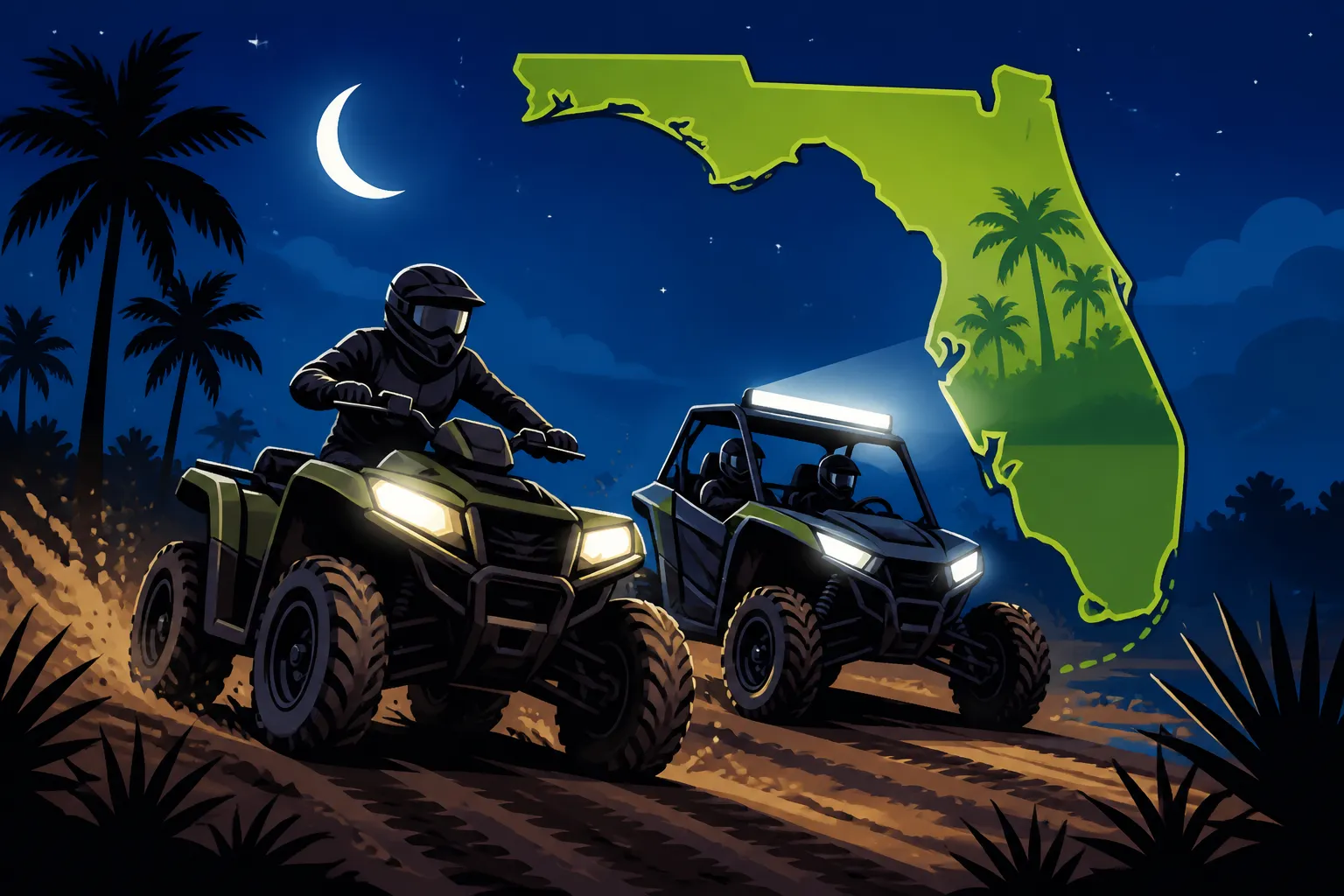
Florida night riding can sound simple until you arrive at a trail gate after dark and discover the area is closed, the route is not authorized for nighttime use, or your phone has no signal. This guide explains where to look for legal after-dark riding in Florida, how public and private areas differ, and what to confirm before unloading your ATV or UTV.
Where night riding may be available in Florida
The key distinction is not whether a place has trails, mud, or open space. It is whether the land manager has specifically allowed riding at night on the date and route you plan to use. A trail that is open during the day should not be assumed to remain open after sunset.
Public OHV areas are generally a daytime plan
Florida’s public riding areas are not interchangeable. National forests, state forests, and other public lands each have their own access rules, operating hours, closures, and permit requirements. For planning purposes, treat public OHV trails as daytime destinations unless the responsible land manager clearly confirms an authorized nighttime opportunity.
Croom Motorcycle Area near Brooksville is a good example of why checking hours matters. It is a well-known public riding area, but its popularity does not mean riders can continue after dark. Check the posted operating information before making the drive, and don’t treat a late arrival or a slow ride back to the staging area as permission to keep riding. [Croom Gate Hours From 8 to 5] offers more context on planning around its access schedule.
The same caution applies to the Ocala National Forest and Florida’s state forest OHV areas. A forest road may be open to some kinds of travel while a designated OHV trail has different conditions or hours. Hunting seasons, weather, maintenance, fire concerns, and temporary closures can also change what is available. Review [Florida Trail Closures You Should Check First] and [Florida Riding Areas That Close for Hunting Season] before you leave.
Private parks are places to ask, not automatic night-riding options
Private parks and mud parks may be more likely than public trails to host scheduled evening or overnight events. That does not mean night riding is available every weekend, on every trail, or to every visitor. A park may allow after-dark riding only during a specific event, in a designated section, or for riders who meet additional rules.
If you are considering a destination such as Hog Waller near Palatka, Redneck Mud Park near Punta Gorda, or Hard Rock Off Road Park in Ocala, contact the park directly before building your trip around night riding. Ask whether the event includes riding after dark, what areas are open, when riding must stop, and whether headlights alone are sufficient. Park schedules and rules can change, so an old social post or a friend’s past experience is not a substitute for confirmation.
| Destination type | What to assume before checking | What to confirm |
|---|---|---|
| National forest OHV area | Daytime use only | Trail hours, closures, pass requirements, and any special event authorization |
| State forest OHV area | Daytime use only | Operating hours, trail status, permit rules, and seasonal restrictions |
| Private riding park | Night riding is not guaranteed | Event dates, permitted riding hours, open sections, lighting rules, and rider requirements |
| County or municipal land | Access depends on the specific property | Whether motorized riding is allowed at all and whether after-dark use is authorized |
| Unpaved public road | Road rules do not automatically grant trail access | Whether ATVs or UTVs may use that road and what hours and conditions apply |
A park employee’s clear answer is more useful than a general claim that a property is “open late.” Ask specifically whether riders can operate machines after sunset, not merely whether the gate or campground remains open.
How to verify that after-dark riding is allowed
A little checking before departure can prevent a frustrating—and potentially unsafe—arrival. Make sure you are verifying the actual land, route, and date, rather than relying on a broad map label or an old recommendation.
Confirm the rule with the land manager
Start with the official contact or current notice for the property. For a public area, that means the agency responsible for that specific trail system. For a private park, contact the park directly. Ask a short set of practical questions:
- Is ATV or UTV riding allowed after sunset on the date I plan to visit?
- Which trails, tracks, or zones are open after dark?
- Is nighttime access limited to a scheduled event, registered campers, or certain riders?
- What time must machines stop, and when must riders leave the riding area?
- Are there separate rules for headlights, taillights, sound, passengers, age, or safety gear?
- Do I need a permit, pass, reservation, or event registration?
- Are there any current closures or weather-related restrictions?
Be precise about the machine you plan to ride. A wide side-by-side may have different access limits from a smaller quad, especially on trails with width restrictions. For public-land trips, review [Florida OHV Permits: What You Need Before You Ride] as well as the rules for the individual site.
If the answer is vague—“people ride late sometimes” or “the park is open”—ask again in plain terms: “Is riding after sunset permitted for visitors on this date?” If you still cannot get a definite answer, plan for daytime riding instead.
Use maps as a planning aid, not permission
Offline mapping can help you understand the area, find a route, and avoid getting turned around. Apps such as onX Offroad can be useful for reviewing mapped roads and trail information before a trip, especially if mobile service may be unreliable. But a mapped line does not establish that a route is open, that motorized riding is permitted, or that night use is authorized.
Before leaving home, compare your route with the park’s or agency’s current information. Save the official rules and contact details, download any maps you expect to need, and check whether your planned route crosses private property or a closed section. The [Florida ATV Trails: Every Public Riding Area] guide can help with identifying public riding options, but you still need to verify current access and hours for the specific destination.
Do not rely on a phone’s online map once you are deep in a rural area. Service can fade around forest roads and remote trailheads, and a route-planning app may not show a temporary closure. If you use onX Offroad or another mapping tool, prepare offline maps ahead of time and carry a separate way to contact your group or get help.
Preparing an ATV or UTV for a night ride
Darkness makes familiar terrain feel different. Sand whoops, ruts, standing water, palmetto edges, and low branches can be difficult to judge even when you know the trail. Preparation matters as much as permission.
Check lighting, protective gear, and the machine
Inspect headlights and taillights before the ride, not in the parking area after sunset. Clean the lenses, check that lights stay on when the machine is running, and confirm that the beam gives you enough view of the ground immediately ahead. A light bar may improve visibility where allowed, but it does not replace required equipment or make an unauthorized route legal.
Wear a properly fitted helmet and eye protection, and choose clothing that covers exposed skin without interfering with controls. Gloves, sturdy footwear, and reflective details can help other riders notice you. On a UTV, make sure every occupant has an appropriate seat and restraint, and keep hands and arms inside the vehicle. Night conditions make sudden stops and uneven ground harder to anticipate, so avoid carrying passengers beyond the machine’s intended capacity.
Give the machine a basic pre-ride check: tires, brakes, throttle return, steering, fuel, and visible damage. On a muddy ride, clean the headlights before they become coated. A headlight that looked bright in the driveway can become nearly useless after a stretch through wet clay or sand.
Ride at a pace that leaves room to react
At night, ride slowly enough that you can stop within the distance your lights illuminate. That may mean going much slower than you would in daylight, especially around blind corners, on unfamiliar trails, or where other machines may approach from the opposite direction. Avoid following so closely that dust or mud spray blocks your view.
Agree on simple group procedures before moving. Choose a lead rider and a sweep rider, decide where to regroup, and make sure everyone knows what to do if the group becomes separated. If one machine stops, tell the group rather than leaving someone behind to troubleshoot alone. Carry a charged phone, but do not assume it will have a signal; review [Florida Trailhead Cell Service and Getting Help] when choosing a remote riding destination.
Sound carries in quiet rural areas, particularly at night. Follow posted limits and park rules, keep unnecessary revving down, and avoid riding near homes or campsites outside permitted hours. For more on this issue, see [Florida Sound Limits on Public Land] and [Florida OHV Trail Etiquette Locals Expect].
Choosing a practical night-riding plan
A good plan starts with the least exciting question: what will you do if night riding is not allowed? Having a daytime alternative keeps a weekend from turning into a long drive for a closed gate or a rule you did not know about.
Build a backup around daylight access
If you cannot get clear confirmation of after-dark riding, plan a daytime visit and finish before the posted closing time. Croom, Ocala-area trails, and state forest riding areas may still make a rewarding trip without nighttime use; just match the destination to your machine and follow its access requirements. If you are looking for a private event, check the event details directly rather than assuming that a nighttime schedule applies to regular park visits.
Do not confuse riding after dark with camping after dark. A campground may remain accessible while the riding area is closed. Likewise, leaving a machine parked near a trailhead does not mean you may resume riding once the trails close. Confirm separate rules for camping, parking, and motorized access.
Keep your travel plan realistic. In Florida, afternoon storms, standing water, and heavy mud can slow a ride and push your return later than expected. Build in enough time to get back before closing, and check [Florida Trail Riding in the Rainy Season] if weather is part of your trip planning.
Make the final decision at the gate
Before unloading, read posted signs and check for notices at the entrance or staging area. A general website statement may not reflect a same-day closure, a special event boundary, or a local instruction posted on site. If the gate attendant or ranger gives you a direction that differs from your map, follow the direction and clarify the route before riding.
If a park’s answer changes, or you arrive and cannot confirm that nighttime riding is authorized, do not test the boundary by riding “just one loop.” Turn the evening into a camp, meal, or early start the next morning. The safest and most dependable Florida night-riding plan is the one where the land manager has clearly approved the time, place, and type of riding—and your group has a way to navigate and communicate if conditions change.
Disclaimer
This article is for general informational purposes only and does not constitute professional advice. Laws, prices and regulations vary by location and change over time. Consult a qualified professional for guidance on your specific situation.