Florida Riding Areas That Allow Dirt Bikes Too
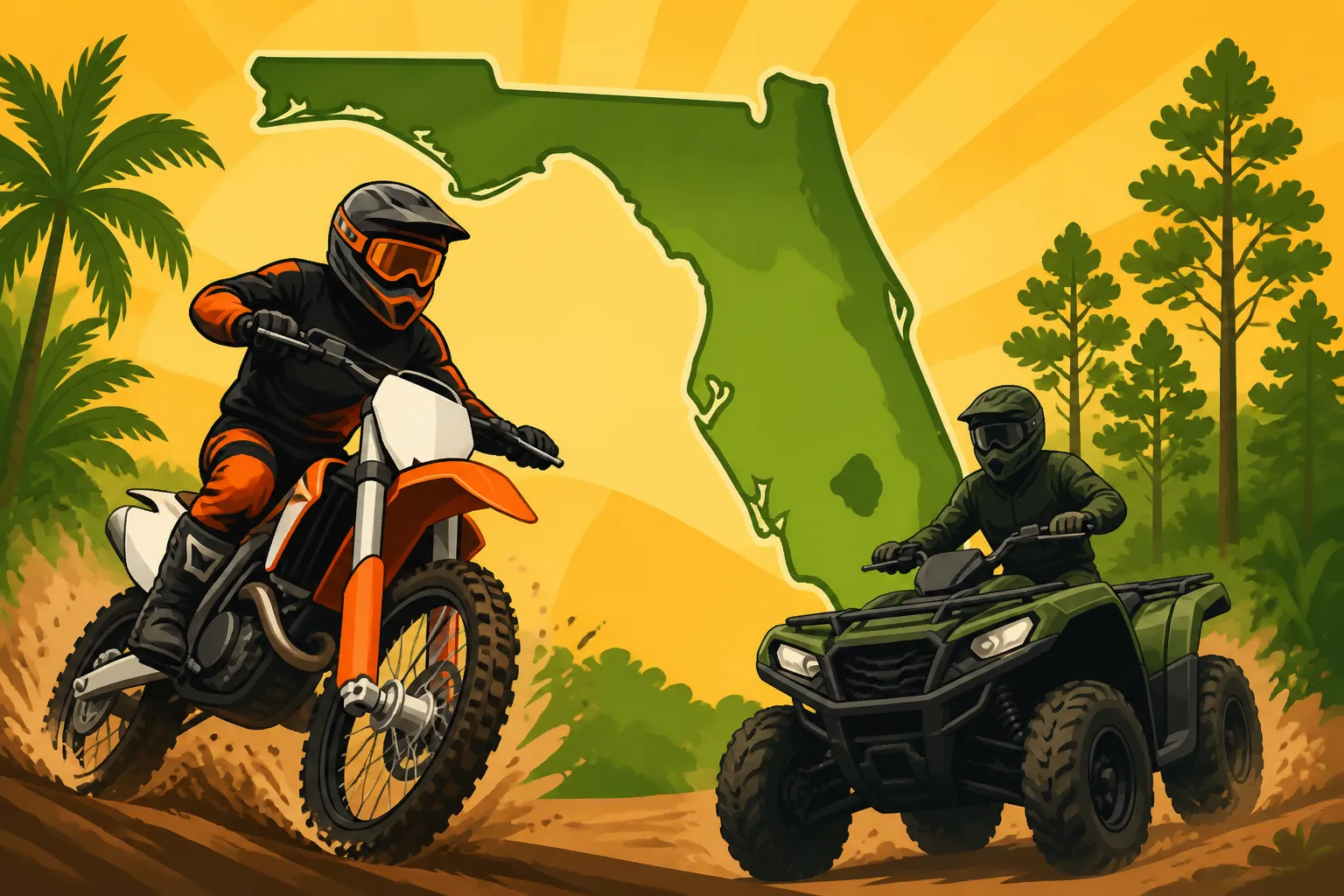
Sharing a Florida trail day with dirt-bike and ATV riders can be trickier than it sounds: an area may welcome both, but not on every trail or with every machine. This guide explains where to look, how to check access rules before hauling out, and how to plan a ride that works for a mixed group.
Florida riding areas where dirt bikes and ATVs can share the day
Several public riding areas in Florida accommodate dirt bikes alongside ATVs, but “the area allows both” does not mean every route is open to both vehicle types. Trail designations, machine width, seasonal closures, and permit requirements can all affect where you can ride.
Croom Motorcycle Area in Withlacoochee State Forest
Croom, near Brooksville, is one of the best-known places in Florida for off-highway riding. Dirt bikes and ATVs use the riding area, but the route you choose matters. Some trails are designed for particular vehicle types or sizes, and restrictions at the entrance can rule out a machine even when another vehicle in your group is allowed in.
Croom is not a place to assume a side-by-side can follow an ATV or dirt-bike route. Width restrictions are a practical concern, and the area has specific rules that may exclude wider machines. Check the current trail map and access information before setting off, especially if your group includes both motorcycles and four-wheelers. [Croom's 55-Inch Width Check at the Gate] explains why checking width before arrival can save a frustrating turn-around.
The layout also affects how a mixed group should ride. A dirt-bike rider may be comfortable on tighter, more technical sections, while an ATV rider may prefer wider routes with room to turn and regroup. Agree on meeting points and a pace before separating. If your group is new to the area, begin with easier routes and check conditions at the trailhead rather than letting the most experienced rider set the day’s pace for everyone.
Ocala National Forest OHV trails
Ocala National Forest has multiple OHV riding opportunities, including routes used by motorcycles and other off-highway vehicles. The key is to identify which routes are designated for your machine. Forest roads, motorcycle trails, and ATV routes are not interchangeable simply because they are all on public land.
Before driving toward a trailhead, check the forest’s current route information and any closure notices. Conditions can change because of weather, maintenance, fire danger, or resource protection. A route that appears on a map may still have a temporary closure, and a trail suitable for a dirt bike may not be appropriate for a wider ATV or UTV. [Ocala National Forest ATV Trails in Florida] is a useful related guide when comparing route types and access points.
Ocala’s scale makes navigation part of the ride plan. Mark the trailhead, parking area, and a regroup location before anyone starts riding. A tool such as onX Offroad can help riders review mapped routes and keep track of where they are, but it should supplement—not replace—official forest maps and posted signs. Download or carry information you can access without a dependable cell signal.
Clear Creek OHV Area and Tate’s Hell
Clear Creek OHV Area, in Blackwater River State Forest, is another public riding destination to investigate when a group includes dirt bikes and ATVs. As with other designated OHV areas, confirm that the particular trail or route is open to each vehicle in your group. Do not rely on a general statement that the area allows off-highway riding; vehicle-type rules and closures can apply to individual routes.
Tate’s Hell State Forest has an OHV trail system as well, but riders should plan around its specific route designations and access conditions. In a large forest, it can be easy to mistake a forest road for an open OHV trail or to assume a route connects to another one. Use the official map, follow signs at intersections, and turn back if the route you reach is marked closed or restricted. [Clear Creek OHV Area at Blackwater River State Forest] and [Tate's Hell OHV Trail System in Florida] offer more area-specific context.
| Riding area | Dirt bikes and ATVs | What to check before going |
|---|---|---|
| Croom Motorcycle Area | Both are part of the riding mix, subject to route and machine restrictions | Width limits, trail designations, entry requirements, and closures |
| Ocala National Forest | Different OHV routes may serve different vehicle types | Official route map, current closures, access points, and pass rules |
| Clear Creek OHV Area | A public OHV destination to consider for mixed groups | Which routes are open to each machine and current access conditions |
| Tate’s Hell OHV trail system | Designated OHV riding opportunities require route-specific planning | Trail designation, forest notices, route connections, and seasonal restrictions |
Use the table as a starting point, not as permission to ride any particular trail. Before leaving home, verify access with the managing agency or riding area.
How to choose a route for a mixed dirt-bike and ATV group
A mixed group can have a great day together, but it helps to decide in advance whether everyone will ride the same route or meet at shared points along the way. Dirt bikes and ATVs handle differently, and a trail that feels easy on one machine may be uncomfortable or unsafe on another.
Match the route to the least experienced rider
Start by talking about experience honestly. A rider who is new to Florida sand, roots, or tight turns may need a different route from someone who has spent years riding technical trails. That is not a reason to split up automatically; it is a reason to choose a route that gives the whole group room to learn.
If one rider is less confident, avoid making the first part of the day a test of endurance. Begin with a shorter, easier section and check in at a planned stopping point. Watch for signs that someone is tiring: delayed reactions, repeated stops, difficulty keeping a steady pace, or taking risks to keep up. On a hot Florida day, heat and dehydration can make those problems appear faster than expected.
A practical approach is to set the group pace by the least experienced rider and let faster riders stop at safe, visible locations to regroup. Do not have a dirt-bike rider disappear around blind corners or ask an ATV rider to rush through terrain they have not assessed. Keep enough space between machines to avoid dust, sudden braking, and collisions.
Confirm that every machine fits the route
Vehicle type is only one part of access. Width, tires, equipment, and trail designation can matter too. A two-wheel dirt bike, a narrow ATV, and a wider side-by-side may all be classed as off-highway vehicles, but that does not mean they are allowed on the same trail. [Florida Trails That Allow Side-by-Sides] can help clarify why UTV access needs a separate check.
Do a quick machine check before loading: tires, brakes, throttle, lights where required, chain condition on a dirt bike, and secure cargo on an ATV. Bring tools and basic repair supplies suited to the machines in your group. A small problem—like a loose lever or a soft tire—can turn into a long walk back if it is noticed only after the group has entered the trail system.
Also ask whether the riding area has requirements for helmets, spark arrestors, sound, permits, or proof of ownership. Rules can differ between public forests and private parks, so do not assume the same preparation works everywhere. [Florida OHV Permits: What You Need Before You Ride] is a helpful starting point for public-land planning.
Plan access, navigation, and safety before you haul out
A little preparation can prevent the most common mixed-group frustrations: arriving at a closed entrance, discovering that one machine is too wide, or losing time because riders cannot agree on where they are headed.
Check rules and closures from the land manager
Use the official managing agency or riding area as your final source for access details. Confirm the area is open, which vehicle types are allowed, and whether restrictions apply to particular routes. Look for notices about maintenance, weather-related closures, fire conditions, hunting seasons, or other temporary limits. If information is unclear, ask before you travel rather than trying to sort it out at the gate.
Public-land riding may involve permits or passes that are separate from permission to use a particular trail. A pass does not automatically make every road or trail legal for every machine. [Florida National Forest OHV Pass: 3-Day, 7-Day or Annual] and [Florida State Forest OHV Day Use and Annual Passes] explain why it is worth checking the rules for the specific land manager and destination.
Build a simple backup plan. If your intended trail is closed, know whether there is another route open to the whole group or another riding area within reasonable reach. Avoid treating an unmarked forest road, private property, or a closed route as an improvised alternative.
Make navigation work even without cell service
Cell coverage can be unreliable in rural areas and forested riding zones. Save the official map or access details before you leave, and make sure the group knows how to identify the trailhead and return route. If you use onX Offroad to review mapped routes, prepare your map before arriving and compare it with the land manager’s information. A phone app is a planning aid, not a substitute for posted signs or closure notices.
Set a meeting point that everyone can recognize, such as the main staging area or a clearly marked junction. Agree on what to do if someone gets separated: stop at a safe location, avoid riding farther in search of the group, and use the agreed communication plan. Carry a charged phone, but do not depend on it as your only way to navigate or contact help.
For a group with different riding speeds, choose a leader and a sweep rider. The leader knows the route plan; the sweep stays behind the last rider and makes sure nobody is left alone. If you need to split into smaller groups, set a specific return time and meeting place before the split.
Make the ride enjoyable for every machine and rider
A shared ride does not have to mean every person follows the exact same line at the exact same pace. The better goal is to keep the group connected, legal, and comfortable while giving each rider room to enjoy their machine.
Pack for Florida trail conditions
Florida terrain can shift from dry sand to mud, standing water, roots, or slick ground. Bring water, sun protection, basic first aid, and clothes that protect against brush and debris. Consider gloves and eye protection suited to the conditions, and carry a way to keep essential items dry. A light rain shower can make a familiar trail feel very different.
Before entering a wet or muddy section, assess it rather than following the first rider blindly. Water can conceal holes, ruts, debris, and soft edges. If riders choose to bypass an obstacle, stay on legal routes and avoid widening the trail. [Florida Trail Riding Gear for the Heat] and [What Florida Riders Carry for Deep Water Crossings] cover additional preparation for challenging conditions.
Think about the ride home, too. Secure every machine properly on the trailer, check tie-downs before driving, and keep muddy gear separated from clean equipment. A short walk around the trailer before leaving the staging area can catch a loose strap or unsecured ramp before it becomes a highway problem.
Keep the group together without forcing identical riding styles
Dirt bikes and ATVs have different strengths. Motorcycles can often turn through narrow spaces more easily, while an ATV may feel more stable to a rider on broader, uneven terrain. Rather than comparing machines or pressuring anyone to ride beyond their comfort level, pick trails that suit the group and take breaks before fatigue sets in.
If the group wants to explore different routes, plan a short split only where the area’s layout and rules make it practical. Agree on a clear rendezvous point, a return time, and what each group will do if a route is blocked. A rider who has to turn around should not be left guessing which fork the others took.
Respect other users and the riding area. Slow down near staging areas, give approaching riders room, avoid sudden passes, and stay on designated routes. Pack out trash, do not disturb wildlife, and follow any local rules about noise or equipment. Good trail manners help keep riding areas available to everyone, including the dirt-bike and ATV riders who want to share them.
Disclaimer
This article is for general informational purposes only and does not constitute professional advice. Laws, prices and regulations vary by location and change over time. Consult a qualified professional for guidance on your specific situation.