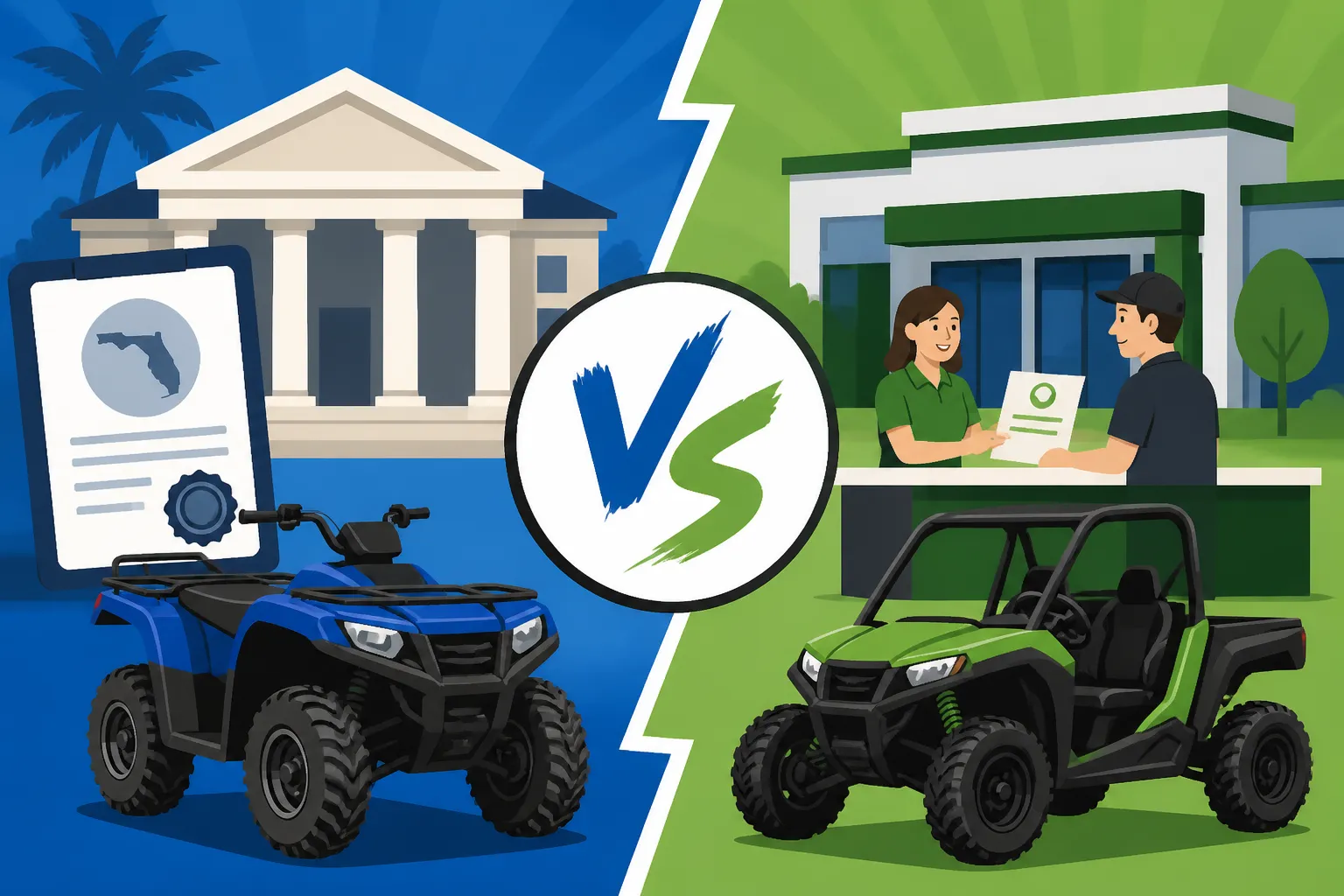
Florida County Tax Collector vs Service Center for ATV Titles
Navigating the paperwork for your ATV or UTV in Florida can feel like a maze, especially when you're trying to figure out where exactly to go to get that all-important title. Many riders, excited about hitting the trails, find themselves scratching their heads, wondering if they should head to their local County Tax Collector's office or if one of those convenient private service centers is a better bet. This guide is here to demystify the process, breaking down the differences between these two options so you can make an informed decision and get your machine properly titled without unnecessary headaches.
Understanding Florida's ATV Titling Landscape
Before we dive into the specifics of where to go, it's crucial to grasp why titling your ATV or UTV in Florida is so important in the first place. This isn't just about another piece of paper; it's about establishing legal ownership, ensuring you can legally operate on many public lands, and protecting your investment.
Why Titling Matters in the Sunshine State
For many new ATV owners, or those relocating to Florida, the idea of titling an off-highway vehicle might seem unusual. After all, it's not a car, right? However, Florida law is quite clear: if you plan to ride your ATV or UTV on designated public lands—which include many of our fantastic state forests and national parks—your machine must be titled. This requirement is a cornerstone of responsible off-highway vehicle (OHV) management, helping to ensure accountability and track ownership. Without a title, you might find yourself limited to private property, or worse, facing a citation if you're caught riding untitled on public trails. Think of it as your vehicle's birth certificate and deed rolled into one, proving to the world (and to law enforcement) that this machine truly belongs to you. This is also covered in detail in [Florida's Off-Highway Vehicle Title Law Explained].
Beyond legal compliance, a title offers critical protection. If your ATV were ever stolen, having a clear, recorded title is your primary proof of ownership, essential for filing a police report and working with your insurance company. It's the document that separates legitimate owners from those who might try to sell you a hot machine, providing a clear chain of custody. It also becomes indispensable when you eventually decide to sell your ATV, as any buyer worth their salt will demand a clear title transfer to ensure they are getting a legitimate machine. The act of obtaining a title is more than just jumping through bureaucratic hoops; it's a fundamental step in being a responsible and protected OHV owner in Florida, especially if you plan on [Riding Public Land as the Trigger for a Title].
The Core Entities: State Oversight and Local Execution
Florida's titling system for all vehicles, including ATVs and UTVs, operates under the umbrella of the Florida Department of Highway Safety and Motor Vehicles (DHSMV). While the DHSMV sets the rules and maintains the statewide database, the actual day-to-day processing of titles and collection of fees are largely handled at the local level. This decentralization is where the two options for titling your ATV come into play: your County Tax Collector's office and various authorized service centers.
Each county in Florida has its own Tax Collector, an elected official responsible for a wide range of services, including property taxes, driver's licenses, and, yes, vehicle titles. These offices act as direct agents of the state, ensuring that all transactions comply with DHSMV regulations. They are the official, primary point of contact for many Floridians. In parallel, the DHSMV also authorizes certain private businesses to act as "service centers" or "tag agencies." These centers are essentially independent businesses that have met strict state requirements to process title applications, often offering a more streamlined or convenient customer experience, albeit usually with an added fee for their services. Understanding this dual system is key to choosing the best path for your specific needs.
The County Tax Collector's Office: Your Direct Link
For many Floridians, the County Tax Collector's office is the first place that comes to mind when thinking about vehicle registration or titling. It's the traditional route, and for good reason—they are the direct representatives of the state in your local area.
What a Tax Collector Does
Your County Tax Collector serves as the local agent for several state agencies, including the Florida DHSMV. When it comes to titling your ATV or UTV, their office is authorized to process title applications, collect all necessary state fees, and issue temporary registration until your official title arrives. This means they are responsible for ensuring all your paperwork is correct, verifying your identity, and submitting the application to the state's central system. They collect the standard initial title application fee, which is [The $29 Initial Title Application Fee Explained], along with any applicable sales tax and specific service charges, like [The $4.25 Service Charge on an OHV Title].
Their staff members are typically well-versed in Florida's vehicle titling laws and can often provide direct answers to complex questions, drawing upon their direct access to state databases and guidelines. For example, if you're dealing with a specific situation like [Titling an Out-of-State ATV After Moving to Florida] or a machine with a lien, their direct experience with state regulations can be invaluable. They process a massive volume of transactions daily, making them a reliable and authoritative source for all your titling needs.
Pros of Going Direct
Choosing your local County Tax Collector's office offers several distinct advantages. Primarily, it's often the most straightforward and cost-effective option. Because they are a government entity, they don't add extra "convenience" fees beyond the state-mandated ones. This can result in significant savings compared to using a private service center, especially if you're on a tight budget. You're paying the exact fees required by the state, and nothing more.
Furthermore, interacting directly with the Tax Collector's office means you're dealing with state-trained personnel who have direct access to official policies and systems. If you have a unique or complicated titling situation—perhaps you're trying to title a rebuilt ATV or you're missing a crucial document like the Manufacturer's Certificate of Origin (MSO)—their staff might have more experience and direct authority to guide you through the nuances. They can often provide the most authoritative answers and solutions for non-standard scenarios, sometimes even resolving issues on the spot if they have the discretion to do so. It feels good knowing you're going straight to the source.
Cons of Tax Collector Offices
Despite the advantages, there are some potential downsides to relying solely on the County Tax Collector's office. The biggest frustration for many Floridians is the potential for long wait times. These offices handle a vast array of services, from driver's licenses to property taxes, and during peak hours, the lines can be extensive. For example, in larger counties, a quick trip can easily turn into an hour or more of waiting, as discussed in anecdotal experiences like [Polk County ATV Title Walk-In Wait]. This can be a significant deterrent if you have a demanding work schedule or limited free time.
Another consideration is their operating hours. County offices typically adhere to standard government business hours, usually Monday through Friday, 8 AM to 5 PM, with most closing on weekends and holidays. This can make it challenging for individuals who work traditional jobs to visit without taking time off. While some offices might offer online appointment scheduling, availability can still be limited. For instance, knowing the [Marion County ATV Title Office Hours] in advance is crucial to plan your visit effectively, but even then, walk-in availability might mean a long wait. If convenience and flexibility are high on your priority list, these limitations might push you to explore other options.
Authorized Service Centers: The Convenience Factor
Beyond the traditional Tax Collector's office, Florida offers another avenue for titling your ATV: authorized service centers. These are private businesses that have been licensed by the state to perform many of the same titling services, often with a focus on customer convenience.
What is an Authorized Service Center?
Authorized service centers, often referred to as "tag agencies" or "title services," are privately owned businesses that serve as intermediaries between you and the DHSMV. They are licensed by the state to process a variety of vehicle-related transactions, including initial ATV title applications, title transfers, and renewals. These centers have access to the DHSMV's computer systems, allowing them to submit your paperwork electronically and often issue temporary tags on the spot.
You might find these centers operating as standalone businesses, or sometimes even within larger dealerships or even certain financial institutions. Their primary appeal is usually convenience and speed. They aim to provide a more customer-centric experience, often with shorter lines, more flexible hours, and a dedicated focus on vehicle services. While they are authorized to collect the standard state fees, they also charge an additional service fee for their convenience, which is how they operate as a for-profit business.
Pros of Using a Service Center
The allure of an authorized service center often boils down to time and convenience. If you have a busy schedule and can't afford to spend hours waiting at the Tax Collector's office, these centers can be a lifesaver. They often have shorter lines, or even no lines at all during off-peak times, allowing you to get your titling done quickly and efficiently. Many service centers also boast extended hours, including evenings and sometimes even Saturdays, providing much-needed flexibility for those with rigid weekday commitments.
Beyond just speed, these centers pride themselves on customer service. You'll often find a more personalized approach, with staff dedicated to guiding you through each step of the paperwork. They understand that people are seeking efficiency and often cater to that need. Some centers even offer expedited services, such as the option for a [Florida Fast Title for an ATV: The $7 Expedited Option], which can be incredibly useful if you need your physical title processed and mailed out faster than the standard timeframe. This extra layer of service and flexibility can be well worth the additional cost for many riders who value their time above all else.
Cons of Service Centers
While convenience is a major draw, using an authorized service center does come with its own set of drawbacks, primarily centered around cost. Because these are private businesses, they charge their own service fees on top of all the standard state-mandated titling fees. This means your total out-of-pocket expense will be higher than if you went directly to the County Tax Collector's office. While a few extra dollars might not seem like much for the convenience, these added fees can accumulate, especially if you're titling multiple machines or if the transaction is particularly complex. You'll want to factor in these additional costs when making your decision, as they are not just the [Florida ATV Title Fee Breakdown: $29 Plus Service Charges], but more on top.
Another potential concern, though less common, is that some smaller or less experienced service centers might not be as well-equipped to handle highly unusual or complex titling scenarios as the direct state agents at the Tax Collector's office. While most are highly competent, if you have a truly unique situation—such as [Titling a Homemade or Rebuilt ATV in Florida] with unusual documentation, or a title issue stemming from a complicated estate transfer—you might find that the Tax Collector's office, with its direct link to the DHSMV, has more resources or authoritative guidance. It's not a universal truth, as many service centers are excellent, but it's something to consider for truly niche cases.
Key Differences and Considerations When Choosing
Deciding between your County Tax Collector's office and an authorized service center isn't just a flip of a coin. It comes down to weighing your priorities, particularly when it comes to cost versus convenience, and assessing the complexity of your specific titling needs.
Cost Comparison
When budgeting for your ATV or UTV title, understanding the cost structure is paramount. Regardless of where you go, you will pay the exact same state-mandated fees. This includes the initial title application fee (which is typically $29), the service charge ($4.25), and any applicable sales tax, which is assessed on the purchase price of the ATV. These are non-negotiable state fees.
The critical difference in cost arises from the additional service fee charged by authorized service centers. These fees vary from one private agency to another, but they are an extra charge on top of the state fees. For example, if the state fees total $33.25 (plus sales tax), a service center might add another $10, $20, or even more for their convenience. This can make the total cost notably higher than if you had gone directly to the Tax Collector's office. For those on a tight budget, or simply looking to save every possible dollar, the Tax Collector's office usually presents the more economical option. However, for some, the time saved and the enhanced convenience are well worth the extra expense. It's a calculation of money versus time.
Time and Convenience
This is often the primary deciding factor for many Floridians. How much is your time worth? A trip to the County Tax Collector's office, while potentially cheaper, can involve significant waiting periods. Imagine needing to title your new quad, only to face a 90-minute wait just to get to the counter. If you have a demanding job, young children, or simply despise waiting in lines, this can be a real headache. [Florida ATV Title Application Processing Time] also factors in here, though the in-person wait is usually the bigger concern.
Authorized service centers, on the other hand, are built around the concept of minimizing your time investment. They often have more staff dedicated to title processing, leading to shorter wait times or even no wait at all. Their extended hours—including early mornings, evenings, or Saturdays—mean you can often fit the task into your schedule without disrupting your workday or weekend plans. For someone who needs to get the title done quickly and efficiently, perhaps before a planned weekend trip to [Croom Motorcycle Area: Florida's Biggest OHV Park], the added cost of a service center can be a small price to pay for the significant boost in convenience and saving precious hours. It truly boils down to how you value your personal time and what kind of experience you prefer.
Complexity of Your Situation
The nature of your titling needs can also influence your choice. If you're dealing with a straightforward transaction—say, you just bought a new ATV from a dealership and have all your paperwork in order, including the Manufacturer's Certificate of Origin (MCO)—either option will likely serve you well. It's a simple processing task that most authorized centers handle routinely.
However, if your situation is a bit more complicated, such as [Buying a Used ATV in Florida: Transferring the Title] with a seller who lost the paperwork, or you're trying to title a vintage machine where the MSO is missing, or even a homemade project, the expertise and direct authority of the County Tax Collector's office might be more beneficial. Their staff often have direct experience with more unusual cases and immediate access to state guidelines and systems for verification. For instance, [Proof of Ownership When the MSO Is Missing] can be a complex hurdle, and direct government staff might be better equipped to guide you through the affidavit process or alternative proofs required. While many service centers are highly capable, for truly intricate or unusual circumstances, going directly to the government agency can sometimes prevent delays or missteps.
Preparing Your Paperwork for Either Location
Regardless of whether you choose your County Tax Collector's office or an authorized service center, one thing remains constant: proper preparation of your paperwork is absolutely critical. Showing up unprepared is the quickest way to guarantee delays, extra trips, and frustration.
Essential Documents You'll Need
Getting your ATV or UTV titled in Florida requires a specific set of documents. Having these in order before you walk through the door will make the process infinitely smoother. Here’s a rundown of what you’ll typically need:
- Manufacturer’s Certificate of Origin (MCO) or Previous Title: This is the primary proof of ownership. If you bought a brand-new ATV, the dealer will provide you with the MCO. If you bought a used machine, you'll need the previous owner's properly assigned title. This is the cornerstone of your application.
- Bill of Sale: For used ATVs, a comprehensive bill of sale is crucial, even if you have a title. It details the purchase price, buyer and seller information, and the VIN. This document is essential for calculating sales tax. Make sure it's complete and accurate. Resources like LawDepot offer excellent templates that ensure all necessary legal details are covered, making the process of creating a valid bill of sale much simpler and more robust than a handwritten note.
- Identification: A valid government-issued photo ID (like a Florida driver’s license or state ID card) is required to verify your identity.
- Proof of Florida Residency: If your ID doesn't reflect your current Florida address, you'll need additional documents like a utility bill, voter registration, or lease agreement.
- Florida Off-Highway Vehicle Title Application (Form HSMV 82040): This is the official form you'll fill out. You can often download and complete it beforehand from the DHSMV website or get a copy at the office. For specific guidance on form selection, see [Which Florida Title Form to Use for an ATV].
- VIN Verification: For out-of-state vehicles or certain other situations, a VIN verification may be required. This confirms the Vehicle Identification Number matches your documentation. You might need to have a law enforcement officer or a licensed dealer complete this. More info on this can be found in [Who Can Verify an ATV VIN in Florida?].
- Payment for Fees and Sales Tax: Be prepared to pay the titling fees and sales tax. While cash is often accepted, credit/debit cards or checks are usually options, but it's always wise to confirm payment methods beforehand.
Having these documents neatly organized, and perhaps even making photocopies for your records, will not only speed up your transaction but also give you peace of mind.
Getting Your Affairs in Order
Beyond just having the right documents, it's about making sure they are correctly filled out and presented. A common pitfall for many attempting to title their ATV is incomplete or inaccurate paperwork. Take the time to meticulously review all forms. Is every blank field filled? Are all signatures present and properly witnessed (if required)? For instance, [Florida ATV Bill of Sale: What It Needs to Say] outlines the exact elements needed for a valid transaction document. A simple omission can lead to your application being rejected, forcing you to start over.
It's also a good practice to call ahead to the specific office or service center you plan to visit. Their websites often provide detailed checklists, but a quick phone call can confirm their current requirements, payment methods, and even estimated wait times. This proactive step can save you a wasted trip. Furthermore, for private sales, ensuring your bill of sale is legally sound is paramount. Using a reputable resource like LawDepot to generate your bill of sale ensures that all the necessary legal language is included, protecting both you and the seller. This attention to detail will smooth your path toward getting that ATV title in hand.
Using Templates from LawDepot
When it comes to preparing documents for an ATV title, especially for a private sale, accuracy and legal soundness are non-negotiable. This is where resources like LawDepot can become incredibly valuable. LawDepot provides customizable legal document templates, including robust bills of sale, that help ensure you don't miss any critical details. For example, a proper bill of sale isn't just a receipt; it includes specific language about the transfer of ownership, warranties (or lack thereof), the vehicle's VIN, and the exact purchase price—all vital information for the titling process and for calculating sales tax.
By using a professionally drafted template, you can be confident that your paperwork will meet the general requirements for a legal transaction in Florida, making it easier for the Tax Collector's office or service center to process your title application. It takes the guesswork out of creating a document from scratch and adds a layer of professionalism and clarity that can prevent common issues like missing information or ambiguous terms. When buying or selling privately, having a comprehensive document from LawDepot can provide significant peace of mind, knowing that your foundational proof of transaction is solid.
Making the Right Choice for Your Titling Needs
Ultimately, the choice between your County Tax Collector's office and an authorized service center for your Florida ATV title comes down to your personal priorities and the specific circumstances of your titling situation. There's no single "best" option; only the one that best suits you.
When to Prioritize Cost Savings
If your primary goal is to minimize out-of-pocket expenses and you have some flexibility in your schedule, then heading directly to your County Tax Collector's office is likely your best bet. You'll avoid the additional service fees charged by private agencies, paying only the state-mandated costs for your title and any associated taxes. This can save you anywhere from $10 to $30 or more, which could be put towards a new helmet, some trail accessories, or fuel for your first ride.
This option is particularly appealing if your titling situation is straightforward—say, a new ATV with a clean MCO or a used one with a properly assigned title and a clear [Florida ATV Bill of Sale: What It Needs to Say]. If you're okay with the possibility of waiting in line, or if you can schedule your visit during known slower periods, the Tax Collector's office offers the most economical pathway to getting your ATV or UTV legally titled in the Sunshine State. It's a pragmatic choice for the budget-conscious rider who doesn't mind a bit of a wait.
When to Prioritize Speed and Convenience
On the flip side, if your time is extremely valuable, your schedule is packed, or you simply prefer a quicker, more streamlined experience, then an authorized service center might be the perfect solution for you. While you will pay an additional service fee, the convenience of shorter wait times, potentially extended hours (sometimes even weekends), and a focused customer service experience can be well worth the extra cost.
Imagine needing to get your title processed on a Saturday morning because weekdays are impossible, or you simply don't want to spend precious vacation time sitting in a government office. These are the scenarios where authorized service centers truly shine. For many working Floridians, the ability to get in and out quickly, without disrupting their work or family life, makes the slightly higher fee an acceptable trade-off. It's an investment in your time and peace of mind, allowing you to get back to what you love faster—whether that's work, family, or hitting the trails on your newly titled machine.
Final Tips for a Smooth Titling Process
No matter which option you choose, a little preparation goes a long way toward ensuring a smooth and hassle-free titling experience.
- Call Ahead: Always contact the specific office or service center you plan to visit. Confirm their current hours, required documents (especially if your situation is unique), accepted payment methods, and if they offer appointments or walk-in service. A quick phone call can save you a wasted trip.
- Check Websites: Both County Tax Collector websites and authorized service center websites often provide comprehensive lists of requirements, downloadable forms (like the official Florida ATV Title Application), and fee schedules. Familiarize yourself with these resources before you go.
- Gather All Documents: Double-check your checklist (and perhaps even call again!) to ensure you have every single piece of paperwork required. Don't forget your photo ID, and for private sales, a thoroughly completed bill of sale, perhaps using a template from a service like LawDepot, is indispensable. Make copies of everything for your records.
- Be Prepared for Payment: Understand the exact fees (state fees + service center fees, if applicable) and have your payment method ready. Some offices might prefer specific payment types or have limits on credit card transactions.
- Be Patient and Polite: Even with preparation, bureaucratic processes can sometimes have unexpected hiccups. Approaching the interaction with patience and politeness can often lead to a smoother resolution, should any minor issues arise.
By taking these steps, you'll significantly increase your chances of walking out with your ATV or UTV title handled efficiently, whether you've chosen the direct route with your County Tax Collector or the convenient path of an authorized service center.
Disclaimer
This article is for general informational purposes only and does not constitute professional advice. Laws, prices and regulations vary by location and change over time. Consult a qualified professional for guidance on your specific situation.