What an OHV Title Does Not Let You Do
It's incredibly easy to get tangled up in the red tape surrounding off-highway vehicles (OHVs) in Florida. Many folks assume that once they've gone through the trouble of getting a title for their ATV or UTV, they've unlocked all sorts of freedoms—especially when it comes to riding. But that's a common misconception that can land you in hot water. This guide is here to untangle those assumptions, clearly laying out exactly what a Florida OHV title doesn't permit you to do, helping you avoid fines and keep your riding adventures on the right side of the law.
The True Scope of a Florida OHV Title: What It Really Means
Before we dive into what an OHV title doesn't let you do, it's really helpful to understand its actual purpose. Think of it like this: a title is fundamentally a legal document, a piece of paper (or increasingly, an electronic record) that primarily establishes ownership. It's about property, not permission to operate. This is a critical distinction that many riders, especially those new to the Florida OHV scene or even seasoned veterans who haven't delved into the specifics, often miss.
Proof of Ownership and Legal Identity
At its heart, a Florida OHV title is your definitive proof that you own that specific ATV, UTV, or dirt bike. It's like the deed to your house or the title to your car – without it, proving you’re the rightful owner can become a nightmare, particularly if your machine is ever stolen. This document contains vital information such as the vehicle identification number (VIN), make, model, year, and the name of the legal owner. It ties you directly to that machine.
Imagine you're out riding on a designated trail in the Ocala National Forest, and a park ranger asks to verify ownership. Having your title, or proof that one exists in your name, can make that interaction smooth and straightforward. Without it, you might face delays, questions, or even the temporary impoundment of your machine until ownership can be definitively established. This document also helps to prevent fraud, making it harder for someone to sell a stolen machine or claim ownership of something that isn't theirs. For a deeper dive, check out [Florida's Off-Highway Title Rules in Plain English].
Facilitating Transfers and Recording Liens
Another primary function of a Florida OHV title is to facilitate legal transfers of ownership. When you buy a used ATV from a private seller, the title is the key document that gets signed over to you. This is how the state updates its records to show you as the new owner. Without a proper title transfer, you could run into serious issues down the road, from not being able to sell the machine yourself to facing legal challenges if the previous owner was involved in something untoward with it.
Similarly, if you finance your OHV purchase, the title is where the lienholder (the bank or credit union) records their interest in your machine. This notation on the title protects their investment by letting everyone know that they have a claim on the vehicle until your loan is paid off. When you finally pay off your loan, the lien is released, and you receive a clear title, free and clear of any encumbrances. This entire process, from initial titling to transfer to lien release, is meticulously designed to ensure clarity and legality in every transaction. Learn more about the transfer process in [Buying a Used ATV in Florida: Transferring the Title].
No Automatic Road Legal Access, Period
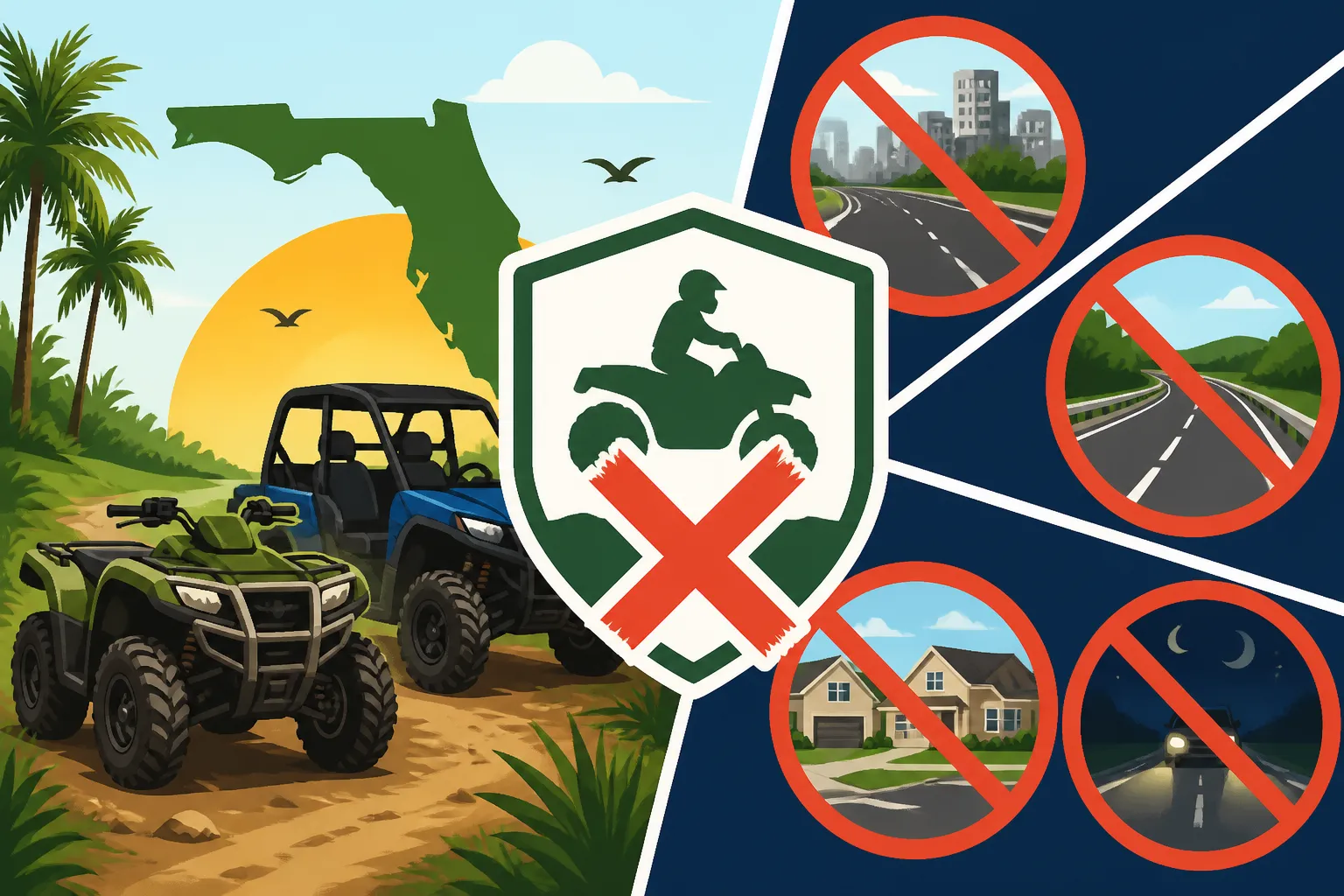
One of the biggest and most dangerous misunderstandings about having a Florida OHV title is the belief that it somehow grants you permission to ride your machine on public roads, streets, or highways. This is a resounding "no." A title, by itself, absolutely does not make your ATV or UTV street legal. Florida law is very clear on this, and breaking these rules can lead to serious fines, impoundment, and even criminal charges.
Public Street Riding: A Major No-Go
You simply cannot jump on your titled ATV and head down a paved city street to the gas station or cruise through your neighborhood on public roads. Florida Statute 316.2123 explicitly prohibits the operation of ATVs on public roads and highways. The intent of these machines is for off-road recreational use, and their design—lack of proper turn signals, mirrors, horn, and other safety equipment required for road vehicles—makes them unsafe for mingling with cars and trucks.
While there are very limited, specific exceptions for crossing a highway or riding on certain designated unpaved roads in some counties (and even then, with strict rules about driver's licenses, daylight hours, and supervision for minors), these are exceptions to a general prohibition. They do not magically transform your off-highway vehicle into a street-legal ride. The presence of a title changes nothing in this regard. If you're curious about the specifics, check out [Florida ATV Road Rules: Where You Can Legally Ride].
Highways, Sidewalks, and Bike Paths Are Off Limits
This prohibition extends beyond just city streets. Major highways, state roads, and especially sidewalks and bike paths are completely off-limits for OHVs, regardless of whether you possess a title. Sidewalks and bike paths are for pedestrians and bicycles, not powerful off-road machines. Attempting to navigate these areas on an ATV or UTV is not only illegal but also extremely dangerous for both the rider and anyone else nearby.
The confusion often stems from the fact that cars, trucks, and motorcycles do require a title to be registered for road use. But for OHVs, the title and road registration are entirely separate concepts. An OHV title simply proves ownership of an off-highway vehicle. It doesn't magically add the necessary safety features or grant the legal status required for on-road operation. For more on the distinction, see [Are ATVs Street Legal in Florida?].
It Is Not a Registration or License Plate
Another crucial distinction often lost in translation is the difference between a title and a registration. Many states have both, but for Florida ATVs and UTVs, the title is the primary document of record for ownership, while a traditional annual road-use registration (like for a car) simply doesn't exist for most OHVs. This often leads to confusion, especially for new residents or those accustomed to other states' rules.
No Annual Tag or Decal
When you title your ATV or UTV in Florida, you will not receive a metal license plate or an annual registration decal to affix to your machine. This is a stark difference from how cars, trucks, and even off-highway motorcycles (dirt bikes used exclusively off-road will still get a title but no plate) are handled. The absence of a plate means your OHV is not permitted on public paved roads. The title itself serves its purpose without needing an annual renewal tag.
Think about it: if you're not supposed to be on the road, there's no need for a road-use plate or a decal that signals annual registration for road use. This is precisely why the Florida Department of Highway Safety and Motor Vehicles (FLHSMV) issues OHV titles without any associated plate or decal. For an exact breakdown of the differences, look at [Florida ATV Title vs Registration: The Difference].
Distinct From Car or Truck Titles
It's tempting to think of an OHV title in the same way you think of a car title, but they serve different regulatory purposes. A car title is the first step toward getting a vehicle registered and legal for highway use. An OHV title, however, is a standalone document for a vehicle specifically not intended for highway use. This fundamental difference is key to understanding Florida's OHV laws.
| Feature | Florida Car/Truck Title | Florida OHV Title |
|---|---|---|
| Primary Function | Proves ownership, facilitates road registration | Proves ownership |
| Road Use Permit? | Yes, with accompanying registration and plate | No |
| License Plate? | Yes, required for operation | No |
| Annual Renewal? | Yes, for registration | No, title is permanent until transferred |
| Safety Equipment | Required (lights, mirrors, etc.) | Off-road specific (spark arrestor, etc.) |
| Insurance Req. | Mandatory for road use | Not mandated by title alone |
This table clearly illustrates that while both documents establish ownership, their roles in enabling vehicle operation are vastly different. Your OHV title is not a golden ticket to bypass road laws, nor does it imply that your machine meets any standard for street-legal operation.
No Exemption from Safety Training or Equipment Rules
Just because you have a legal title for your OHV doesn't mean you can throw caution to the wind regarding safety. Florida has very specific rules about rider safety, equipment, and training, especially for younger riders. An OHV title does nothing to exempt you or your passengers from these crucial safety requirements.
Still Need a Safety Course for Young Riders
For riders under the age of 16, Florida law mandates completion of an approved ATV safety course before they can operate an ATV on public lands. This isn't just a suggestion; it's a legal requirement. The title doesn't override this. Whether your child is riding your newly titled quad or an older machine, if they're under 16 and on public land, they need that safety certificate. This course teaches vital skills, awareness, and safe operating procedures that can prevent accidents and injuries. Ignoring this requirement not only puts the rider at risk but can also lead to citations for parents or guardians. More details on this can be found in [Florida ATV Safety Course Requirements for Riders Under 16].
Helmet and Eye Protection Rules Still Apply
Similarly, having a title doesn't mean you can skip the helmet. All ATV riders under 16 years of age are required to wear a U.S. DOT-compliant safety helmet and eye protection when operating an ATV. This rule is in place because head injuries are incredibly dangerous, and ATVs, by their very nature, carry risks of tipovers and collisions. Many private parks and even some public riding areas extend this helmet rule to all riders, regardless of age. Always check the specific rules of where you plan to ride. Your OHV title won't save you from a citation if you're caught without the proper safety gear.
Even if you're over 16, wearing a helmet and eye protection is just plain smart. The terrain can be unpredictable, and other riders can be careless. Protecting yourself should always be a top priority, regardless of what the law strictly mandates for adults.
Spark Arrestors and Sound Limits
It's not just about personal protective equipment. Your OHV itself must often meet certain equipment standards, and a title doesn't change these. For instance, most public lands and designated OHV areas require your machine to be equipped with a U.S. Forest Service-approved spark arrestor. This critical component prevents sparks from escaping your exhaust and potentially igniting wildfires, which are a serious concern in Florida's dry seasons.
Additionally, some areas might have sound limits. While not as universally enforced as spark arrestors, excessive noise can be a nuisance and can lead to restrictions or even closures of riding areas. Your title simply confirms you own the machine; it doesn't certify that your exhaust system is quiet enough or that your machine is equipped with the necessary spark arrestor. Always ensure your OHV complies with the specific requirements of the area you intend to ride in.
No Automatic Access to All Lands
This is another major point of confusion. Many riders, having secured their title, feel like they've done their due diligence and can now ride wherever they please, especially if it looks like open land. This is a dangerous assumption. An OHV title never grants you automatic permission to ride on any land you choose. Land ownership and usage regulations are complex, and respecting them is paramount.
Private Land Still Needs Permission
This might seem obvious to some, but it bears repeating: riding on private land without the express permission of the landowner is trespassing, plain and simple. Your Florida OHV title does not give you any special right to access someone else's property. Whether it's a vast ranch, a citrus grove, or a vacant lot, if it's private property, you need to get explicit permission, preferably in writing, before you ride.
Trespassing can lead to legal consequences, including fines, impoundment of your vehicle, and even arrest. It also erodes the positive image of the OHV community, making it harder for responsible riders to secure access in the future. Always know who owns the land you're riding on and make sure you have permission. You can learn more about private land riding in [Can You Ride an Untitled ATV on Private Land in Florida].
State and National Forest Rules and Permits
Even on public lands, such as Florida State Forests or National Forests like Ocala, Big Cypress, or Apalachicola, your OHV title is not an all-access pass. These areas have specific rules, designated trail systems, and often require separate permits or passes to ride. For instance, the Florida Forest Service and the U.S. Forest Service manage their OHV recreation areas with care, often requiring day-use fees or annual passes. You can find out more about these requirements in [Florida OHV Permits: What You Need Before You Ride].
These permits help fund trail maintenance, signage, and enforcement, ensuring that these valuable riding resources remain available for everyone. Simply having your title in hand won't get you past the gate or satisfy a ranger checking for valid permits. Always research the specific rules, operating hours, and permit requirements for any public riding area before you load up your machine and head out.
Conservation and Water Management District Lands
Florida is home to vast tracts of conservation land and properties managed by Water Management Districts (WMDs). While some of these areas might appear open and wild, many have strict rules about motorized vehicle access, often prohibiting OHVs altogether to protect sensitive ecosystems, wildlife habitats, or water resources. Your OHV title holds no sway here.
Riding illegally in these protected areas can lead to significant fines, penalties for environmental damage, and even confiscation of your machine. It's vital to educate yourself on what is allowed and what is not. Do not assume that just because you see a dirt track or a wide-open space, it's fair game for your ATV or UTV. A quick call to the managing agency or a check of their website before you ride can save you a lot of trouble and protect Florida's natural beauty.
No Substitute for Insurance Requirements in All Scenarios
Another common misconception revolves around insurance. While Florida doesn't mandate liability insurance specifically for OHVs that are used exclusively off-road, having an OHV title doesn't mean you're covered in every situation or that you shouldn't consider insurance.
No Requirement for OHV Title Itself
It's true that unlike cars or trucks that require proof of insurance for road registration, a Florida OHV title does not inherently require you to carry insurance. This often leads riders to believe they don't need it at all. However, this lack of a state mandate only applies to the titling process and the direct operation of the OHV off-road.
Think about it this way: if you're only riding on private land or designated off-road parks, the state doesn't require you to carry the same level of liability insurance as if you were driving on public roads. However, that doesn't mean you're immune to financial responsibility if an accident occurs.
Insurance for Road Use (e.g., LSV Conversion)
If you happen to modify your UTV to become a Low-Speed Vehicle (LSV) for limited street use (a very specific and complex conversion with strict rules), then yes, insurance becomes mandatory. An LSV is no longer just an OHV in the eyes of the law; it's a street-legal vehicle with all the associated requirements, including insurance, registration, and a license plate. Your original OHV title would be exchanged or noted for this new classification.
But for the vast majority of ATVs and UTVs that remain purely off-highway vehicles, the title itself doesn't trigger an insurance requirement. It's important to understand that converting an OHV to an LSV is not a simple matter of adding a few lights; it involves specific equipment, inspections, and new titling/registration.
Private Park Requirements and Your Own Protection
Even without a state mandate, many private mud parks, riding resorts, and organized events will require proof of insurance for your OHV. They want to ensure that if you cause damage to their property or injure another rider, there's some form of financial coverage. If you show up to a private park with your titled quad but no insurance, you might be turned away at the gate.
Furthermore, carrying OHV insurance, even if not strictly required by the state for off-road use, is a wise personal decision. Accidents happen. You could damage your expensive machine, injure yourself, or unintentionally harm another person or their property. Standard homeowners' insurance policies typically do not cover ATVs or UTVs, especially when they're operated off your property. A dedicated OHV policy can provide crucial coverage for:
- Liability: If you cause an accident and are found responsible for injuries or property damage to others.
- Collision: To repair or replace your own machine if it's damaged in a crash.
- Comprehensive: Coverage for theft, fire, vandalism, or natural disasters.
- Uninsured/Underinsured Motorist: If you're hit by another rider who doesn't have insurance.
While your title is essential for proving ownership, it won't pay for medical bills or property repairs. For related documentation, especially for private sales or liability waivers, resources like LawDepot can offer useful templates to ensure you're covered. Always consider the financial risks and explore suitable insurance options to protect yourself and your investment.
When an OHV Title is Absolutely Essential
Now that we’ve thoroughly covered what an OHV title doesn't let you do, it’s worth reiterating its critical functions. Despite its limitations regarding road use or access, the Florida OHV title is an indispensable document for responsible OHV ownership in the Sunshine State. It serves as the bedrock for several key aspects of your machine's legal life.
Establishing Unquestionable Ownership
First and foremost, the title establishes who legally owns the ATV or UTV. This might seem simple, but in the event of theft, a dispute over a sale, or even just proving to a curious law enforcement officer that the machine is yours, that piece of paper is gold. Without it, you could face significant challenges proving your rights to the vehicle. It's the ultimate safeguard against someone else claiming your cherished quad. This is especially important for transactions, as detailed in [Florida ATV Title Transfer After a Private Sale].
Facilitating Legal Sales and Purchases
When you buy or sell an OHV, the title is the official document that changes hands. Properly transferring the title ensures that the new owner is legally recognized and that the previous owner is relieved of liability. Attempting to buy or sell an OHV without a title in Florida can lead to complications, legal grey areas, and potential headaches down the road. It ensures a clear chain of ownership, protecting both buyer and seller. Sites like LawDepot can be helpful for generating a comprehensive bill of sale to accompany the title transfer, adding an extra layer of legal protection for both parties.
Recording and Releasing Liens
For those who finance their OHV, the title is where the lender's lien is recorded. This is crucial for banks and credit unions to secure their investment. Once the loan is paid off, the lien is released, and you receive a clear title, confirming that you are the sole, unencumbered owner. This process provides transparency and protection for all parties involved in a financed purchase. Understanding [Florida ATV Title With a Lien Recorded] is vital if you finance your machine.
Compliance with Public Land Riding Rules
While the title itself doesn't grant access, it is often a prerequisite for obtaining the necessary permits to ride on designated public lands. For example, when purchasing an OHV pass for a State Forest or National Forest, you may be required to provide information from your title to ensure the machine is legally owned. It forms part of the overall compliance package that responsible riders maintain. Without a title, you might find it difficult to satisfy the administrative requirements for some public riding areas.
Final Thoughts for Florida OHV Riders
Navigating the world of Florida ATV and UTV ownership can feel like walking through a legal swamp sometimes. The key takeaway from all of this is straightforward: a Florida OHV title is a document of ownership, not a license to ride anywhere or to ignore safety regulations. It's a critical piece of paperwork that protects your investment and facilitates legal transactions, but it does not grant road-legal status, replace safety training, provide automatic land access, or eliminate the need for personal insurance.
Always remember that operating an OHV, whether titled or not, comes with responsibilities. Understand the specific laws governing where you can ride, what safety gear is required, and what permits you need. By separating the function of the title from the rules of operation, you can enjoy Florida's fantastic off-road opportunities safely and legally. Stay informed, ride smart, and protect your investment by understanding exactly what your OHV title does—and doesn't—do for you.
Disclaimer
This article is for general informational purposes only and does not constitute professional advice. Laws, prices and regulations vary by location and change over time. Consult a qualified professional for guidance on your specific situation.