Why Florida Issues No Decal With the Title
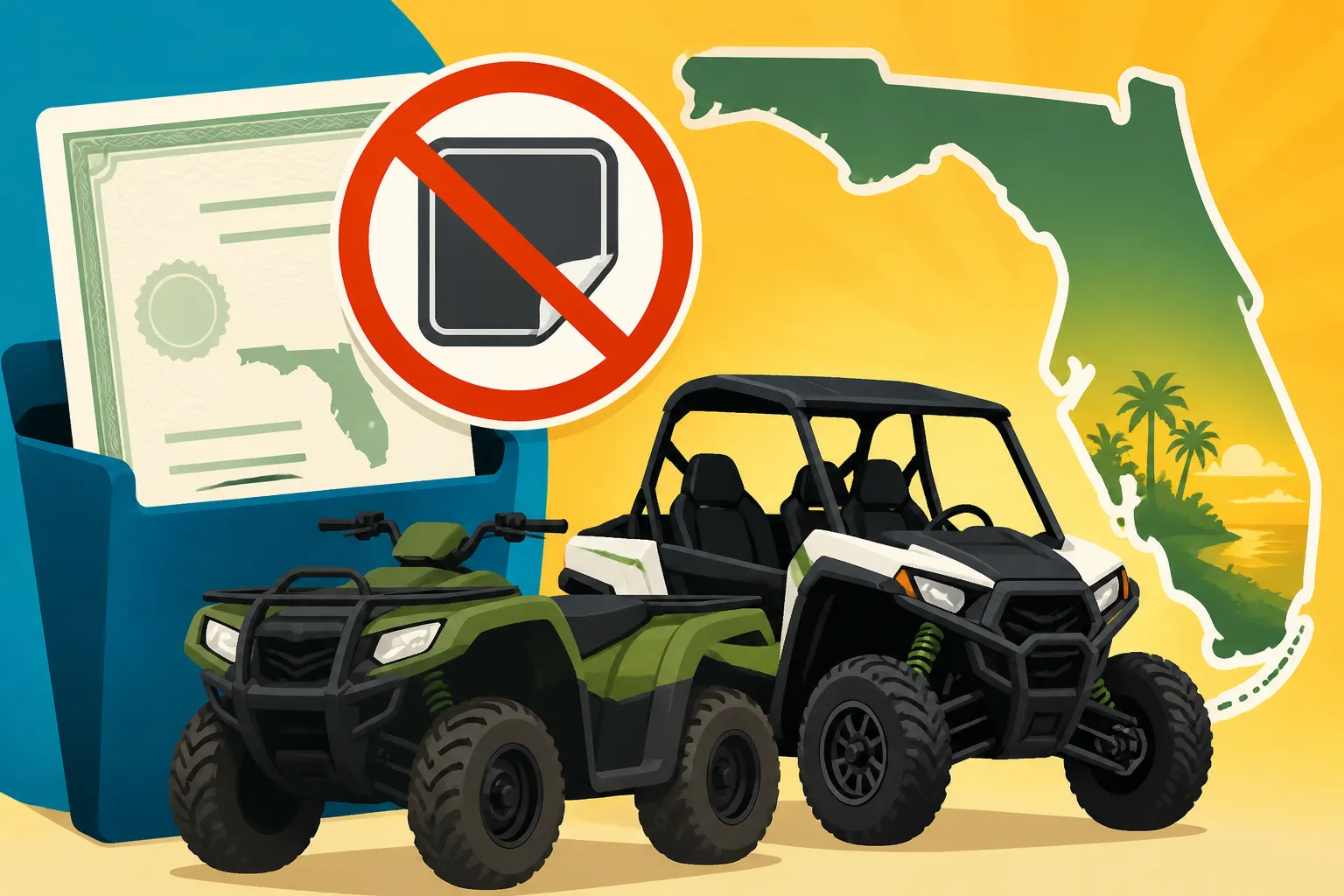
It’s a common moment of confusion for many new or even seasoned ATV owners in Florida: you go through the whole process of titling your quad, fill out all the paperwork, pay your fees, and then… you get your shiny new title in the mail, but there’s no decal. No sticker for your fender, no little tag for your license plate area. It leaves you scratching your head, wondering if you missed a step or if the state forgot something. This guide is here to clear up that very specific frustration, explaining exactly why Florida issues no decal with your ATV title and what it all means for you as a rider.
The Fundamental Difference: Title vs. Registration in Florida
When you’re dealing with vehicles, especially off-highway ones, it’s easy to conflate the terms "title" and "registration." In Florida, these are distinct concepts for ATVs, and understanding their difference is key to understanding why no decal comes with your title.
What a Title Actually Proves
A title is primarily a document of ownership. Think of it as the deed to your house, but for your ATV. It officially establishes you as the legal owner of that specific machine. This is crucial for several reasons. First, it's your primary defense against theft. If your ATV is ever stolen, your title is the definitive proof that it belongs to you, aiding law enforcement in its recovery. Without a title, proving ownership can be a nightmare, turning a frustrating situation into an almost impossible one. Imagine trying to explain to the sheriff that the quad you bought off Craigslist without any paperwork is actually yours when it's recovered miles away. It just doesn't fly.
Beyond theft protection, the title is essential for legal transactions. When you buy a used ATV, the seller must sign over a valid title to you. This transfers legal ownership. If you plan to sell your ATV in the future, you’ll need a clear title to complete the sale legally. It protects both the buyer and the seller from disputes over who truly owns the machine. This is vastly different from how passenger cars are handled, where the title almost always comes hand-in-hand with an immediate registration requirement that includes a license plate and yearly decal. For your quad, the title is simply the proof of who owns it, nothing more, nothing less. It’s about property rights, not road-use permissions.
Why Registration is a Separate Step and Often Not Needed
Here's where the "no decal" question really gets answered. In Florida, most ATVs are considered "off-highway vehicles" (OHVs). Because they are generally not permitted on paved public roads and highways (with very limited exceptions we'll get into later), they don't require traditional road "registration" in the same way cars, trucks, or even motorcycles do. That means no license plate, no yearly renewal sticker, and certainly no decal issued with your initial title. The state isn't expecting you to drive your quad down I-75, so it doesn't equip it with the identifying markers it would need for that purpose.
However, the lack of a "registration" decal doesn't mean there are never other forms of identification or permits required. If you plan to ride your ATV on public lands, such as state forests or national forests, you will almost certainly need to purchase an OHV pass. These passes often come with their own sticker or tag that does get affixed to your machine. This isn't a state-wide registration from the Department of Highway Safety and Motor Vehicles (DHSMV) like a car's registration, but rather a permit issued by the land management agency to allow access to specific riding areas. It’s a permit for the privilege of using designated trails, not a broad registration for the vehicle itself. Understanding this distinction is crucial: your title is for ownership, and specific passes are for access, but neither is a general road registration that would involve a state-issued decal. You can learn more about this by reading [Florida ATV Title vs Registration: The Difference].
Understanding Florida's Off-Highway Vehicle OHV Laws
Florida's approach to ATVs is rooted in their classification as off-highway vehicles. This classification shapes how they are titled, and more importantly, why they don't receive road-use decals.
The 'Off-Highway' Distinction
The term "Off-Highway Vehicle" (OHV) is central to Florida's legal framework for ATVs. By definition, these vehicles are designed and intended for use on unpaved surfaces, trails, and private land. They are not built to meet the stringent safety and equipment standards required for highway use, such as specific lighting, mirrors, or tires. Because their primary domain is off the beaten path, the state's titling system reflects this. Your ATV title proves ownership, but it doesn't confer any rights to operate the vehicle on public paved roads. This fundamental difference is why the state doesn't issue a decal with your title; a decal would imply road-worthiness or registration for public highway use, which simply isn't the case for most ATVs.
Consider a dirt bike, for instance. Dirt bikes also typically fall under the OHV classification. While you can title a dirt bike in Florida, just like an ATV, you won't get a decal for it either. The intent is the same: these are machines for trails and private property, not for cruising down Main Street. This distinction helps clarify why Florida's OHV titling process diverges significantly from that of cars, which are inherently designed and regulated for highway travel. It's not an oversight; it's a deliberate legal classification. For a deeper dive, check out [Florida's Off-Highway Vehicle Title Law Explained].
When You Do Need Proof of Public Land Access
While your Florida ATV title won't come with a decal, that doesn't mean your machine will always be devoid of stickers. As mentioned earlier, if you plan to hit the trails in one of Florida's fantastic public riding areas, like the Croom Motorcycle Area in the Withlacoochee State Forest or the Ocala National Forest, you will almost certainly need a special pass. These are typically issued by the Florida Forest Service (for state lands) or the U.S. Forest Service (for national lands).
These passes usually come in the form of adhesive decals or hang tags that you do display on your ATV. They serve as proof that you've paid the necessary fees to access and enjoy those specific public lands. This is where many riders get confused, thinking these access stickers are the "registration decal" they expected with their title. But they're distinct. The access pass is about permission to use a specific piece of land, while the title is about ownership. These passes might be daily, weekly, or annual, and the rules vary by location. For example, Croom might require one type of pass, while the Ocala National Forest might require another. Always check with the specific land management agency before you head out to avoid any unexpected fines or turn-arounds. It’s about adhering to the rules of the trail, not proving your vehicle is street legal. Many of these parks even have staff at the gates who will check for these. You can often buy these passes right at the trailhead or online, but they are completely separate from your ATV title. You can read more in [Florida OHV Permits: What You Need Before You Ride].
Practical Implications for ATV Owners
Understanding the "no decal" rule has several practical implications for you as an ATV owner in Florida, impacting everything from how you prove ownership to what to expect at the DMV.
Proving Ownership Without a Decal
Since your title is the primary document of ownership, keeping it safe and accessible (but not on the ATV while riding) is paramount. When you buy or sell an ATV, the physical paper title is what legally changes hands. This document will have your name (or the previous owner's name) on it, along with the ATV's Vehicle Identification Number (VIN). This VIN is the unique identifier for your specific machine, much like a fingerprint.
When you're out riding on private land, you might not always carry the physical title, but it's wise to have some form of proof of ownership readily available, such as a copy of the title or a bill of sale. Law enforcement, if ever called to an incident, might ask for this. If you’re riding on land that isn’t yours, carrying a written permission slip from the landowner, along with proof of ownership, is always a smart move. For private sales, creating a clear and comprehensive bill of sale is crucial, even if the title is being transferred directly. Services like LawDepot can provide excellent templates for these kinds of legal documents, ensuring all necessary information is included to prevent future disputes. This way, whether you're buying from a friend or selling to a stranger, you have a solid paper trail. Learn more about what needs to be on that bill of sale by reading [Florida ATV Bill of Sale: What It Needs to Say].
What to Expect When Titling Your ATV
The process of titling your ATV in Florida is straightforward, but knowing what not to expect can save you a trip or a call to the tax collector's office. When you visit your local Florida county tax collector's office or a licensed tag agency, you'll bring the necessary documents: typically the Manufacturer's Certificate of Origin (MSO) if it's a new ATV, or the previous owner's signed-over title if it's used. You'll also need identification, proof of Florida residency, and the funds for the titling fees and any applicable sales tax. For used ATVs, a bill of sale is also highly recommended.
After you submit your paperwork and pay the fees, the clerk will process your application. You won't walk out with a decal. Instead, you'll receive a receipt confirming your application, and your official paper title will be mailed to you, usually within a few weeks. Sometimes, if there's a lien on the ATV (meaning you're financing it), the title might be held electronically until the lien is satisfied. In any case, the final product is the title document itself, without any accompanying decals. Don't worry, this is completely normal and exactly how the system is designed for OHVs in Florida. The process is primarily about establishing and recording legal ownership with the state, not about issuing a road-use identifier. You can get more details in [Florida's ATV Title Application Explained].
Avoiding Confusion with Other Vehicle Types
Part of the confusion around ATV decals stems from the varied rules for other recreational vehicles. While ATVs themselves don't get a decal with their title, other types of machines or specific vehicle modifications might.
For instance, a UTV (Utility Task Vehicle), often called a side-by-side, generally falls under the same OHV titling rules as ATVs in Florida – meaning no decal with the title. However, if a UTV is modified to meet specific criteria and registered as a Low-Speed Vehicle (LSV), it would then require a license plate and registration decals. This transformation is not a simple process; it involves adding specific safety equipment (like windshields, seat belts, headlights, turn signals, etc.) and meeting defined speed limits. LSVs are then treated much more like street-legal cars, hence the need for registration.
Similarly, golf carts have their own set of rules, and while they don't get titles, some require registration or permits depending on where they are operated. The key takeaway here is to always understand the specific classification of your machine and the particular laws that apply to it. Don't assume that rules for a golf cart or a street-legal UTV will automatically apply to your off-highway ATV. Each vehicle class has its own distinct set of requirements. For insights on UTV street legality, refer to [Is a UTV Street Legal in Florida?].
Common Misconceptions and What to Watch Out For
Given the unique nature of Florida's ATV titling, several misconceptions tend to circulate among riders. It's vital to be aware of these to ensure you're always on the right side of the law and avoid potential pitfalls.
The "Car Title" Trap
One of the most frequent sources of confusion for new ATV owners, or those relocating from other states, is expecting their ATV title to function exactly like a car title. In many states, and certainly for cars in Florida, the process of titling and registering is integrated, resulting in a title document and a registration card with a decal for your license plate. It's a natural assumption to think the same applies to your ATV. However, as we've thoroughly discussed, ATVs in Florida are specifically designated as off-highway vehicles. This classification means the state titles them for ownership purposes, but does not register them for general road use, and therefore does not issue a corresponding decal.
This isn't a flaw in the system or an oversight by the DHSMV; it's by design. The absence of a decal with your ATV title is a clear indicator of its intended use – off the paved roads. Trying to find a spot for a non-existent decal, or wondering why you didn't receive one, is a common experience, but rest assured, if you have your paper title, you've completed the official ownership documentation for your ATV in Florida. Don't let the expectation of a car-like process lead you to believe something is missing when it isn't.
Scams and Misinformation
Because of this specific nuance in Florida's titling process, unscrupulous individuals might try to take advantage of new buyers. Be extremely wary if someone tries to sell you an ATV and claims it has a "special road-legal registration" or implies that the lack of a decal is temporary or easily remedied for road use. Unless that ATV has undergone a very specific, extensive, and expensive modification process to become an LSV (which is usually only for UTVs, not traditional ATVs), it is generally not street legal, and its title will not come with a road registration decal.
Always do your due diligence when buying an ATV, especially from a private seller. Verify the VIN on the machine matches the VIN on the title. Ensure the seller actually has a clear, signed-over title to provide you. If a seller insists the machine is "registered" but can't produce official state documentation (beyond a private park pass), or tries to explain away the absence of a decal with vague or complex reasons, it's a major red flag. Stick to verified sources for information and transaction documents. You can protect yourself by understanding [Buying a Used ATV in Florida: Transferring the Title].
Documenting Sales and Ownership Transfers
Given that the title is your primary proof of ownership and there's no decal to track annual registration, accurate and thorough documentation becomes even more critical for every transaction. Whether you're buying or selling, always ensure you have a clear, legible bill of sale in addition to the properly transferred title. This document should include:
- The full names and addresses of both the buyer and seller.
- The date of the sale.
- The purchase price.
- A detailed description of the ATV, including make, model, year, and crucially, the full VIN.
- A statement confirming the transfer of ownership and that the ATV is sold "as is."
- Signatures of both parties.
Using a template from a reputable source like LawDepot can ensure you don't miss any critical details on your bill of sale. While Florida doesn't require bills of sale to be notarized for ATV titling, it can add an extra layer of security and proof of transaction, especially in private sales. Keeping copies of all your paperwork is a must. This diligence protects you in case of any future disputes, questions about ownership, or even if you need to report the ATV as stolen. Without a decal, your paper trail is your best friend.
| Feature | Florida ATV Title | Florida ATV Public Land Pass (e.g., Forest Pass) | Florida Passenger Car Registration |
|---|---|---|---|
| Purpose | Proof of legal ownership | Permission to ride on specific public lands | Permission to operate on public roads |
| Issued By | Florida DHSMV (via Tax Collector/Tag Agency) | Land Management Agency (e.g., Forest Service) | Florida DHSMV (via Tax Collector/Tag Agency) |
| Decal Issued? | NO | YES (often a sticker for the machine) | YES (for license plate) |
| Requirement | Required for all ATVs used on public land or sold privately | Required for public land access (rules vary) | Required for road use |
| Expires | No, it's a permanent document until ownership changes | Yes, typically annually or per visit | Yes, annually or biennially |
| Legal Document | Yes | Yes (as a permit) | Yes |
| Road Use? | Does NOT confer road use privileges | Does NOT confer road use privileges | Confers road use privileges |
Disclaimer
This article is for general informational purposes only and does not constitute professional advice. Laws, prices and regulations vary by location and change over time. Consult a qualified professional for guidance on your specific situation.