Titling an Out-of-State ATV After Moving to Florida
So, you've made the big move to the Sunshine State, maybe you're escaping colder winters or embracing the year-round outdoor lifestyle. But you didn't leave your trusty ATV or UTV behind – it came with you! Now you're staring at your out-of-state title, wondering what in the world Florida expects from you to make your machine legal here. It’s a common headache, and honestly, the process can feel like navigating a swamp buggy through thick mud if you don't know the route. This comprehensive guide will cut through the confusion, walking you step-by-step through exactly how to title your out-of-state ATV or UTV in Florida, ensuring you're ready to hit those sandy trails without a worry.
Understanding Florida's ATV Titling Philosophy
Moving to a new state always comes with a mountain of paperwork, and bringing your off-highway vehicle (OHV) with you is no exception. It's easy to assume that if your ATV was titled in another state, that title automatically carries over and everything is fine. Unfortunately, Florida has its own set of rules, and to legally own and operate your ATV here, especially on public lands, you'll need to get it properly titled in the state. This isn't just bureaucratic red tape; it's about establishing clear ownership and ensuring all vehicles on public property meet certain standards.
Why Florida Cares About Out-of-State ATVs
Florida's approach to titling out-of-state ATVs boils down to a few key reasons, all designed to protect both the state and you as the owner. First, a Florida title provides definitive proof of ownership within the state's legal framework. This is crucial for deterring theft, recovering stolen property, and resolving any disputes over who rightfully owns a machine. When your ATV has a Florida title, it’s officially recognized as yours by all state agencies, from local law enforcement to the county tax collector.
Secondly, Florida wants to ensure that any vehicle operating on its public lands, like the extensive trail systems in the Ocala National Forest or the Croom Motorcycle Area, is accounted for. While an ATV title doesn't grant you permission to ride anywhere (you still need the proper permits for specific trail systems), it’s a foundational step towards legal use. It also helps the state maintain records for accident reporting, environmental impact studies, and overall safety enforcement. Imagine trying to track down the owner of an illegally dumped or abandoned ATV without a clear state title – it would be nearly impossible. So, while it might feel like an extra hoop to jump through, titling your out-of-state ATV in Florida is ultimately for everyone's benefit.
Key Differences: Title vs. Registration in Florida
One of the most common points of confusion for new Florida residents coming from other states is understanding the distinction between a "title" and a "registration." In many states, especially for automobiles, these two concepts are tightly linked – you get a title and a registration (which often includes a license plate and annual tag renewal). For ATVs and other off-highway vehicles in Florida, the situation is different.
Florida titles ATVs, UTVs, and other OHVs, but it does not require them to be registered in the traditional sense like cars or trucks. What does this mean in practice? When you successfully title your out-of-state ATV in Florida, you will receive a certificate of title, which is your official proof of ownership. This document will show your name as the owner, the ATV's vehicle identification number (VIN), and any recorded liens. However, you will not receive a license plate, an annual sticker, or any other form of registration that needs to be renewed each year. The title is a one-time process (unless you sell it or lose it), and as long as you maintain ownership, you won't need to re-apply for the title annually. This can be a relief for some riders who are used to yearly registration fees, but it's vital to understand that the absence of a "registration" doesn't mean the title isn't important. It's the document that establishes your legal claim to the machine. For a deeper dive into this, check out our guide on [Florida ATV Title vs Registration: The Difference].
Gathering Your Out-of-State Paperwork
Before you even think about stepping foot into a Florida tax collector's office, you need to get your ducks in a row with all the documentation you already possess from your previous state. This step is critical because any missing or incomplete paperwork here can lead to significant delays and frustration down the line. Think of it like packing for a long trip – you don't want to realize you forgot your toothbrush halfway there.
Your Existing Out-of-State Title or MSO
The primary document you'll need to kickstart the Florida titling process for your out-of-state ATV is its existing certificate of title. If your ATV was previously titled in another state, you should have a physical paper title in your possession. This document is golden. It proves that you, or the person you acquired the ATV from, had legal ownership. Make sure the title is clearly assigned to you if you recently purchased the ATV, or that it's in your name from your prior state of residence. If there's an open lien on the title from your previous state, be prepared to provide documentation related to that, as Florida will want to acknowledge or process the lien release accordingly.
Now, what if your ATV was never titled in your previous state, or perhaps it was new and you only have the Manufacturer's Statement of Origin (MSO)? An MSO (sometimes called a Manufacturer's Certificate of Origin or MCO) is the document issued by the manufacturer when the ATV is brand new. It's essentially the birth certificate of your vehicle, indicating its initial transfer from the factory to the first dealer, and then eventually to you. If you have an MSO and the ATV has never been titled anywhere, this is the document you'll present to Florida as your proof of ownership. Just like with a title, ensure the MSO is properly assigned to you by the dealer or previous owner. If you don't have either a title or an MSO, things get a bit trickier, but we'll address that in a later section. For now, locate that crucial piece of paper!
Proof of Florida Residency and Identity
Beyond proving ownership of your ATV, you'll also need to prove that you are indeed a resident of Florida and who you say you are. This is standard procedure for any vehicle titling or registration process in the state. The most straightforward way to establish your identity is with a valid Florida driver's license or identification card. If you've just moved, you might still have your out-of-state driver's license, but you will typically need to have begun the process of obtaining a Florida license or ID.
To prove residency, the Department of Highway Safety and Motor Vehicles (FLHSMV) usually requires two documents showing your Florida residential address. Examples include a utility bill (electric, water, gas), a homeowner's insurance policy, a mortgage statement, a lease agreement, or a bank statement from a Florida bank. These documents confirm that you're not just passing through but genuinely establishing roots in the state. Make sure the name and address on these documents match the name and address you'll be using on your title application. It's a good idea to gather more than two, just in case one isn't accepted for any reason. Don't forget, these proofs help cement your eligibility for a Florida title, as it's primarily for residents. Our article [Proving Florida Residency at the Counter] offers more detailed insights on what documents are acceptable.
Bill of Sale and Purchase Documents
Even if you have a perfectly valid out-of-state title or MSO in your name, Florida might still want to see a bill of sale or other purchase documents, especially if you've recently acquired the ATV. This is particularly important for calculating sales tax, which Florida is keen on collecting if it hasn't been paid here already. A bill of sale should clearly state the buyer's and seller's names and addresses, the ATV's make, model, year, and VIN, the date of sale, and the purchase price.
If you bought the ATV privately and the bill of sale was a casual affair or you've misplaced it, it's wise to create a formal one now. Tools like LawDepot offer templates for bills of sale that can help you formalize the transaction details retrospectively. Even if you're the sole owner and just moving your vehicle to Florida, having a clear record of when and for how much you acquired the ATV can smooth out the process, especially concerning sales tax calculations. If the ATV was gifted to you, you'll need a different kind of document, often an affidavit of gift or a bill of sale stating a nominal value (like $1) and clearly indicating it was a gift. The clearer and more complete your purchase documentation, the less likely you are to face questions or delays when you finally submit your application.
The VIN Verification Hurdle
One of the unique requirements for titling an out-of-state ATV in Florida is the Vehicle Identification Number (VIN) verification. This isn't just a quick glance at the VIN to make sure it matches your paperwork; it's a formal process that needs to be completed by an authorized entity. It's a critical step that ensures the legitimacy of your machine before it can be officially recognized by the state of Florida.
Why VIN Verification is Mandatory for Out-of-State Vehicles
Florida takes vehicle theft and fraud very seriously, and the VIN verification process is a primary line of defense. When you bring an ATV from another state, Florida wants to confirm several things: first, that the VIN on your machine matches the VIN on your out-of-state title or MSO exactly. Any discrepancies could indicate a problem, from a simple clerical error to something more sinister like a tampered VIN. Second, the verification confirms that the ATV itself exists and is physically present in Florida. This prevents someone from trying to title a non-existent or stolen vehicle using fraudulent paperwork.
Furthermore, VIN verification helps to identify "title washing" schemes, where a salvaged or heavily damaged vehicle might be re-titled in another state to hide its true condition. While ATVs don't have salvage titles in the same way cars do, the principle applies to ensuring the machine isn't an unidentifiable Frankenstein monster of parts. It's about establishing a clear chain of custody and confirming that your ATV is a legitimate machine ready for Florida's trails. Without this verification, Florida simply won't process your title application, as it's a non-negotiable step for any out-of-state vehicle, including OHVs, seeking a Florida title.
Who Can Perform a Florida VIN Verification
You can't just have your buddy scribble down your VIN on a piece of paper. Florida requires that VIN verifications for out-of-state vehicles be performed by specific authorized personnel. Your options generally include:
- Law Enforcement Officers: This is often the most common route. You can visit your local Sheriff's Office or Police Department. Some departments have specific times or days for VIN verifications, or you might need to call ahead to schedule an appointment. Be prepared to bring your ATV, your out-of-state title/MSO, and your identification.
- Licensed Florida Automobile Dealers: Many car or powersports dealerships that are licensed in Florida can perform VIN verifications. They have the necessary forms and often the expertise. It's worth calling around to local ATV dealers in your area to see if they offer this service, and if there's a fee involved.
- Florida Department of Highway Safety and Motor Vehicles (FLHSMV) Employees: In some cases, certain FLHSMV service centers might have staff authorized to conduct VIN verifications. This is less common than law enforcement, but it's another potential avenue.
- County Tax Collector Employees: While the tax collector's office is where you'll submit your application, some larger offices may have staff trained and authorized to perform VIN verifications on-site. Again, calling ahead is crucial to confirm availability and requirements.
It's vital that the person performing the verification fills out the correct form (usually form HSMV 82042, "Vehicle Identification Number and Odometer Verification") and signs it appropriately. This signed form is what you'll present with your title application. For more specific guidance on who to contact in your area, our article [Who Can Verify an ATV VIN in Florida?] can provide helpful local insights.
What Happens During a VIN Verification
When you take your ATV for VIN verification, the process is usually straightforward but requires your full cooperation. First, the authorized person will physically locate the VIN on your ATV. Manufacturers typically stamp the VIN on a permanent part of the frame, often near the steering head, on a main cross-member, or sometimes on the engine casing itself. The verifier will compare this physical VIN to the one listed on your out-of-state title or MSO. They're looking for an exact match, character for character.
Beyond just matching the numbers, the verifier will also be checking the integrity of the VIN plate or stamping. They'll look for any signs of tampering, alteration, or removal. This is a crucial part of preventing stolen vehicles from being re-titled. They might also quickly visually inspect the ATV to ensure it generally aligns with the make and model described on your paperwork. It's not a full mechanical inspection, but rather a confirmation of identity. Once satisfied, the authorized individual will complete and sign the VIN verification form. Make sure you keep this original signed form safe, as it's a mandatory attachment to your Florida ATV title application. Without it, your application will be rejected, and you'll have to go through the process again.
Completing the Florida ATV Title Application
With your out-of-state paperwork in hand and your VIN verification complete, you're ready for the main event: filling out Florida's specific title application form. This form collects all the necessary information about you, your ATV, and its history to officially transfer it into the Florida system. Taking your time and being meticulous here will prevent common errors that can delay your title.
The Essential Form: HSMLV 82040
The primary document you'll need to complete is Florida's "Application for Certificate of Title With/Without Registration," form HSMV 82040. Don't let the "With/Without Registration" part confuse you; this is the standard form for all vehicles, including OHVs that only receive a title. You can usually download this form from the Florida FLHSMV website or pick up a physical copy at your local county tax collector's office.
When filling it out, pay close attention to each section. You'll enter your personal information: name, address, driver's license number, and contact details. For the vehicle information, you'll need the ATV's VIN, make, model, year, and odometer reading (if applicable, though many ATVs don't have odometers, in which case you can indicate "N/A"). You'll also specify the type of vehicle – for an ATV, you'll generally select "Off-Highway Vehicle" or a similar category. Since you're moving from out-of-state, you'll check the box indicating it's a "New Florida Title" from an "Out-of-State" vehicle. If you have any questions about specific fields, it's always better to ask a clerk at the tax collector's office or consult the FLHSMV instructions rather than guessing. Making mistakes on this form is a common reason for applications being returned, so double-check everything before submitting. For more specific details on navigating this form, our guide [Which Florida Title Form to Use for an ATV] offers a line-by-line breakdown.
Declaring Your ATV's Specifications
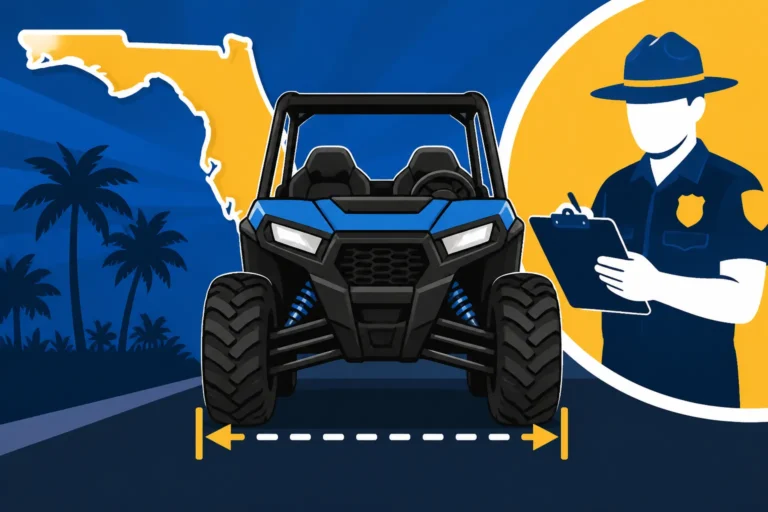
One crucial part of the application is accurately declaring your ATV's specifications, as Florida classifies OHVs based on certain physical characteristics. This helps the state determine if your machine falls into the "ATV," "UTV," or "ROV" (Recreational Off-Highway Vehicle) category, each with its own definitions. The most critical measurement for an ATV is its width. Florida defines an ATV as a motorized off-highway vehicle 55 inches or less in width. If your machine is wider than 55 inches, it generally falls into the UTV or ROV category, which has slightly different titling rules.
You'll need to provide the width, dry weight, and sometimes even the engine displacement (cc) of your machine on the application. It's a good idea to measure your ATV from its widest point (usually the outside of the tires) before you fill out the form. You can often find the dry weight and engine size in your owner's manual or by looking up your specific make and model online. Be honest and accurate with these specifications, as misclassifying your vehicle could lead to issues down the road, including potential fines if you're ever stopped while riding on public land. Understanding [Florida's 55-Inch ATV Definition and Why It Matters] is key here, especially if you think you might have a UTV, in which case [Florida UTV Titling for Side-by-Sides Over 55 Inches] would be a valuable read.
Addressing Liens from Your Previous State
It's common for people to still owe money on their ATV when they move to a new state. If there's an existing lien (meaning a lender still has a financial claim on your ATV) recorded on your out-of-state title, you absolutely must address this during the Florida titling process. You cannot simply ignore it; Florida will want to acknowledge and record this lien on your new Florida title.
Typically, you'll need to provide documentation from your lienholder (the bank or credit union that financed your ATV) that includes their full name, address, and your account number. Florida will then record this lien on your new Florida title. This means your new Florida title will show the lienholder's name, indicating their interest in the vehicle. Once you pay off the loan, your lienholder will send you a lien satisfaction document, which you'll then submit to the FLHSMV to have the lien removed from your Florida title. It's a good idea to contact your lienholder before you go to the tax collector's office to ensure you have all the necessary information they require for transferring the lien to Florida. Some lenders might have specific forms or procedures for out-of-state transfers. Our guide on [Florida ATV Title With a Lien Recorded] provides more detailed instructions on navigating this process.
Understanding Florida's Fees and Taxes
No government transaction is complete without fees, and titling your out-of-state ATV in Florida is no different. It's important to understand the various charges you'll encounter so you can budget appropriately and avoid any surprises at the counter. These fees cover the administrative costs of processing your application and maintaining state records, as well as any applicable taxes.
The Initial Title Application Fee
The foundational cost for getting your out-of-state ATV titled in Florida is the initial title application fee. This is a one-time fee associated with processing your request for a new Florida certificate of title. While specific amounts can change, the standard initial fee for an off-highway vehicle title is around $29. This covers the state's administrative costs for reviewing your paperwork, issuing the new title document (whether electronic or paper), and updating their vehicle records.
It's important to note that this $29 fee is just for the application itself. It doesn't include any sales tax, service charges, or additional fees for expedited processing. Think of it as the base price for getting your ATV officially recognized by the state. While it's a relatively small sum compared to other vehicle fees, it's non-negotiable and must be paid at the time of your application submission. For a detailed breakdown of what this covers, you can refer to [The $29 Initial Title Application Fee Explained].
Florida Sales Tax on Out-of-State Purchases
This is where many new residents get surprised. Even if you paid sales tax on your ATV in your previous state, Florida may still levy its own sales tax if certain conditions aren't met. Florida's general sales tax rate applies to the purchase price of your ATV. The rule of thumb is this: if you purchased the ATV less than six months before moving to Florida, you generally have to pay Florida sales tax on the purchase price. However, Florida offers a credit for sales tax paid in another state. So, if you paid sales tax in your old state, you'll likely only pay the difference if Florida's sales tax rate is higher. If Florida's rate is lower or the same, you might not owe anything.
If you owned the ATV for more than six months before becoming a Florida resident, you are generally exempt from paying Florida sales tax. This is often referred to as the "used property exemption" for new residents. To prove this, you'll need to provide documentation showing your purchase date (like a bill of sale) and evidence of when you became a Florida resident (like the issue date on your Florida driver's license). Make sure your bill of sale clearly states the purchase price, as this is the figure the tax collector will use to calculate any owed sales tax. If you received the ATV as a gift, you'll typically pay sales tax on a nominal value or be exempt, depending on the circumstances and the tax collector's interpretation. Understanding [Florida Sales Tax When You Title an ATV] is crucial for avoiding unexpected costs.
Additional Service Charges and Options
Beyond the initial title fee and sales tax, you'll likely encounter a few other minor charges when titling your ATV. The most common is a service charge, often referred to as the "county tax collector service fee." This fee, typically $4.25, is charged by the county tax collector's office for processing your transaction. It's a standard charge on nearly all vehicle-related transactions conducted at these offices and helps fund their operations. Our article [The $4.25 Service Charge on an OHV Title] details this common fee.
Additionally, if you're in a hurry and need your title expedited, Florida offers a "Fast Title" option. For an extra fee (usually around $7), you can request that your title be processed more quickly. This means you might receive your paper title in the mail much sooner, or if it's an electronic title, it will be recorded faster. While it's not mandatory, many people opt for this if they need the title quickly for a resale, to secure a loan, or simply for peace of mind. Otherwise, standard processing times can vary. Remember, all these fees are typically collected at the time of application, so be prepared to pay them all at once. [Florida Fast Title for an ATV: The $7 Expedited Option] explains when this might be a worthwhile investment.
Where and How to File Your Application
Once all your paperwork is meticulously gathered, verified, and filled out, the final step in the titling process is submitting your application. Knowing where to go and what to expect will make this experience as smooth as possible. Florida has a decentralized system, meaning you'll interact with local county offices for these services.
Choosing Your Filing Location: Tax Collector vs. Service Center
In Florida, ATV title applications are handled by your local county tax collector's office or one of their designated service centers. These offices act as agents for the Florida Department of Highway Safety and Motor Vehicles (FLHSMV) for vehicle-related transactions. You can generally go to any tax collector's office in any county in Florida, but it's often most convenient to visit the one in the county where you reside.
- County Tax Collector's Office: These are the primary locations. They usually have dedicated departments for motor vehicle services. You'll take a number, wait your turn, and then present all your documents to a clerk. They will review everything, process your payment, and submit your application.
- Designated Service Centers: Some counties operate satellite service centers that offer the same vehicle services as the main tax collector's office. These can sometimes be less crowded than the main office, but it's always wise to check their specific hours and services before you go.
It's highly recommended to check your specific county tax collector's website before you visit. They often list required documents, hours of operation, and sometimes even offer appointment scheduling or online queue management systems, which can save you a significant amount of waiting time. For further information on choosing between these options, [Florida County Tax Collector vs Service Center for ATV Titles] and [Where to File an ATV Title in Florida] offer helpful distinctions.
What to Expect at the Counter
When you arrive at the tax collector's office, be prepared with every single document you've gathered. This includes:
- Your completed Florida ATV title application (HSMV 82040).
- Your out-of-state title or MSO.
- The original signed VIN verification form (HSMV 82042).
- Proof of Florida residency and identity (Florida driver's license/ID, utility bills, etc.).
- Your bill of sale or other purchase documents.
- Any lien information or lien release documents.
- Method of payment for all fees and taxes (check your county's website for accepted payment types – usually cash, check, or credit/debit card, though credit card transactions might incur an additional convenience fee).
The clerk will meticulously review all your documents. They're looking for completeness, accuracy, and proper signatures. Don't be surprised if they ask you questions for clarification. If everything is in order, they will process your payment and provide you with a receipt. They'll keep all the original forms required for the application. If anything is missing or incorrect, they will inform you, and you'll have to correct the issue and resubmit your application. Patience and preparedness are your best friends at this stage.
Receiving Your Florida ATV Title
After you've successfully submitted your application and paid all fees, the waiting game begins. Florida primarily issues electronic titles (e-titles) by default. This means you won't immediately receive a physical paper title unless you specifically request one and sometimes pay an additional fee. If you opt for an e-title, the ownership information is stored electronically in the FLHSMV database. This is generally convenient, as it reduces the risk of losing a paper title and makes future transfers simpler.
If you prefer a paper title, you can usually request one on the application form or at the counter. A paper title will be mailed to the address you provided on your application. The processing time can vary. Standard processing for a mailed title might take a few weeks. If you opted for the "Fast Title" service, it could arrive much sooner. Keep your receipt as proof that your application was submitted. You can often check the status of your title application online through the FLHSMV website using your VIN or application number. [Florida ATV Title Application Processing Time] and [How Long a Florida ATV Title Takes to Arrive] provide more specific timelines and what to expect.
Common Challenges and Troubleshooting for New Residents
While the process outlined above is fairly standard, moving from state to state with an ATV can present unique challenges. It's smart to anticipate these potential roadblocks so you can navigate them effectively without excessive stress or delays.
Missing Out-of-State Title or MSO
This is perhaps one of the biggest hurdles. What if you've moved to Florida, and you realize your original out-of-state title or MSO is missing? Maybe it got lost in the move, or perhaps you bought the ATV years ago and never thought to keep the paperwork for an untitled machine. Florida cannot issue a title without proof of prior ownership.
If your ATV was titled in another state and that title is now lost, your first step should be to contact the Department of Motor Vehicles (or equivalent agency) in your previous state to request a duplicate title. This will be easier if the title was in your name. If you only had an MSO and it's lost, or if the ATV was never formally titled, things become more complex. You might need to gather alternative proofs of ownership, such as old registration documents, insurance policies, or a very detailed bill of sale supported by sworn affidavits. In some rare cases, for older machines with no traceable history, Florida might consider a bonded title. This is a surety bond that protects the state and any previous owner from claims against the title. It's a more involved process and often a last resort. However, starting with contacting your previous state for a duplicate is always the most direct route. Our article [Florida ATV Title When the Seller Lost the Paperwork] offers practical advice for these situations. You might find a generic affidavit of ownership form on a site like LawDepot if you need to formalize a sworn statement about how you came to possess the ATV.
Incorrect Information on Your Old Title
Imagine you've pulled out your old title, and you spot a typo in your name, an incorrect VIN digit, or the wrong year for your ATV. This is definitely a hiccup, but usually manageable. If the error is on your out-of-state title, Florida's tax collector will likely require you to get that error corrected by the issuing state before they will issue a new Florida title. They want to ensure the information they're transferring into their system is accurate from the start.
Contact the DMV or titling agency in your previous state and explain the error. They will guide you on their specific process for corrections, which might involve a form, proof of the correct information, and a fee. Once you have a corrected title from your previous state, then you can proceed with the Florida titling process. If the error is minor and clearly a clerical mistake (e.g., a transposed letter in your street address on your old title, but your ID shows the correct one), the Florida clerk might be able to make a note, but for vehicle-specific data like VIN or year, expect to go back to the source.
Dealing with Different State Laws
Moving from one state to another means encountering a new set of rules and regulations. What was perfectly acceptable for an ATV in Georgia, Alabama, or New York might have different implications in Florida. For example, some states might not title ATVs at all, or they might have different definitions for what constitutes an "ATV" versus an "off-road motorcycle" or "UTV." Florida has its own clear definitions based on width, weight, and intended use.
While Florida will accept your out-of-state title as proof of ownership, your ATV must then conform to Florida's classifications and titling requirements. This means if your machine was considered an "off-road vehicle" in your old state but fits Florida's definition of a UTV (wider than 55 inches), it will be titled as a UTV in Florida, even if your old title just said "ATV." Be prepared for these subtle shifts in terminology and classification. The key is to understand that once you're a Florida resident, Florida law governs your ATV, regardless of how it was treated elsewhere. Don't assume your old state's rules automatically transfer; embrace the Florida way of doing things.
Conclusion
Bringing your out-of-state ATV or UTV to Florida doesn't have to be a bewildering ordeal. While the process involves several steps, from gathering your old documents and getting a VIN verification to filling out the Florida application and paying the necessary fees, each step is manageable with the right information and a bit of patience. By meticulously preparing your paperwork, understanding Florida's unique titling philosophy, and knowing where to go, you can smoothly transition your machine into its new legal home in the Sunshine State.
Once your ATV proudly bears a Florida title, you'll have the peace of mind knowing that you're a responsible owner, compliant with state laws, and ready to explore Florida's incredible network of trails and riding areas. So, get that paperwork sorted, get your title, and get ready to ride – Florida-style!
Disclaimer
This article is for general informational purposes only and does not constitute professional advice. Laws, prices and regulations vary by location and change over time. Consult a qualified professional for guidance on your specific situation.