Where Florida Riders Buy a Pass On Site
Buying a Florida OHV pass at the trailhead can sound like the easiest plan—until you arrive and find that the kiosk is out of service, the signal is gone, or the pass you need is sold through a different system. The key is knowing which agency manages your riding area and what “on-site purchase” actually means there. This guide explains your options and how to avoid a wasted trip.
First, identify which pass your riding area requires
Florida riders may need different permits depending on whether they are riding in a national forest or a state forest. Those systems are not interchangeable, even when the trailheads are fairly close together. A pass purchased for one agency’s riding area does not automatically cover another.
National Forest OHV passes and Florida State Forest OHV passes are handled through separate systems. The purchase channel, pass period, and rules can differ, too. Before you look for a place to buy a pass in person, confirm the land manager for the exact trail or riding area you plan to use.
| Where you plan to ride | Pass system to check | What to confirm before leaving |
|---|---|---|
| An OHV area in a national forest | National Forest OHV pass | Whether your route requires a pass, how to buy it, and whether an on-site sales point is available |
| An OHV area in a state forest | Florida State Forest OHV pass or day-use arrangement | Whether the pass is required for your machine and whether the trailhead has a working payment option |
| A private riding park | The park’s own admission or permit system | Whether payment is available at the gate, and which forms of payment are accepted |
| A route crossing or connecting different public lands | Each land manager’s rules | Whether separate passes or permissions are required for each property |
If you are unsure which system applies, start with the official page for the specific riding area, not a general search for “Florida ATV pass.” A forest’s main recreation page may describe general access, while its OHV page explains vehicle-specific requirements. The difference matters: a general day-use payment may not satisfy an OHV permit requirement.
For national forests, review Florida National Forest OHV Pass: 3-Day, 7-Day or Annual and Recreation.gov and the Two-Forest OHV Pass. For state forests, see Florida State Forest OHV Day Use and Annual Passes and ReserveAmerica and the State Forest Web Store. These explain the separate systems and can help you avoid buying the wrong product.
Visitors from outside Florida should check the rules that apply to them before heading to a kiosk. A pass requirement can be separate from a vehicle title or registration issue, and an out-of-state registration does not necessarily replace a land manager’s OHV pass. See Florida OHV Permit Rules for Out-of-State Riders for the visitor-specific questions to sort out.
Where an on-site purchase may be possible
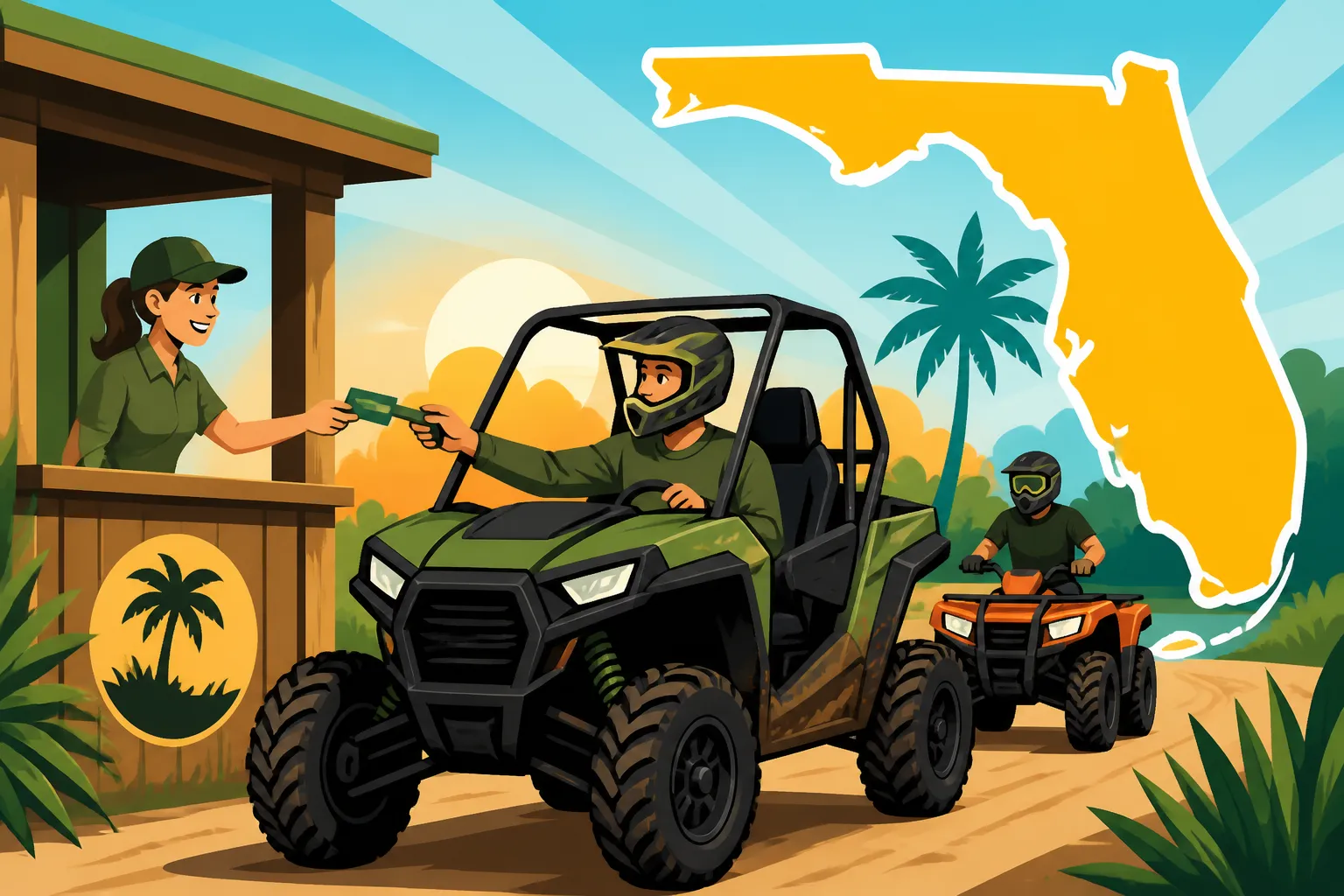
“Buy on site” can mean several different things. It might mean paying at a self-pay kiosk near a trailhead, purchasing from a staffed office, or paying a park operator at an entrance booth. It could also mean buying online from the parking area before unloading. Those options are not guaranteed at every location.
Trailhead kiosks and self-pay stations
Some Florida riding areas have self-pay stations or kiosks where visitors can pay for access. These can be useful when you arrive outside office hours or when you did not purchase ahead of time. But a kiosk may sell only certain passes or day-use products. Don’t assume that the machine handles every OHV permit, every pass duration, or every type of payment.
Before relying on a kiosk, verify three things with the land manager:
- That a kiosk is located at your intended entrance. A nearby recreation site may have one, while the trailhead you plan to use does not.
- That it sells the specific OHV pass you need. General parking or day-use payment may be different from an OHV permit.
- That it is currently usable. A kiosk can be temporarily unavailable, and a remote location may not have another staffed sales point nearby.
The guide to Florida Self-Pay Kiosks at Trailheads is a useful starting point. Treat it as a prompt to check the current details for your destination, rather than proof that every kiosk can issue every pass.
Staffed offices and visitor contact points
A staffed forest office or visitor contact point may be able to answer questions about the local pass process. Some offices or authorized sellers may offer in-person purchases, but availability and business hours vary. A forest office being open does not automatically mean it sells the pass you need, so call ahead or check the official listing before driving there.
When you call, ask directly: “Can I buy the OHV pass for this riding area in person at this location today?” Then ask whether the office accepts your intended payment method, whether it is open when you expect to arrive, and whether you need a printed copy or other proof after purchase.
Avoid relying only on a general agency office address. An administrative office may not be at the riding area, may not handle visitor transactions, or may have limited public hours. If you are planning to buy before reaching the trail, confirm the precise address and entry instructions.
Online purchase from the parking area
For some pass systems, the practical “on-site” option is to buy online once you reach the area. This can work if your phone has a reliable connection and you have the required account and payment details ready. It is a fallback, not a plan to count on blindly: cell coverage can be weak at trailheads, checkout can take time, and a purchase receipt may not be the same thing as the pass display or proof required by the land manager.
If you expect to use this option, sign in or set up the account in advance, and understand what confirmation you need to save. Take a screenshot or download the confirmation if the system allows it, then follow the site’s instructions for displaying or carrying the pass. A screenshot can help you retrieve your purchase details, but don’t assume it replaces whatever official proof is required.
What to check before you drive to the trailhead
A little preparation is more reliable than hoping to sort out a pass at the gate. Pass sales arrangements can differ by forest, site, season, and entrance. Even when an agency offers on-site sales somewhere, that does not establish that the specific trailhead you’re visiting can sell the pass.
Confirm the exact riding area and its manager
Use the official map or page for the riding area to confirm the land manager and entrance. Names can be confusing: a recreation area, campground, forest, and trail system may be nearby but have different access rules. If your ride includes more than one property, check each property separately.
Also confirm that the riding area is open to the type of machine you plan to bring. A pass does not grant access to a trail that is closed, restricted by vehicle type, or outside the designated riding area. For public routes, check seasonal notices and closures as well as pass requirements.
Confirm the pass and purchase channel
Check the pass product itself, not just a general fee page. Look for the permitted location, pass duration, whether it applies per machine or per rider, and whether it covers the particular type of vehicle you’re bringing. If two machines are in your trailer, ask whether each needs its own pass.
For a national forest, pass details and sales options may be managed online and vary from on-site arrangements in state forests. For state forest areas, consult the state forest’s own purchase instructions. Florida OHV Pass Payment Methods can help you plan what to bring, but the specific location’s current instructions should settle the question.
Check hours, payment and connectivity
If you plan to purchase from a staffed location, confirm its public hours and the exact address. If you plan to use a kiosk, ask whether it accepts your expected payment type and whether it issues a receipt or pass you must display. If you plan to buy online at the trailhead, download the app or prepare the website login before you leave home.
Do not assume that a kiosk accepts cash, cards, or contactless payment just because another kiosk does. Likewise, don’t assume that a phone signal will be strong enough to complete a purchase. Remote forest roads can have patchy connectivity, and a payment page that works in town may load slowly or fail near the trailhead.
Keep proof accessible
Follow the instructions for how to display or carry the pass. If you receive a printed permit, keep it protected from water and mud without obscuring any information that must remain visible. If the pass is digital, save the confirmation where you can retrieve it without relying on an incoming text message or email at the trailhead.
A clear waterproof document sleeve can protect paper from rain and splash. If you’re looking for one, Amazon may have basic sleeves, but a resealable bag or another suitable waterproof holder can work just as well. Measure your printed pass before ordering from Amazon, and make sure the cover won’t hide required details. A product listing on Amazon is only gear; it is not an official permit or proof that your purchase is valid.
A practical plan for buying in person
Use this sequence to reduce the chance of getting to the entrance without a valid pass.
- Choose the specific riding area. Confirm the trail system and entrance, not merely the nearest town or forest name.
- Identify who manages it. Determine whether it is in a national forest, a state forest, private property, or another land category.
- Read the official OHV pass instructions. Confirm the pass type, location coverage, duration, and how it must be displayed or carried.
- Look for an on-site sales option. Check whether the official page lists a staffed sales point or kiosk at the entrance you’ll use.
- Call if anything is unclear. Ask whether you can purchase the correct pass at that exact location on the day you plan to ride.
- Prepare a backup. If online purchase is allowed, set up your account in advance and save the official confirmation. If buying ahead is possible and practical, it removes the risk of relying on trailhead connectivity.
- Check for closures before departure. A valid pass does not override a trail closure, a vehicle restriction, or a temporary access notice.
On the phone, be specific. “Do you sell ATV permits?” might get an answer about general admission, not the OHV pass for your destination. Instead ask: “I’m bringing a quad to this named riding area and entrance. Can I buy the required OHV pass at that entrance? If not, where is the nearest authorized place to purchase it, and what proof do I need to carry?”
If you are visiting a riding park with a staffed gate, ask about the park’s own admission process. Private parks set their own procedures, so public-forest pass instructions do not apply unless the park explicitly says they do. Ask whether admission is sold at the gate, whether reservations are needed, and whether the park has separate requirements for each vehicle.
If the kiosk is closed, broken or unavailable
If you arrive and cannot buy the pass as expected, stop and resolve it before riding. Don’t assume that a failed payment machine means passes are not required, and don’t ride while planning to explain the problem later. A ranger, trail employee, or park operator may ask for proof of payment or a valid pass. Florida Ranger Checks at a Trailhead explains why it pays to have your documentation ready.
Use the official instructions posted at the site or contact the land manager through the number or website listed for that location. If online sales are an approved option, try that only if you can complete the purchase and save the confirmation. If the system is unavailable and no approved alternative is offered, the safest choice is to delay the ride or use a location where you can confirm access and payment arrangements.
A few common assumptions can create trouble:
- “The kiosk took my general day-use payment, so the OHV pass must be included.” Verify what the payment covered. A receipt for general access may not satisfy the OHV requirement.
- “I paid online, so I don’t need to save anything.” Keep the confirmation and follow the pass display or carry instructions.
- “A pass for a nearby forest should cover this trail.” Check the pass’s stated coverage. Separate land managers may operate separate programs.
- “The office is on the map, so it must be selling passes.” Confirm the office handles sales, is open, and has the right pass available.
- “The machine is closed, so the trails must be closed too.” Check official closure notices rather than guessing. A sales problem and a trail closure are different issues.
If you can’t produce the pass or required proof, you may be turned away or face enforcement under the applicable rules. What Happens If You Cannot Show a Pass covers what to consider before proceeding without documentation.
For future rides, note the exact purchase point and process that worked. Keep the official instructions bookmarked, save the customer-service contact details, and make a reminder to recheck closures and pass requirements before each trip. A familiar trailhead can still change its sales arrangements or access status.
The safest approach is simple: verify the correct pass through the managing agency, confirm that your chosen on-site point actually sells it, and carry the proof the agency requires. If any part of that plan depends on a kiosk, office, or phone connection, have a backup before you unload.
Disclaimer
This article is for general informational purposes only and does not constitute professional advice. Laws, prices and regulations vary by location and change over time. Consult a qualified professional for guidance on your specific situation.