Parents Riding With Kids on Public Land
Taking children on a Florida public trail involves more than choosing an easy route. Parents need to check supervision and safety-course rules, confirm the riding area’s pass requirements, and make sure each child has a suitable machine and protective gear. The details can vary between public lands, so plan around the specific trail system rather than assuming one set of rules applies everywhere.
What parental supervision means on public land
Riding together is not always the same as meeting a land manager’s supervision requirement. A rule may specify who must supervise a young rider, whether the adult must ride with the child, and what age or certification requirements apply to the child. Those details can differ by land unit and by the type of riding area.
Florida’s rules for riders under 16 are an important starting point, but they are not the only rules to check. Some public-land managers set additional conditions for their trails. For example, the requirements for a national forest may not be identical to those for a state forest or another public riding area. Review Florida Adult Supervision Rules on Public Land and Florida National Forest Under-16 Course Requirement before choosing a destination.
In practice, parents should plan to remain close enough to see and communicate with the child, not simply ride somewhere in the same area. The meaning of direct supervision can matter, especially if a group spreads out, reaches a trail junction, or has riders on machines with very different speeds. What Supervision Means in Practice explains why a parent’s presence nearby may not be enough if the rule calls for active supervision.
Before heading out, check the official information for the specific trail system. Look for instructions on:
- The minimum age or other eligibility requirements for young operators
- Whether an adult must accompany or directly supervise a child
- Required safety training and what proof the child needs to carry
- Approved machine types, trail access, and any width restrictions
- Current closures, permit requirements, and riding-area conditions
A parent can usually make a safer decision by treating the most restrictive applicable rule as the one to follow until the land manager confirms otherwise. If the published instructions are unclear, contact the office responsible for that riding area before traveling. Do not rely on a rule from a nearby forest or a previous visit; access conditions and local instructions can differ.
A parent riding along does not make every machine appropriate
Supervision cannot compensate for a machine that is too large, too powerful, or unsuitable for a child’s size and experience. The child needs to reach and operate the controls comfortably, understand how the throttle and brakes respond, and have enough strength and coordination to steer and stop safely. A machine that looks manageable in a parking area may feel very different on sand, ruts, or uneven ground.
Use the manufacturer’s age and size guidance as one input, not as a guarantee that a particular child is ready. Consider the child’s attention, judgment, experience, and ability to follow directions under stress. If they cannot reliably stop when asked, stay on the trail, and respond calmly to a changing surface, choose a more controlled setting or wait.
Passengers need separate consideration. Do not assume a child can ride as a passenger on any quad or side-by-side. Check the machine’s intended seating, occupant limits, restraint system, and the riding area’s rules. A passenger should have a designated seat and appropriate handholds or restraints; riding on a machine not designed for a passenger creates avoidable risk. For more detail, see Florida ATV Passenger Rules and Florida Rules for Riding Two Up on a Quad.
Courses, passes, and documents to check before you leave
A child’s safety course, a land-use pass, proof of ownership, and a machine’s title are different things. Having one does not automatically satisfy the others. That distinction can prevent a frustrating surprise at the trailhead.
Some public-land riding rules require riders under a certain age to complete an approved safety course. The course and proof requirements may depend on the land manager. Check Florida ATV Safety Course for Public Land Riding and Two Different Florida Safety Course Rules for the broader distinction between requirements. If your child completed training outside Florida, do not assume that the certificate is accepted everywhere. Ask the land manager whether it recognizes that course and what documentation it wants to see.
A riding pass is another separate requirement. Depending on the destination, the pass may be tied to a particular vehicle or may cover use of a defined area. A pass does not itself establish that a child has completed required training or that the machine is eligible for the trail. Confirm the pass rules for the exact forest or riding area, and check whether the adult must carry a printed or electronic copy.
| What to check | Why it matters | What to confirm |
|---|---|---|
| Child’s age and supervision | Rules may apply specifically to young operators | Minimum age, adult role, and whether the adult must ride alongside |
| Safety course | Some areas require training for young riders | Accepted course, age requirement, and proof to carry |
| Riding pass | Access may require a separate land-use pass | Which machine it covers and how to display or carry it |
| Machine eligibility | Not every ATV or UTV can use every trail | Type, size, width, and any trail restrictions |
| Ownership documents | Staff may ask questions about the machine being used | What proof the area requires and whether it must be on hand |
| Current access | Trails can close or have temporary restrictions | Official notices, operating hours, and route availability |
If you are visiting from another state, check both the land manager’s rules and any applicable Florida requirements. An out-of-state registration, training card, or permit should not be treated as automatically interchangeable with a Florida document. Ask the agency or riding area directly what it recognizes. The same caution applies if you are a Florida resident riding a machine titled or registered elsewhere.
Keep the documents easy to find, but protect them from water and mud. A sealed pouch can help with paper certificates or printed confirmation. If proof is electronic, make sure it is saved where you can access it without relying on trailhead cell service. Check Carrying a Safety Certificate on the Trail and Florida Riding on Public Land: Permits and Proof for more on what to have available.
Before traveling, confirm the machine itself is allowed at the destination. Public-land trail systems may limit access by machine type or width, and a side-by-side that is suitable for one area may not be permitted on another trail. Verify measurements and access rules using the land manager’s current information rather than relying only on a seller’s description. Where a title or ownership question comes up, Proof You Own the Quad You Are Riding can help you identify what to ask.
Plan a family ride around the child, not the adult group
A successful family outing starts with a route and pace the youngest or least experienced rider can manage. A trail that seems easy to an adult may feel difficult to a child who is coping with loose sand, vibration, noise, heat, and the need to watch for other riders at the same time.
Start with a short ride on terrain suited to the child’s skill. Avoid making a long route the first test of a new machine or a new riding area. Leave time for breaks and be ready to turn back early. The goal is not to complete a mileage target; it is to keep the group together and give the child enough energy and attention to ride safely.
A simple pre-ride plan helps:
- Choose the riding area and confirm access. Check the official source for permits, closures, machine restrictions, and current conditions. Do not assume every trail in a public forest is open to motorized riding.
- Match the route to the least experienced rider. Consider distance, sand, uneven ground, water, traffic, and the availability of a safe place to stop.
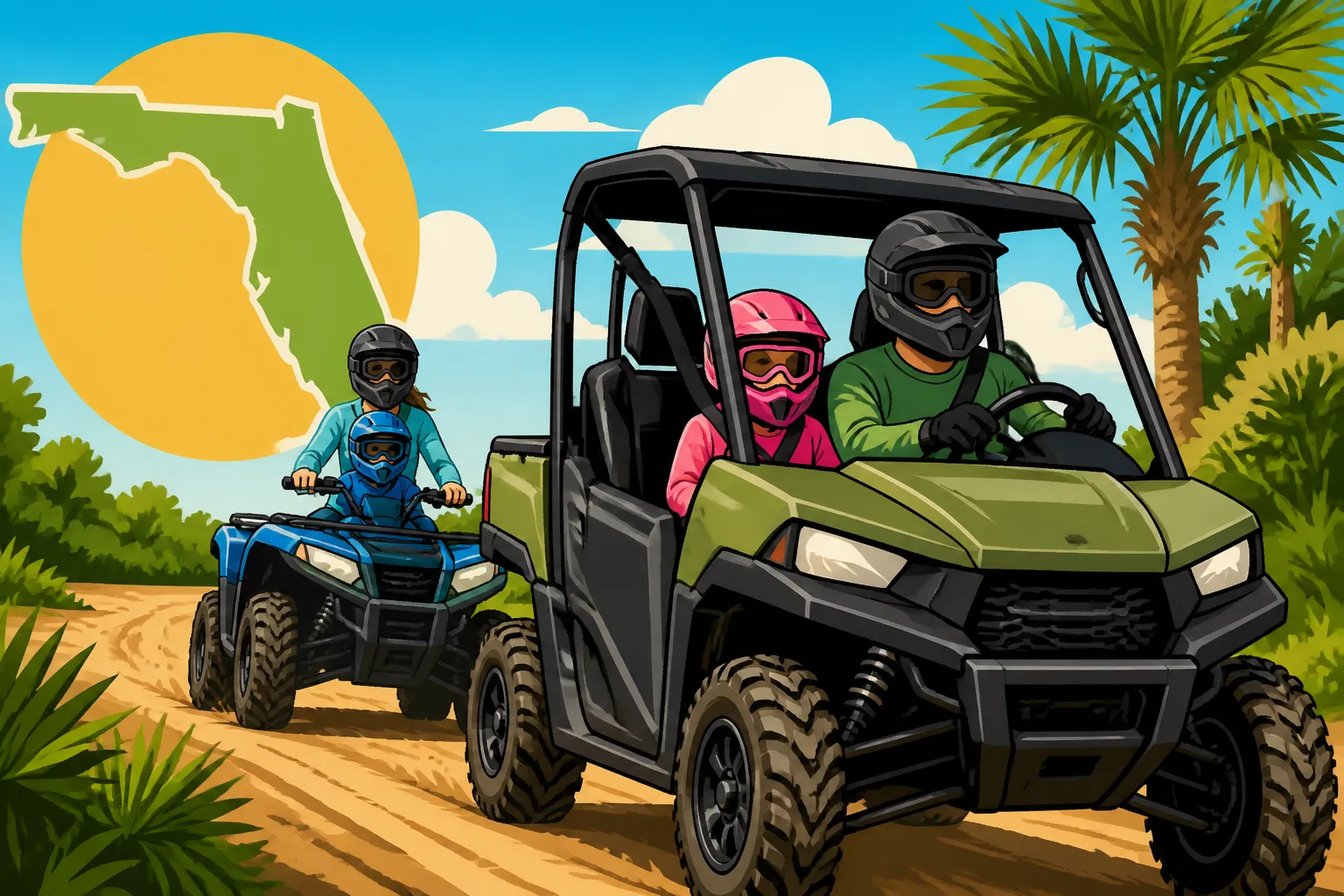
- Set the group order. Put a capable adult in front to set a steady pace and another responsible rider behind the child when the group is large enough. Do not let the child ride out of sight.
- Agree on simple signals and stopping rules. Explain where the group stops, what to do if someone gets separated, and how the child should respond if the machine stalls or they feel uncomfortable.
- Check machines and protective gear. Test controls, tires, brakes, lights where relevant, and restraints. Make sure each rider has the right gear before entering the trail.
- Set a turnaround point. Stop and reassess before the child becomes tired, overheated, or overwhelmed.
Protective equipment should fit the rider and be appropriate for off-highway use. A helmet that moves around or sits incorrectly can be less protective, and a child should be able to see clearly through goggles or other required eye protection. Check the riding area’s equipment rules as well as applicable Florida requirements. Buying gear from a local shop or Amazon does not remove the need to check fit, condition, and the relevant safety markings.
Dress for the conditions, not just the parking lot. Long sleeves, gloves, sturdy footwear, and eye protection can help guard against sun, dust, branches, and flying debris. Carry drinking water and take breaks, especially in hot weather. Children may not recognize or describe fatigue and heat stress as quickly as adults expect, so watch for slowing reactions, irritability, dizziness, or unusual quietness. Stop in a safe place if anyone feels unwell.
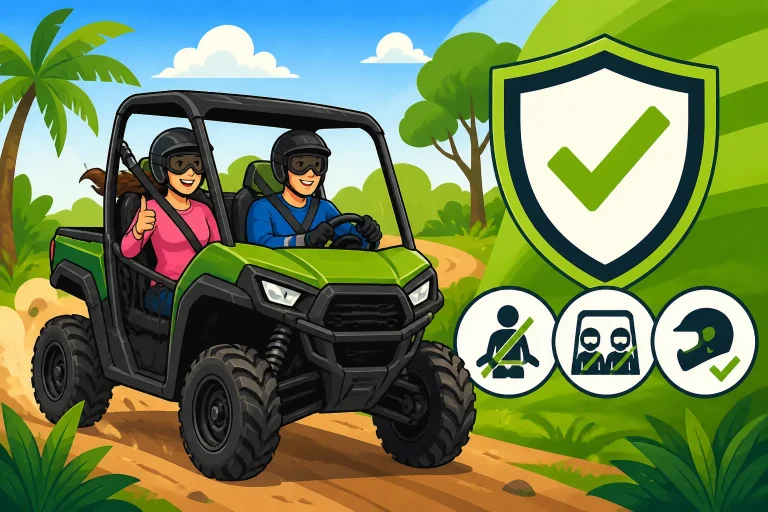
The machine should also be prepared for the route. Check the owner’s manual for maintenance and load guidance, and do a basic inspection before riding. For a UTV, make sure occupants use the installed seat belts and remain seated as instructed. Do not treat a roll cage as a substitute for restraints. For an ATV, check that the machine is intended for the rider’s use and that its controls are accessible without stretching or losing control.
Keep the ride controlled once you reach the trail
Public trails are shared spaces, and a child may not anticipate what an experienced adult notices automatically: an oncoming rider, a blind corner, a change in traction, or a branch across the path. Adults should manage spacing and pace so the child has time to react.
Keep the group close enough to communicate while leaving room to stop safely. Do not pressure a child to keep up with faster adults, and do not let other riders crowd them from behind. If the trail narrows, becomes rougher than expected, or has more traffic than the child can handle, stop in a safe place and choose a suitable route back. A parent who is supervising should be ready to adjust the plan, not simply encourage the child to push through.
Avoid dividing attention between riding and a phone. If you need to check a map, take a photograph, or handle a document, pull well off the trail where permitted and stop the machines first. If the group becomes separated, follow the plan you agreed on before setting out rather than sending a child to search alone. Make sure the child knows the adult’s name and where the group will stop if anyone has to pull over.
Respect posted signs and instructions from land managers. A trail that looks passable may be closed, restricted, or unsuitable for the machine being used. Stay on designated routes, do not create new paths around wet or damaged areas, and give other users room. If a staff member or ranger asks about a pass, certificate, or machine, respond calmly and follow the area’s directions.
Parents should also be prepared to end the ride early. Stop if the child is tired, frightened, overheated, having trouble controlling the machine, or no longer following instructions. Continuing because the group is close to a destination can turn a manageable problem into a dangerous one. Before another trip, talk through what was difficult and adjust the route, machine, group size, or riding time.
The most reliable family plan is straightforward: verify the rules with the land manager, carry the required proof, use a machine the child can control, and ride at the child’s pace. A parent’s presence is essential, but it does not replace training, protective equipment, permits, or sound judgment.
Disclaimer
This article is for general informational purposes only and does not constitute professional advice. Laws, prices and regulations vary by location and change over time. Consult a qualified professional for guidance on your specific situation.