What a Dealer Files on Your Behalf After a Sale
Buying a new or even a used ATV or UTV from a licensed dealer in Florida can feel like a breath of fresh air compared to the sometimes-daunting process of a private sale. Many buyers assume that once they sign the papers and drive off, everything is magically handled, but it’s not always crystal clear what specific tasks your dealer undertakes on your behalf. This guide is here to demystify that process, breaking down the crucial paperwork your dealer files so you can ride with confidence, knowing all the legal bases are covered.
The Dealer's Indispensable Role in Your ATV or UTV Titling Process
When you purchase an ATV or UTV from a Florida dealer, you're not just buying a machine; you're often purchasing convenience. Unlike a private transaction where you, the buyer, are solely responsible for ensuring the title transfer and all associated fees are paid, a licensed dealer steps in to handle much of that bureaucratic heavy lifting. This is a significant advantage, especially for first-time buyers or those who simply don't have the time to navigate the intricacies of the state's titling requirements.
Think about it: the Florida Department of Highway Safety and Motor Vehicles (FLHSMV) has very specific rules for off-highway vehicles (OHVs). These rules cover everything from the initial application to sales tax collection and even how liens are recorded. A reputable dealer is well-versed in these regulations, acting as a crucial intermediary between you and the state's titling agencies. Their expertise helps ensure that your new machine is legally documented, preventing future headaches down the road, such as issues when you eventually decide to sell your quad. You might be interested in [Florida's Off-Highway Vehicle Title Law Explained] for a broader context.
Why Dealers Handle the Paperwork
Dealers don't just handle your paperwork out of the goodness of their hearts, though good customer service is certainly a factor. They are legally mandated to do so. Florida law places the responsibility on licensed dealers to submit the necessary documentation for titling and registration (if applicable) within a certain timeframe after a sale. This ensures the state accurately tracks vehicle ownership and collects all due taxes and fees. Without this requirement, there would be a significant lag in the titling process, potentially leading to a black market of untitled machines and lost revenue for the state.
This legal obligation provides a layer of protection for you, the consumer. It means you don't have to worry about missing a crucial deadline or incorrectly filling out a form, which could delay your ability to legally operate your ATV or UTV. When you buy from a dealer, you're essentially outsourcing a complex administrative task to a professional. This frees you up to focus on the exciting part: planning your first ride on Florida's amazing trails.
What Happens if They Don't File Correctly?
While rare with reputable dealers, mistakes can happen. If a dealer fails to file your paperwork correctly or within the mandated timeframe, it can create a cascade of problems for you. The most immediate issue is that your ATV or UTV won't be legally titled in your name. This means if you're stopped by a Florida Fish and Wildlife Conservation Commission (FWC) officer or a county sheriff's deputy while riding on public land, you could face penalties for operating an untitled vehicle. Remember, [Riding Public Land as the Trigger for a Title].
Beyond enforcement issues, an incorrect or delayed title can complicate insurance claims in the event of an accident or theft. Insurance companies often require proof of ownership, and a title in your name is the ultimate verification. Correct titling also impacts your ability to sell or transfer ownership of the machine in the future. Imagine trying to sell an ATV years later only to find out the title was never properly transferred to you! It's a frustrating and time-consuming situation that can usually be avoided by choosing a trustworthy dealer who understands their responsibilities.
Key Documents Your Dealer Handles for You
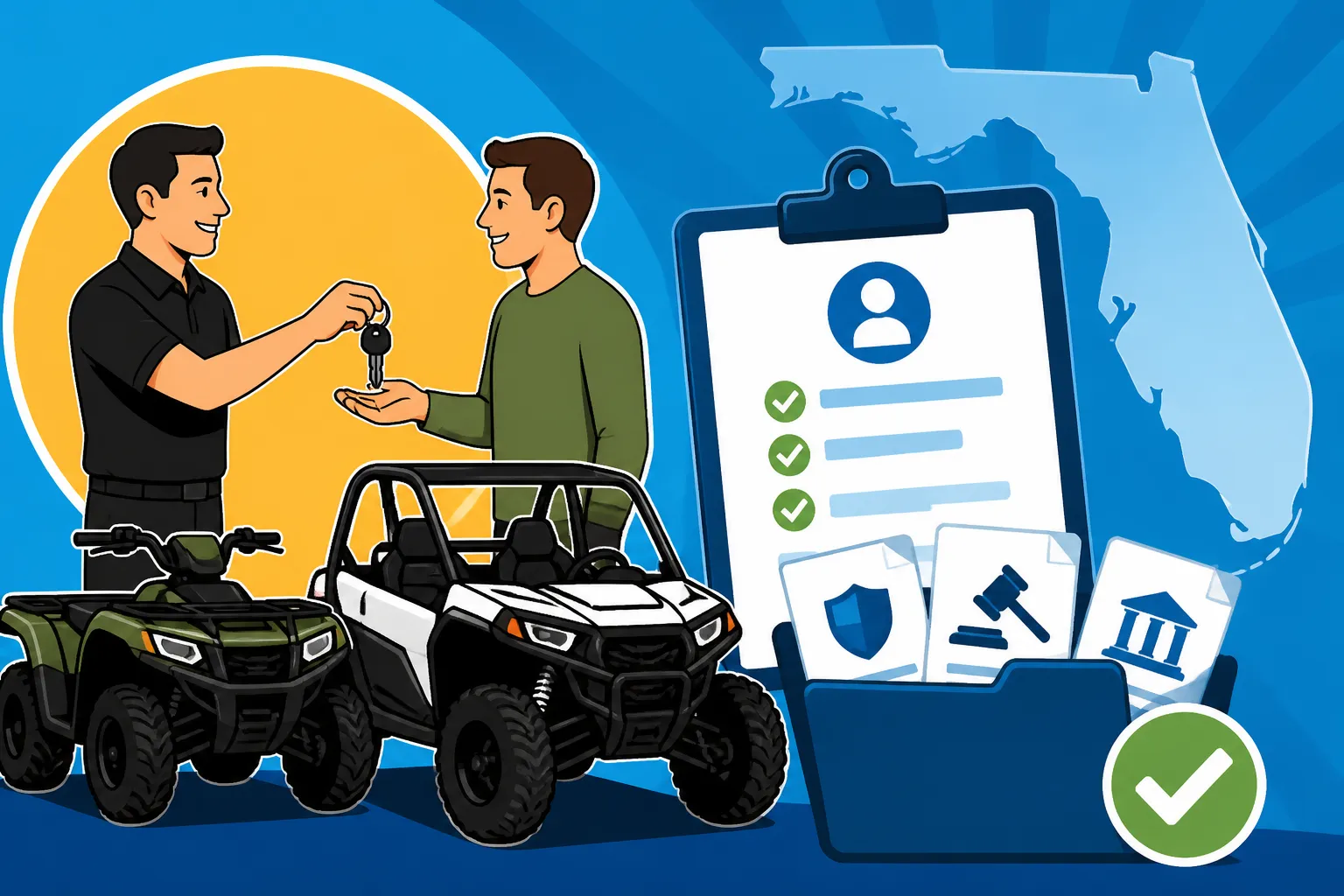
When you complete your purchase at a Florida ATV/UTV dealership, there's a stack of critical documents that change hands or are prepared by the dealer for submission. Understanding what these are and why they matter can help you feel more informed and confident about your purchase.
The Manufacturer's Certificate of Origin (MSO) or Existing Title
For a brand-new ATV or UTV, the most important document your dealer starts with is the Manufacturer's Certificate of Origin, or MSO. This document is essentially the "birth certificate" of your machine. It proves that the vehicle was manufactured and lists its specifications, including the Vehicle Identification Number (VIN). The MSO is crucial because it's the first step in establishing legal ownership for a new vehicle. Without it, your machine can't be titled in Florida. The dealer will endorse the MSO over to you and submit it to the state as part of your title application. If you're buying a used machine from a dealer, they'll be working with the previous owner's existing title, which they will then transfer into your name. This is similar to [Buying a Used ATV in Florida: Transferring the Title].
It's vital to ensure the VIN on your sales agreement matches the VIN on the MSO or existing title, as well as the physical VIN plate on your machine. This simple check can prevent significant headaches down the line. The dealer is responsible for accurately reporting this information to the state.
The Application for Certificate of Title
This is the big one: the application form for your Florida ATV or UTV title. While you'll sign it, the dealer will typically fill out most of the details. This form collects essential information about you (the new owner), the vehicle, and the sales transaction. It's where the purchase price, odometer reading (if applicable and accurate), and any lienholder information are recorded.
The dealer will ensure all fields are correctly populated, especially those pertaining to the vehicle's classification (ATV, UTV, ROV) and your personal details. They'll also include any required attachments, such as the MSO or the previous title. This form is the cornerstone of your titling process, and the dealer's careful completion significantly streamlines the path to receiving your official Florida OHV title. You can get more details on [Florida's ATV Title Application Explained].
Collecting and Remitting Sales Tax
One of the most significant benefits of buying from a dealer is that they handle the collection and remittance of Florida sales tax on your behalf. When you purchase an ATV or UTV, you are required to pay sales tax on the full purchase price (minus any trade-in value). The dealer collects this tax from you at the time of sale and then forwards it to the state. This saves you the step of having to calculate and pay the sales tax yourself when you go to the tax collector's office.
This is a critical function, as failure to pay sales tax can prevent you from titling your vehicle. The dealer acts as an agent of the state in this regard, ensuring that this important financial obligation is met. Knowing that this is taken care of gives many buyers peace of mind. For a deeper dive, check out [Florida Sales Tax When You Title an ATV].
Recording Liens and Other Encumbrances
If you financed your ATV or UTV purchase through the dealership or an outside lender, the dealer also plays a crucial role in ensuring that the lienholder's interest is properly recorded on your title. Florida uses an electronic lien and title system for most vehicles, including ATVs and UTVs. The dealer will submit the necessary information to the FLHSMV, indicating that there is a lien on your machine. This protects the lender by officially noting their financial interest until the loan is paid off.
Once your loan is satisfied, the lienholder will electronically release the lien, and the FLHSMV will then issue a clear title directly to you. This process is seamless when handled correctly by the dealer. Understanding this helps clarify [Florida ATV Title With a Lien Recorded].
Here's a quick overview of what your dealer typically handles:
| Document/Action | Dealer's Responsibility | Your Primary Role |
|---|---|---|
| Manufacturer's Certificate of Origin (MSO) / Previous Title | Endorse and submit to FLHSMV. | Verify VIN matches machine and sales contract. |
| Application for Certificate of Title (HSMV 82040) | Prepare, ensure accuracy, obtain your signature, and submit. | Review for accuracy, sign, provide ID. |
| Collection & Remittance of Sales Tax | Collect tax from you, forward to the state. | Pay the sales tax at time of purchase. |
| Recording of Liens | Submit lienholder information to FLHSMV for electronic recording. | Provide lender details if financing. |
| Issuance of Temporary Tag (if applicable) | Provide a temporary tag allowing you to legally move the vehicle before title arrives. | Display temporary tag as instructed. |
Understanding the Fees and Taxes Processed by the Dealer
Beyond the purchase price and sales tax, there are several other fees associated with titling an ATV or UTV in Florida. Your dealer will itemize these on your bill of sale and collect them from you at the time of purchase, then remit them to the state on your behalf. It’s important to understand what each of these fees covers, so you’re not caught off guard by the total cost.
Initial Title Application Fee
Every new title application in Florida comes with a fee. This is a standard charge that covers the administrative costs of processing your title and creating the official record of ownership. While the specific amount can fluctuate, it's a non-negotiable part of the titling process. Your dealer will collect this fee from you and submit it along with your title application. It's the cost of getting your name officially on the machine's "pink slip." For more on this, you might look into [The $29 Initial Title Application Fee Explained].
Sometimes, this fee might be combined with other service charges on your sales agreement. Don't hesitate to ask your dealer for a clear breakdown of all the fees associated with your purchase.
Service Charges and Expedited Options
In addition to the basic title fee, you'll often see a "service charge" or "processing fee" from the dealer. This typically covers the dealer's administrative costs for preparing and submitting all your paperwork to the FLHSMV or the local county tax collector's office. This isn't a state-mandated fee, but rather a charge for the convenience the dealer provides by handling the entire process. It's a common practice across the industry.
Florida also offers an "expedited" or "Fast Title" option for an additional fee. This service significantly speeds up the processing of your title, often allowing you to receive it in paper form much faster than the standard electronic title process. If you need a paper title quickly, perhaps for an out-of-state transfer or specific financing needs, your dealer can facilitate this for you by collecting the additional fee and submitting the request. Learn more about [Florida Fast Title for an ATV: The $7 Expedited Option]. While your dealer handles the actual filing, understanding what you're paying for, even with template forms from sites like LawDepot, can make you a savvier buyer.
Lien Recording Fees
As mentioned earlier, if you finance your ATV or UTV, there's typically a separate fee for recording the lien on your title. This ensures that the lender's interest is officially noted in the state's records. This fee is usually a small, standardized amount and is collected by the dealer along with the other title-related charges. It's part of the comprehensive cost of financing a new machine and is remitted to the state by the dealer.
What Happens After the Dealer Files the Paperwork?
Once your dealer has collected all the necessary documents, signatures, and fees, their job isn't quite finished. They still need to submit everything to the appropriate state agency. This final step officially kicks off the state's processing of your new title.
Submission to the Tax Collector's Office
In Florida, most vehicle titling and registration paperwork is processed through the local county tax collector's office. Your dealer will gather all the completed forms, the MSO or existing title, proof of sales tax paid, and all associated fees, and submit them to the tax collector. This submission can happen electronically or via physical mail, depending on the dealer's setup and the specific county office.
It's during this submission that the official clock starts ticking on your title application. The tax collector's office will review all the documentation to ensure accuracy and completeness before forwarding it to the FLHSMV for final processing. You can find out more about this in [Florida County Tax Collector vs Service Center for ATV Titles].
Processing Time for Your Florida Title
After the dealer submits your paperwork, there's a waiting period while the state processes your application. The FLHSMV aims to process titles efficiently, but the exact turnaround time can vary based on workload, time of year, and whether there are any issues with your application. Generally, if all paperwork is in order and you don't opt for a "Fast Title," you can expect an electronic title to be issued within a few weeks. If you requested a paper title, it would be mailed to you after the electronic record is established. For more on this, check out [Florida ATV Title Application Processing Time].
While your title is being processed, the dealer will often provide you with a temporary tag or a copy of your sales agreement. This allows you to legally operate your ATV or UTV for a limited period until your official title arrives. It's important to keep this temporary documentation with you when riding.
Receiving Your Official Title
Most Florida ATV and UTV titles are issued electronically. This means you won't receive a physical paper title unless you specifically request one (often with an additional fee) or if there's a lien recorded and subsequently released. With an electronic title, the ownership information is stored securely in the FLHSMV database. When you eventually sell your machine or need a copy for insurance purposes, you can request a paper title from the FLHSMV or your local tax collector's office. This is covered in [When a Florida Quad Title Is Electronic Only].
If you opted for a paper title, it will be mailed to the address provided on your application. Always double-check your mailing address on the sales contract and title application before you leave the dealership to avoid any delivery issues.
It's a huge relief to know that when you drive away from a Florida ATV or UTV dealer, much of the tedious paperwork is being handled for you. By understanding the dealer's responsibilities and the documents they file, you can feel confident that your new machine is legally titled, allowing you to focus on the thrill of hitting the trails.
Disclaimer
This article is for general informational purposes only and does not constitute professional advice. Laws, prices and regulations vary by location and change over time. Consult a qualified professional for guidance on your specific situation.