Fence Lines, Gates and Riding Etiquette
A narrow trail beside a fence can look like a shortcut, but it may cross private property, disturb livestock, or lead you onto a road where ATV access is restricted. In Florida, knowing where you may ride is only part of the job; how you approach fences and gates matters too. This guide explains practical ways to check access, handle gates, and ride considerately.
Check permission before you follow a fence line
A visible trail is not proof of access
A worn track beside a fence can be tempting, especially when it seems to connect two familiar roads or trails. But tire marks, an open gate, or a gap in the fence do not tell you who owns the land or whether riders have permission to use it. Someone may have left a gate open temporarily, or the route may be used only by the property owner, a utility crew, or a permitted land manager.
Treat the fence as a boundary, not as an invitation to ride alongside it. A fence line can run through private ranch land, a conservation area, or a mix of properties with different access rules. Florida’s rural areas can change quickly from a public road to private pasture or managed land, and a route that was open last season may not be open now.
Before setting out, confirm that your planned route is authorized. For public riding, check the managing agency’s current maps and notices. For private land, get clear permission from the owner or someone authorized to grant it. If you are uncertain, turn around rather than guessing. [Florida Trespass Law for ATV Riders] explains why riding onto land without authorization can create serious problems, even when the route looks established.
Ask specific questions about the route
A general “Can I ride here?” can leave important details unclear. Ask where you may enter, which trails or roads are included, whether the permission covers your ATV or UTV, and whether there are limits on dates, hours, passengers, or group size. If the owner says to stay on a particular side of a fence, follow that instruction even if another route looks easier.
It also helps to ask about gates, livestock, hunting activity, and temporary closures. A ranch road might be usable only when cattle are not being moved. A gate may need to stay shut because animals are in a particular pasture, or a landowner may close access during wet conditions to prevent ruts. Permission is most useful when both parties understand exactly what it allows.
For permission that may be questioned later, keep a written message or permission slip with you. It should identify the property or route as clearly as possible and state any conditions the owner gave you. Written permission is not a substitute for following posted rules or local law, but it can prevent confusion about whether you were invited onto the property. [Ranch Easements and Written Permission] offers more detail on why clear permission matters.
Handle gates carefully and leave them as you found them
Stop and assess before opening a gate
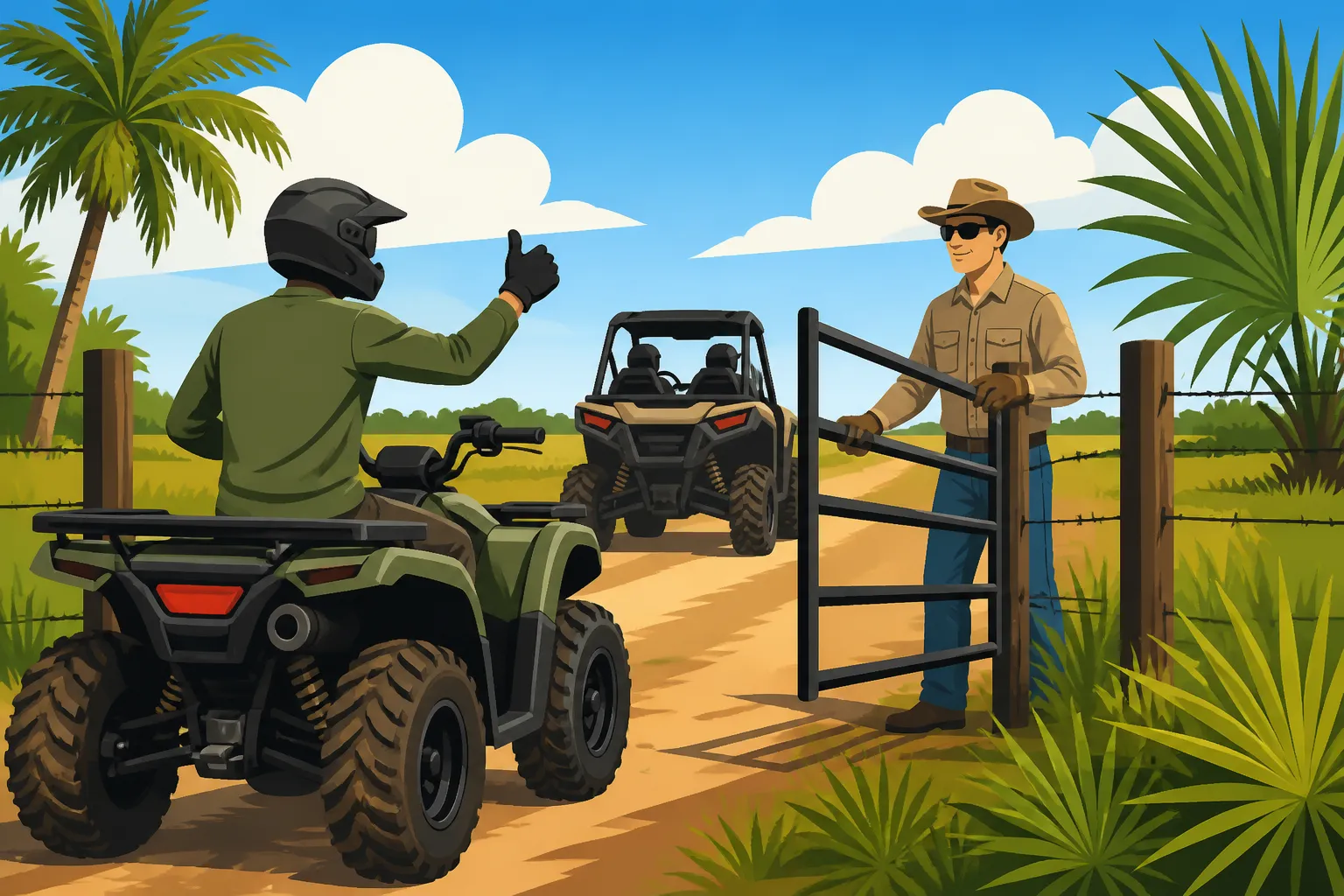
When you reach a gate, stop well before it. Look for signs, locks, livestock, people, and other vehicles. Check whether the gate has instructions, such as a request to close it immediately or a notice that access is prohibited. Don’t assume that an unlocked gate is meant for recreational riders, and never cut a chain, climb a fence, or force a gate to continue your ride.
If you have permission and are expected to use the gate, approach slowly and keep your machine under control. A UTV’s size can make a tight gate awkward, while an ATV may require you to dismount to open it safely. Park where you are not blocking the entrance or the roadway, and keep children and passengers clear of moving parts and the gate’s swing path.
Take a moment to notice how the gate is secured before touching it. Some gates use a simple latch; others may have a chain or a specific arrangement intended to keep animals in or out. If you cannot figure out how it should be operated, or if the gate appears damaged, contact the property owner rather than improvising. The route is not worth risking an escape, injury, or property damage.
Close the gate exactly as instructed
A useful rule is to leave a gate in the same condition you found it, unless the landowner has given you a different instruction. If it was closed and latched, close and latch it again. If it was open, don’t automatically close it: the owner may have left it open deliberately for livestock movement or another reason. When in doubt, ask before your ride or call the person who granted permission.
Make sure the latch is fully engaged before moving on. A gate that looks closed but is not secured can swing open in wind or when an animal pushes against it. On a group ride, tell the next rider whether the gate needs to remain open or be closed, and don’t leave that decision to someone who may not have heard the landowner’s instructions.
Be especially cautious when cattle, horses, or other animals are nearby. Move slowly, avoid sudden revving, and give animals room to move away. Don’t chase them or try to herd them with your machine. On a ranch road around places such as Okeechobee’s agricultural country, a quiet, patient approach is more considerate and often safer than trying to hurry through. [Fence Lines, Gates and Riding Etiquette] is a useful topic to revisit with everyone in your group before a ride.
Ride respectfully near fences, farms, and neighbors
Protect fences, land, and livestock
Keep a safe distance from fences rather than riding directly against them. A tire can catch wire, a handlebar can snag a post, and a UTV can damage a fence simply by brushing it. Turning around or passing through an authorized gate is better than squeezing through a narrow opening or making a new gap. Never move fence posts or wire to create a route.
Avoid spinning tires near fence corners, gates, or soft ground. Florida’s sandy soil can rut quickly, and wet ground near pastures, drainage areas, and low spots can be particularly vulnerable. A damaged track may channel water, undermine a fence post, or leave the property owner with a repair. If a section of trail is muddy or badly rutted, use an approved alternate route or turn back rather than widening the damage.
Keep noise and speed down around homes, barns, animals, and workers. A loud approach can startle livestock or people who are not expecting a machine. If you see someone working, slow down, give them space, and wait for a clear signal before passing. Accessories such as handguards or protective components from SuperATV may help protect a machine on brushy routes, but equipment cannot make an unauthorized shortcut or close pass acceptable.
Do not treat a fence line as a public road
Some riders use a fence as a navigation aid, then assume the track beside it is a public road. That assumption can lead to trespass or an unsafe road crossing. A fence may mark a property boundary without indicating where public access begins or ends. Even when a fence follows a roadway, the land on either side may have separate rules.
If your route reaches a road, stop and confirm that ATVs or UTVs are permitted there before proceeding. Florida road access depends on the type of road and local rules; an unpaved surface is not automatically open to off-highway vehicles. Check the route rather than relying on another rider’s tracks or a navigation app alone. [Florida County ATV Opt-Outs: Why Rules Change at the Line] and [Florida ATV Road Rules by County] can help explain why access may change from one jurisdiction to another.
Don’t ride along a fence to avoid an official trail checkpoint, a closed entrance, or a posted restriction. If a route is closed, respect the closure and find an authorized alternative. [Florida Trespass Law for ATV Riders] and [Private Dirt Roads and Florida ATV Law] provide helpful context when a route appears usable but its legal status is unclear.
Use a simple pre-ride routine
Plan the route and brief your group
Before the ride, identify the trailhead, authorized routes, property boundaries, and any gates. Use the land manager’s information or confirm the route with the landowner. Save a map for offline use if cell reception may be unreliable, but treat it as a planning aid rather than proof that every track is open. [Carrying Proof of Ownership on the Trail] covers another practical piece of preparation for riding on public land.
Agree on what the group will do if it reaches a closed gate, unclear boundary, or unexpected livestock. A simple rule—stop, regroup, and confirm access—keeps one rider from making a decision that puts everyone in a difficult position. Make sure the lead rider passes along gate instructions, and have the last rider check that any gate was left as directed.
| Situation | Safer response |
|---|---|
| Gate is closed and access is unclear | Stop and confirm permission before proceeding |
| Gate was open when you arrived | Leave it as found unless the owner instructed otherwise |
| Gate must be opened with permission | Follow the owner’s instructions and secure it afterward |
| Livestock are near the route | Slow down, avoid startling them, and give them room |
| Fence is damaged or the latch will not secure | Don’t improvise; contact the owner or land manager |
| Route reaches a public road | Verify that ATV or UTV access is allowed before entering |
Know when to turn around
Turning back is the right call when permission is uncertain, a route is blocked, a gate is locked, or posted signs conflict with what you were told. It can feel frustrating after hauling a machine to a trailhead or riding a long way, but pushing ahead can create property damage, a confrontation, or a citation. Protecting access for other riders starts with not making a questionable situation worse.
If you accidentally damage a gate or fence, stop and report it to the owner or land manager. Don’t leave the problem for the next person, and don’t attempt a repair unless the owner asks you to. A prompt, honest report gives the person responsible a chance to secure livestock and arrange a proper fix.
The same principle applies when a route becomes unsafe. Deep mud beside a fence, poor visibility, nearby animals, or a narrow gate that cannot be navigated without scraping are good reasons to pause and reconsider. A winch or other recovery equipment from a supplier such as SuperATV may be useful when a machine is stuck on an authorized route, but it should not be used to pull through a barrier or cross land without permission. Respecting boundaries, gates, and people is part of being a welcome guest on Florida trails and rural roads.
Disclaimer
This article is for general informational purposes only and does not constitute professional advice. Laws, prices and regulations vary by location and change over time. Consult a qualified professional for guidance on your specific situation.