Reporting Illegal Riders on Conservation Land
Illegal ATV and UTV riding on conservation land can damage habitat, disturb wildlife, and make trails less safe for everyone. But access rules vary by property, and a machine on a trail is not automatically breaking the law. This guide explains how to check the rules, report a concern safely, and give land managers useful information.
Confirm the riding may be unauthorized
Identify who manages the land
“Conservation land” can mean a wildlife management area, state forest, water management district property, national forest, or another protected area. Each may have different routes, seasonal closures, permits, and enforcement contacts. Before reporting a rider, try to establish the property name and land manager. Signs at entrances, trailheads, kiosks, and access roads may identify the agency.
Rules can also vary within one property. A route may be open to certain vehicles while a nearby habitat area, fire road, or seasonal trail is closed. Some places permit motorized use only on designated roads; others prohibit it or require a pass. Check the land manager’s official map or access information if you can do so without entering a restricted area. [Florida Conservation Land Riding Permission] and [Florida WMA Rules for ATV Riders] explain why permission depends on the type of land and its rules.
Do not rely only on what another rider says, an old social-media post, or tire tracks on the ground. Tracks show that someone has ridden there; they do not prove that the route is open. Likewise, an ATV or UTV with lights, a license plate, or aftermarket equipment is not necessarily authorized to ride on that property.
Separate a rule violation from a disagreement
A rider may be using a lawful route even if the route looks unofficial or unfamiliar to you. Conversely, a route that appears established may be closed, private, or restricted during a particular season. Look for clear indicators such as posted closure signs, barriers, marked boundaries, or an official map showing that motorized use is not permitted.
If the question is whether a machine needs a pass or whether a particular road is open, look up the property’s rules before making a report. [Florida Riding on Public Land: Permits and Proof] covers the kinds of requirements riders may need to check, while [Florida Water Management District Riding Permits] is relevant when the land belongs to a water management district. For hunting areas, access rules can be especially different from those on a public OHV trail, so review [Florida Hunting Land Access for ATV Riders].
When you cannot tell whether a rule is being broken, report the concern as an observation, not a proven violation. For example, say that you saw a group riding beyond a posted gate and ask the manager to determine whether access was permitted. That is more useful—and fairer—than publicly accusing a specific person based on incomplete information.
Make a safe and useful report
Choose the right contact
For an immediate threat to someone’s safety, an active crash, fire, or situation that appears to require urgent police or medical assistance, contact emergency services. Do not approach riders or place yourself in the middle of an unsafe situation to get a better look.
For a non-emergency access concern, contact the agency responsible for the property. That may be the Florida Fish and Wildlife Conservation Commission for a wildlife area, the Florida Forest Service for a state forest, a water management district, or the relevant federal land agency. If the responsible manager is unclear, a local law enforcement agency may be able to direct you to the appropriate office. Use the agency’s official contact information, since reporting channels can differ by property and type of incident.
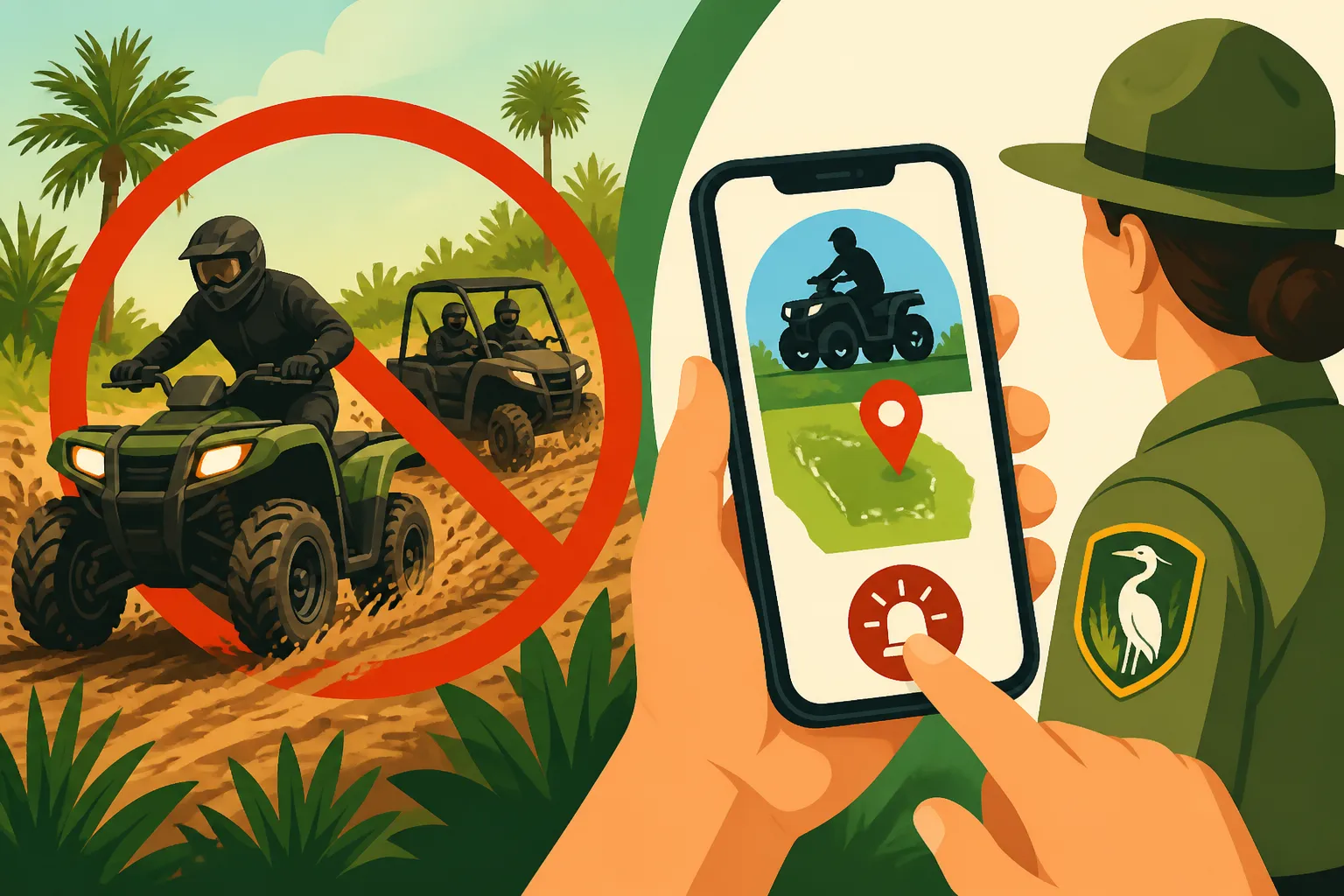
If the concern involves wildlife, suspected poaching, or deliberate harm to animals, the Florida Fish and Wildlife Conservation Commission’s Wildlife Alert reporting channel may be appropriate. For other access issues, the property manager may be better placed to check maps, closures, gates, and permits. A clear report to the right agency is more likely to reach someone who can investigate than a general complaint posted online.
Share facts, not guesses
A useful report gives the agency enough information to locate and assess the incident. Include details such as:
- The property name, trail, road, entrance, or nearby landmark
- The date and approximate time
- The direction the riders were traveling
- The number and general type of machines, such as ATV, UTV, or dirt bike
- What you directly observed, such as riding past a closed gate or leaving a marked trail
- Whether there was apparent damage, a collision, a fire, or a risk to other visitors
- Any relevant sign, gate, or boundary marker you saw
If you do not know the exact trail name, describe how to reach the location from a recognizable entrance or road. A report saying “near the north entrance, past the first marked junction” can be more actionable than “somewhere in the woods.” Avoid adding details you did not personally see. If you are unsure whether a gate was closed or a sign applied to that route, say so.
Record evidence without putting yourself at risk
If you can safely note identifying details, do so from a lawful public location. A general description of the machines, clothing, travel direction, and group size may help distinguish one report from another. A photograph can be useful when it is taken safely and lawfully, but getting close, stepping onto a restricted route, or following riders to capture a plate or face is not worth risking injury or creating a second access problem.
Do not touch a machine, move a barrier, block a trail, or attempt to detain anyone. Do not follow the group into remote terrain or confront riders who may be armed, impaired, or traveling at speed. If the riders have already left, report the time and direction they went rather than trying to track them yourself.
Keep the original notes and images intact if you submit them. Avoid editing a photo in a way that changes what it shows, and do not post identifying images or accusations publicly. A direct report to the responsible agency gives staff a chance to review the information and decide what action is appropriate.
| What to include | Helpful example | What to avoid |
|---|---|---|
| Location | Property name, entrance, trail marker, or nearby road | A vague description with no way to find the spot |
| Time | Approximate time and date | Guessing an exact time you did not record |
| Activity | “Three UTVs crossed a posted closure” | “They were definitely criminals” |
| Machine details | General color, type, number, and direction of travel | Risky close-up attempts to identify riders |
| Evidence | Original photos taken from a safe, lawful place | Altered images or public accusations |
| Safety concern | Fire, injury, habitat damage, or dangerous speed | Treating a routine access question as an emergency |
What to do after submitting a report
Give the agency room to assess it
Once you have made a report, the agency may need to check its maps, verify the property boundary, review a closure notice, or determine which rules applied at that time. Staff may not be able to share details about an investigation or enforcement action. A lack of visible follow-up does not necessarily mean the report was ignored; the agency may be handling it through a process you cannot see.
If you discover a concrete correction—such as the trail name, entrance, or time—send it through the same reporting channel and refer to your original report if you have a reference number. Keep follow-up factual and concise. Repeatedly contacting multiple agencies with the same unverified claim can make it harder to identify who is responsible.
If the first contact says the property belongs to another agency, ask which office handles access concerns there. Then forward your observations to that office rather than assuming the first person will transfer the report. Land boundaries can be complicated, especially around easements, leased land, and adjoining public parcels.
Avoid trying to enforce the rules yourself
It is tempting to block a trail, remove a sign, take keys, or argue with riders who appear to be damaging land. Those actions can escalate a situation and may expose you to injury, trespass claims, or other problems. Leave enforcement to the land manager and law enforcement. If you are a rider who finds an unfamiliar closure, turn around and confirm the route rather than treating the absence of a barrier as permission.
If you regularly visit a conservation area, learn its authorized routes before your next trip. Keep a current map available, note seasonal closures, and check whether you need a permit or pass. [Florida OHV Trails: Every Public Riding Area] can help distinguish designated riding areas from places where motorized access may not be allowed. For general trail behavior that helps reduce conflicts, see [Florida OHV Trail Etiquette Locals Expect].
Land managers may rely on reports to identify recurring problems, damaged signs, or places where riders are entering through an open gate or informal path. The most helpful report is calm, specific, and limited to what you observed. It gives the agency a starting point without putting you—or anyone else—in unnecessary danger.
Common reporting questions
Should I report every ATV I see on conservation land?
No. First check whether the property allows motorized use and whether the machine is on an authorized route. Some conservation properties include designated roads or OHV areas, while nearby sections may be closed. If you cannot confirm a violation, describe what you saw and ask the land manager to verify the applicable rule.
What if the riders leave before I can get details?
Report the location, approximate time, number and type of machines, and direction of travel. Even a general description can help staff compare the incident with other reports. Do not follow the riders to obtain more information.
Can I post a photo or video online to identify them?
A direct report to the responsible agency is usually the safer first step. Public posts can misidentify people, expose personal information, or inflame a dispute before the facts are checked. Preserve the original material and let the agency decide whether it is useful.
What if I am not sure who owns or manages the land?
Use the signs or official property information available at the entrance, and contact the agency named there. If there is no clear sign, describe the nearest road, gate, or landmark when you ask for help identifying the manager. Do not cross a fence or enter a restricted area to investigate ownership.
What if the riding has caused damage?
Describe the visible damage and its location, and note whether there is an immediate safety issue. Do not disturb the site or attempt repairs unless an authorized official asks you to do so. If there is an active fire, serious injury, or immediate danger, contact emergency services rather than waiting for a routine land-management response.
Disclaimer
This article is for general informational purposes only and does not constitute professional advice. Laws, prices and regulations vary by location and change over time. Consult a qualified professional for guidance on your specific situation.