Golf Cart Tunnels Under The Villages, Florida
It's easy to feel a little lost and perhaps even a bit frustrated when you're trying to figure out the complex world of Florida's off-highway vehicle laws, especially when you see communities with their own unique transportation ecosystems. You might drive through a place like The Villages, marvel at the sheer number of golf carts, and spot those intriguing tunnels, immediately wondering if your ATV or UTV could be part of that convenient network. It's a natural question to ask: if golf carts can navigate these specific community pathways, why can't my trusty quad or side-by-side? This guide is here to clear up the confusion, explaining exactly what those famous golf cart tunnels are for, who can use them, and why your ATV or UTV likely won't be able to share the same path. We'll dive into the specific rules that govern golf carts versus off-highway vehicles in Florida, particularly within a community like The Villages.
Understanding The Villages' Unique Transportation Landscape
The Villages, Florida, is renowned for its distinctive approach to community design, heavily favoring golf carts as the primary mode of internal transportation. This isn't just a quirky preference; it's a deeply integrated system that defines daily life for its residents. Understanding this unique landscape is crucial to grasping why certain vehicles are welcomed and others, like your ATV or UTV, are not.
The Golf Cart as the Primary Mode of Transport
Imagine a community where you can do almost everything – grocery shopping, doctor's appointments, dining out, and visiting friends – all without ever touching the keys to your car. That's the reality for many residents in The Villages. Golf carts aren't just for the links here; they are a fundamental part of the transportation infrastructure. There's an extensive network of golf cart paths, designated lanes, and even specific parking areas designed exclusively for these low-speed vehicles. This system fosters a highly social, active, and convenient lifestyle, reducing reliance on traditional automobiles within the community's sprawling footprint.
The sheer prevalence of golf carts means that the entire infrastructure, from pathways to parking and even the tunnels we're discussing, is meticulously designed to accommodate their specific size, weight, and speed. For residents, this means less traffic congestion from cars, easier access to amenities, and a more relaxed pace of life. It’s a carefully crafted environment where the golf cart reigns supreme, creating a distinct experience that sets The Villages apart. If you're coming from an area where ATVs and UTVs are primarily recreational off-road vehicles, seeing the integration of golf carts can definitely spark curiosity about where your machine fits in. You might even want to check out [Florida Golf Cart Laws vs ATV Laws] to see how different they truly are.
The Role of Golf Cart Tunnels in Connectivity
At the heart of The Villages' golf cart-centric design are its numerous golf cart tunnels. These aren't just decorative features; they are critical pieces of infrastructure engineered to solve a very specific problem: how to safely and efficiently move golf cart traffic across major, often busy, roadways. Think of them as dedicated underpasses, allowing golf carts to seamlessly transition from one part of the community to another without ever interacting with higher-speed car traffic on the surface.
Their purpose is paramount: safety and convenience. Without these tunnels, golf cart operators would face repeated stops, waits, and potentially hazardous crossings at intersections with cars and trucks. The tunnels provide an uninterrupted flow, enhancing both the safety of golf cart riders and the overall efficiency of traffic within the community. They prevent golf cart paths from dead-ending at arterial roads, effectively weaving the expansive community together into a cohesive whole. From a design perspective, these tunnels are a stroke of genius, enabling the seamless, low-stress movement that is so characteristic of The Villages.
Navigating Golf Cart Tunnels: Rules and Realities
While the golf cart tunnels in The Villages offer unparalleled convenience for residents, their accessibility is strictly defined by the type of vehicle. It’s easy to look at a golf cart and then look at a compact UTV and think they’re similar enough, but legally and practically, there are crucial differences that dictate who can and cannot use these tunnels.
Who Can Use the Tunnels? Defining "Golf Cart"
The critical distinction lies in the legal definition of a "golf cart" in Florida. Generally, a golf cart is defined as a motor vehicle that has at least three wheels, an unloaded weight of less than 1,300 pounds, and is designed to be operated at speeds of no more than 20 miles per hour. This definition is key because it establishes the parameters for vehicles permitted on golf cart paths and, by extension, within the tunnels of The Villages.
ATVs and UTVs, while often capable of low speeds, typically fall outside these parameters. Most ATVs are designed for off-road performance, not community navigation. Many UTVs, or side-by-sides, can exceed the 20 mph speed limit, often weigh more than 1,300 pounds, and are wider than a standard golf cart. Even smaller UTVs, while seemingly comparable in size, often have engines designed for greater power and speed, pushing them out of the "golf cart" classification. The tunnels, with their specific width and height clearances, are built precisely for golf carts, not for the often larger, heavier, or faster profile of a UTV.
Therefore, while your UTV might have turn signals and a horn, modifications alone don't change its fundamental classification. Even if you've added some fantastic accessories from a brand like SuperATV to enhance your UTV's functionality or appearance, those upgrades are unlikely to transform it into a street-legal golf cart for The Villages' unique infrastructure. The regulations are in place to maintain the integrity and safety of the golf cart path system. Trying to squeeze a wider UTV, designed for rugged terrain and higher speeds, into an environment made for a golf cart creates both a legal issue and a potential safety hazard. For more context on vehicle classes, you might find [Florida Low-Speed Vehicle Rules for Side-by-Sides] helpful, as LSVs are a distinct category from golf carts and ATVs.
Safety and Etiquette Within the Tunnel System
Operating a golf cart within The Villages' tunnel system comes with its own set of rules and expected etiquette, all designed to ensure smooth and safe passage. For instance, golf cart operators are expected to maintain a reasonable speed, often well below the 20 mph maximum, particularly in tunnels where visibility might be limited or traffic heavy. Headlights are required at all times, even during daylight hours, to ensure visibility for all users. Right-of-way rules are generally common sense, prioritizing safety over speed.
The design of these tunnels, with their relatively narrow passages and sometimes sharp curves, reinforces why ATVs and UTVs are unsuitable. Their wider stances and potentially higher speeds could easily lead to collisions or blockages. The infrastructure simply isn't engineered to handle the varied characteristics of off-highway vehicles, which often have different turning radii, braking capabilities, and operator sightlines than golf carts. Imagine the chaos and danger if a high-horsepower UTV, even one equipped with street-legal accessories for broader road use, tried to navigate a tunnel designed for a leisurely-paced golf cart. The entire system would be compromised, defeating its purpose of enhancing safety and flow.
ATV and UTV Road Rules in Florida (and The Villages)
It's a common misconception that because golf carts have dedicated pathways, ATVs and UTVs might enjoy similar privileges. However, the legal frameworks for these vehicle types are vastly different in Florida, and particularly within a highly regulated community like The Villages. Understanding these distinctions is crucial for any ATV or UTV owner in the Sunshine State.
Why ATVs and UTVs Aren't Like Golf Carts on Florida Roads
The most important thing to grasp is that in Florida, ATVs and UTVs are generally classified as off-highway vehicles (OHVs). This means their primary intended use is off-road, not on public streets or highways. Unlike golf carts, which are designed for community travel at low speeds, ATVs and UTVs are built for tackling diverse terrain, from sandy trails to muddy bogs. While some UTVs might resemble a small car, their engineering and legal status place them firmly in the off-road category.
Florida law is quite clear: ATVs and UTVs are largely restricted from paved public roads. There are very specific, limited exceptions, such as crossing a highway (at a 90-degree angle, with specific safety precautions), or riding on designated unpaved county roads if the county specifically permits it. Even then, riders usually need to be licensed drivers, wear helmets if under 16, and operate during daylight hours. This is a far cry from the free-wheeling golf cart access seen in The Villages. If you're feeling confused about the specifics, resources like [Are ATVs Street Legal in Florida?] and [Florida ATV Road Rules: Where You Can Legally Ride] can provide a lot more detail on these restrictions. It's a fundamental difference: one is designed and legally permitted for community roads, the other for trails and private land.
The Villages' Stance on ATVs and UTVs
Given The Villages' unique infrastructure and its prioritization of golf cart traffic, it should come as no surprise that ATVs and UTVs are typically not permitted on golf cart paths, tunnels, or even most internal community roads. The local ordinances and community rules within The Villages are designed to maintain a specific environment, and that environment does not include off-highway vehicles. Attempts to ride an ATV or UTV on these pathways would not only violate community rules but could also lead to citations from local law enforcement, as these machines don't meet the legal definition of a golf cart or a street-legal vehicle for those areas.
While you might have seen UTVs from a company like SuperATV that have been customized with turn signals, mirrors, or even windshields, making them appear more "street-ready," these modifications alone do not grant them access to golf cart paths or tunnels in The Villages. Such accessories are fantastic for making a UTV safer and more versatile for permitted road use (like crossing a highway or on specific unpaved roads), but they don't magically transform the vehicle's legal classification within a community that has its own specific rules. The focus in The Villages is on maintaining a quiet, low-speed, golf cart-centric atmosphere, and ATVs and UTVs, by their very nature and design, simply don't fit that mold. For a specific deep dive into this, consider reading [What ATVs Cannot Do on The Villages Cart Paths].
Alternatives for ATV/UTV Riders in Florida
For those of us who love our ATVs and UTVs, realizing that communities like The Villages are off-limits can be a bit of a letdown. However, Florida is a vast state with a vibrant off-roading scene that caters specifically to these machines. There are plenty of fantastic alternatives where you can legally and safely enjoy your off-highway vehicle without running afoul of local ordinances or state laws.
Public Land Riding Opportunities
While The Villages' golf cart tunnels might be a no-go, Florida boasts an impressive array of public lands specifically designated for ATV and UTV riding. These areas offer diverse terrains, from sprawling sand hills to challenging mud bogs, ensuring there’s something for every type of rider. Places like the Ocala National Forest, with its extensive network of trails, or the Croom Motorcycle Area in the Withlacoochee State Forest, are prime destinations. These managed parks and forests provide designated trails, often with amenities like parking, restrooms, and even camping options.
Venturing into these areas means you're operating within the legal and intended environment for your machine. You'll find other enthusiasts, well-maintained trails, and the freedom to truly experience what your ATV or UTV was built for. Remember that most public riding areas require an OHV pass and may have age restrictions or helmet requirements, especially for younger riders. Always check the specific rules of any park or forest before you head out. These experiences are a far cry from the manicured paths of The Villages, offering genuine adventure and exhilaration. For planning your next adventure, be sure to check out guides like [Ocala National Forest ATV Trails in Florida] and [Croom Motorcycle Area: Florida's Biggest OHV Park].
Considering Street-Legal Conversions (and Their Limits)
Some UTV owners, keen to expand their machine's usability, explore the possibility of converting their side-by-side into a Low-Speed Vehicle (LSV) in Florida. An LSV is a street-legal vehicle with a top speed between 20 and 25 mph, equipped with specific safety features like headlights, taillights, turn signals, seatbelts, and a VIN. While converting a UTV to an LSV is a complex process involving inspections and proper titling, it can allow a UTV to be driven on public roads with posted speed limits of 35 mph or less.
However, it's critical to understand the limitations. An LSV is not a golf cart, and even a street-legal UTV classified as an LSV would still generally be prohibited from golf cart paths and tunnels in communities like The Villages. LSVs must abide by traffic laws just like cars, meaning they can't dart through golf cart-specific underpasses. The conversion process is an investment in time and money, and while it opens up certain public roads, it doesn't grant universal access or magically change local community rules about golf cart paths. So, while aftermarket kits from companies like SuperATV might offer components for such a conversion, these parts facilitate compliance with LSV standards, they don't grant permission to use golf cart tunnels. The distinction between an LSV, a golf cart, and an ATV/UTV is crucial, and you can learn more about it in [Florida Side-by-Side Street Legal Conversion Cost] and [Is a UTV Street Legal in Florida?].
This table helps illustrate the key differences between these vehicle types and their general road access in Florida:
| Feature | Golf Cart | ATV/UTV (Off-Highway Vehicle) | Low-Speed Vehicle (LSV) |
|---|---|---|---|
| Primary Use | Community/Golf Course | Off-road recreation/Utility | Street-legal, low-speed travel |
| Max Speed (Typical) | Up to 20 mph | Varies (often much higher) | 20-25 mph |
| Road Access | Designated golf cart paths, low-speed roads | Limited to specific unpaved roads, trails | Public roads with speed limits ≤ 35 mph |
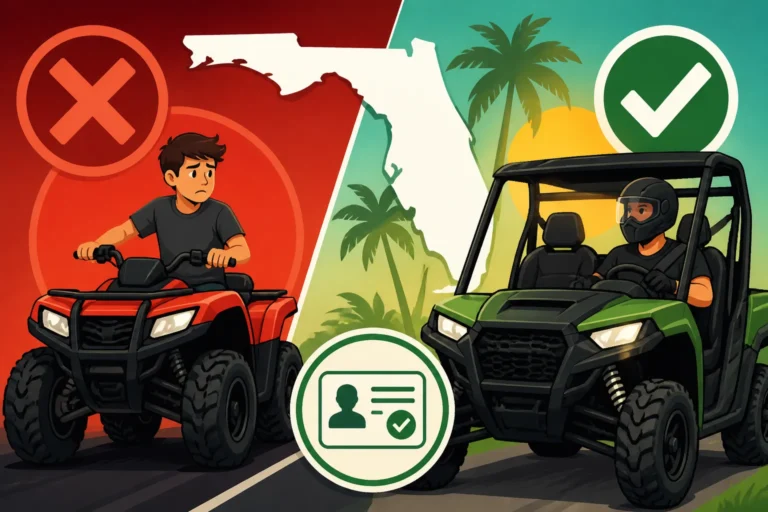
| The Villages Tunnels | YES | NO | NO |
| Registration/Title | Not typically titled/registered | Titled (OHV title) | Titled & Registered |
| Safety Equipment | Basic | Helmets (under 16), eye protection | Headlights, turn signals, seatbelts, etc. |
| Driver's License Req. | Varies by location/age ([Florida Golf Cart Age Law Since October 2023]) | Yes (for public road use) | Yes |
Ultimately, while the idea of cruising through golf cart tunnels on your ATV or UTV in The Villages might sound appealing, the reality is that these specific amenities are reserved for golf carts. Florida's laws and local community regulations clearly differentiate between these vehicle types, ensuring that each operates safely and appropriately within its designated environment. For ATV and UTV enthusiasts, the vast public lands and trails across the state offer unparalleled opportunities to ride, providing the adventure and freedom these machines were truly designed for.
Disclaimer
This article is for general informational purposes only and does not constitute professional advice. Laws, prices and regulations vary by location and change over time. Consult a qualified professional for guidance on your specific situation.