Can You Carry a Passenger on a Single-Rider Quad?
It's completely understandable to want to share the thrill of tearing up Florida's trails and backroads with a friend, family member, or partner. There’s something special about experiencing the adventure together. But when you look at your trusty quad, designed for one, you might wonder, "Can I just squeeze someone on behind me?" This is a really common question, and honestly, the answer isn't always what riders want to hear, especially here in Florida. This guide is going to dive deep into Florida's specific rules and, more importantly, the crucial safety implications of carrying a passenger on an ATV that was built for a single rider.
The Design Philosophy of a "Single-Rider" Quad in Florida
Before we even get to the law, let's talk about what an ATV is meant to be, at least in the eyes of its manufacturer and, by extension, Florida's statutes. Most ATVs you see out there, the classic four-wheeler, are designed with a very specific purpose and rider in mind: one person, in control, navigating challenging terrain.
What Florida Law Says About Machine Design
In Florida, the legal definition of an all-terrain vehicle (ATV) often hinges on how the machine was originally designed and equipped by the manufacturer. This isn't just a technicality; it's fundamental. When a manufacturer designs an ATV, they engineer it to safely carry a certain load and distribute weight optimally for a single rider. This involves everything from the frame's strength to the suspension tuning, the braking system's capacity, and even the ergonomics of the seat and handlebars.
The law isn't interested in what modifications you might make or what "feels" safe to you in your backyard. It's focused on the original intent and engineering. So, if your ATV left the factory with a single, saddle-style seat and no dedicated footrests for a second person, Florida considers it a single-rider machine. It doesn't matter if you bolt on a buddy seat or rig up some extra footpegs; the core design for safe two-person operation simply isn't there. This distinction is crucial because it forms the very basis of why you often cannot carry a passenger. For more on how Florida defines these machines, you might want to read up on [Florida's 55-Inch ATV Definition and Why It Matters].
Why Most ATVs Are Not Designed for Passengers
Think about how you ride an ATV. You shift your weight, lean into turns, stand up over bumps, and use your body as an integral part of controlling the machine. Now, imagine trying to do all of that with another person perched behind you. The entire dynamic changes drastically.
- Center of Gravity: Adding a passenger, especially one not actively participating in the ride's physics, significantly raises and shifts the machine's center of gravity. This makes the ATV much more prone to tipping, particularly during turns, climbs, or traversing side slopes. What was once a stable machine for one becomes a wobbly, unpredictable handful for two.
- Suspension and Braking: The suspension system on a single-rider ATV is tuned for one rider's weight. Add a second person, and you instantly overload it. The suspension will bottom out more easily, losing its ability to absorb impacts and keep the tires in contact with the ground. Similarly, the brakes are designed to stop a certain amount of mass. Doubling that mass means much longer stopping distances and increased brake fade, which could be disastrous in an emergency.
- Steering and Control: With a passenger, the front wheels can become light, making steering less precise and harder to control. The added weight at the back can also make the machine prone to wheelies on acceleration, or even flip backward on steep inclines if the weight distribution isn't managed perfectly—which is nearly impossible with an inexperienced passenger.
Many aftermarket companies, like SuperATV, offer fantastic upgrades for performance and utility, but none can fundamentally alter a single-rider ATV's safety profile to legally or safely carry a second passenger if it wasn't designed for it from the factory. The physics just don't allow it.
Florida's Rules on Carrying Passengers on ATVs
Now that we understand the design realities, let's get into the brass tacks of what Florida law actually permits when it comes to riding two-up on an ATV. The state has clear regulations in place, primarily driven by safety concerns.
The Statute and Its Specific Language
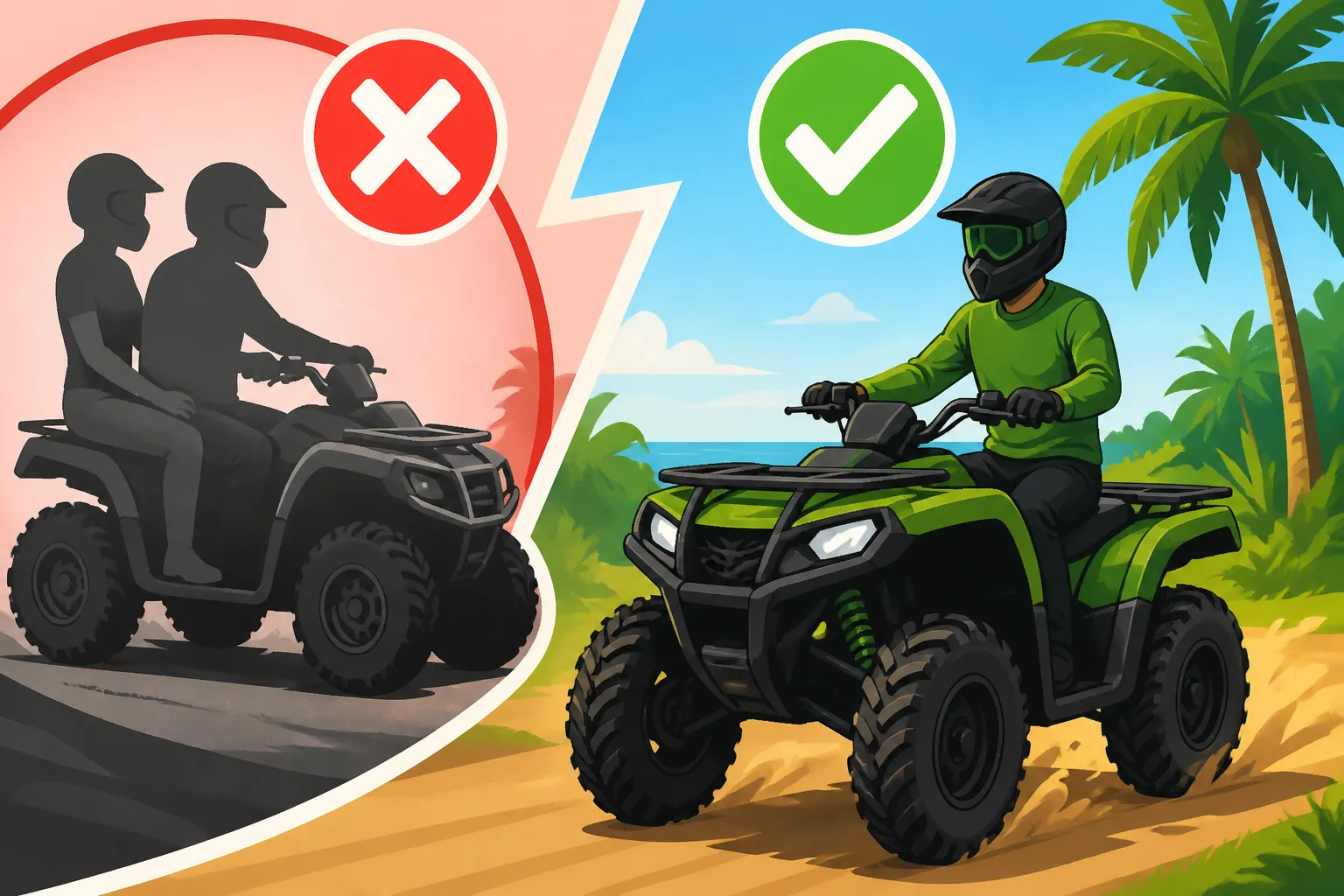
Florida Statute 316.2074, which governs the operation of all-terrain vehicles, is pretty unambiguous on this matter. Specifically, subsection (1)(a) states that an ATV "may not carry a passenger unless the ATV is designed by the manufacturer to carry more than one person."
This single sentence is the cornerstone of the entire issue. It doesn't say "unless you think it's safe" or "unless you've added extra seating." It explicitly refers back to the manufacturer's design. If your ATV rolled off the assembly line as a single-rider model, then carrying a passenger on it on public lands, trails, or any regulated area in Florida is against the law. This rule applies equally to adults and minors. Law enforcement, whether it's a county sheriff's deputy or a forest ranger, will be looking for this specific design feature. You can find more details on this topic in [Florida ATV Passenger Rules].
The intent behind this statute is pure safety. The state wants to minimize accidents and injuries associated with improper ATV use. When you're out there, whether it's at Croom Motorcycle Area or enjoying some less formal riding, compliance with these rules isn't just about avoiding a ticket; it's about protecting everyone involved.
Exceptions and Designated Two-Rider Quads
So, does this mean you can never ride two people on an ATV in Florida? Not entirely. The critical phrase is "unless the ATV is designed by the manufacturer to carry more than one person." This refers to what are commonly known as "two-up" or "tandem" ATVs.
These machines are specifically engineered from the ground up to accommodate a driver and a passenger safely. How can you tell the difference?
- Extended Seating: Two-up ATVs have a noticeably longer seat, often with a raised portion for the passenger to provide back support and prevent them from sliding backward.
- Dedicated Passenger Footrests: Crucially, they will have separate, sturdy footrests specifically for the passenger, positioned further back and often at a slightly different height than the driver's footpegs.
- Grab Handles: Most two-up models also include integrated grab handles for the passenger to hold onto, providing stability and security during the ride.
- Larger Frame and Suspension: The frame is reinforced, and the suspension components (shocks, springs) are beefier and tuned to handle the increased weight and different weight distribution of two riders.
- Manufacturer's Sticker/Manual: The ATV's manufacturer will explicitly state in the owner's manual and often on a warning decal on the machine itself that it is designed for two riders.
If you have a genuine two-up ATV, then yes, you can legally carry a passenger in Florida, provided all other operating rules (like age requirements for riders and passengers, helmet laws for minors, etc.) are followed. This is a very important distinction, and understanding [What Florida's Two-Rider ATV Class Means for Passengers] can save you a lot of headache and potential legal trouble.
For comparison, here’s a quick overview of key design features:
| Feature | Single-Rider ATV | Two-Up/Tandem ATV (Manufacturer Designed) |
|---|---|---|
| Seat Length | Shorter, saddle-style, fits one comfortably | Extended, often raised rear portion, fits two |
| Footrests | Driver-only footpegs/floorboards | Dedicated, separate footrests for passenger |
| Grab Handles | Generally none for a passenger | Integrated passenger grab handles |
| Suspension | Tuned for a single rider's weight | Heavier duty, tuned for two riders' combined weight |
| Frame | Designed for single-rider stresses | Reinforced for higher load and different stresses |
| Legal Status | Illegal to carry passenger in Florida on public land | Legal to carry passenger in Florida on public land |
Safety and Practical Concerns Beyond the Law
While the law is clear, it's just one piece of the puzzle. Even if you decide to take the risk and bend the rules, the inherent dangers of carrying a passenger on a single-rider ATV are significant and far outweigh any perceived convenience or fun.
The Dangers of Overloading a Single-Rider ATV
We touched on some of these earlier, but it’s worth reiterating and expanding on the very real physical risks. Imagine you're out on a challenging trail at Ocala National Forest, navigating some deep sand or trying to climb a steep, root-laden embankment.
- Loss of Control: With a passenger, especially one unfamiliar with riding or unable to anticipate the machine's movements, you lose that crucial ability to shift your weight and react instinctively. If your passenger suddenly leans the wrong way, or just sits there like a sack of potatoes, you've lost a vital part of your control input. A simple turn that you'd normally execute with ease can become unstable, leading to an unexpected tip-over.
- Decreased Braking Efficiency: Picture having to stop quickly to avoid an obstacle or another rider. With the extra weight, your brakes have to work much harder and for longer to bring the ATV to a halt. This means you'll travel further before stopping, increasing the risk of collision. In a panic situation, this reduced braking capability can be the difference between a near-miss and a serious accident.
- Impaired Handling: The balance of the machine is off. The front end might lift too easily, making steering erratic, or the back end might sag so much that you scrape the undercarriage on obstacles you'd normally clear. This isn't just uncomfortable; it makes the ATV unpredictable and dangerous.
- Increased Rollover Risk: This is perhaps the most critical danger. Single-rider ATVs are designed to be dynamic. They bank, tilt, and shift with the rider. Adding a static, often top-heavy, passenger means the machine's stability limits are reached far sooner. A sharp turn, an unexpected dip, or even just hitting a rock can cause the ATV to roll, often pinning one or both riders beneath it. The consequences can be severe, including broken bones, head injuries, or worse. This is why [Florida ATV Helmet Law for Riders Under 16] exists, and why helmets are always a good idea for all riders.
Liability and Insurance Implications
Beyond the immediate physical risks, there are significant legal and financial consequences to consider.
- Voiding Insurance Coverage: Most ATV insurance policies are written with the assumption that the machine is being operated according to its manufacturer's design and applicable laws. If you're carrying a passenger on a single-rider ATV and an accident occurs, your insurance company could very well deny coverage. They could argue that you were operating the vehicle outside of its intended use and legal parameters. This means you would be personally responsible for all medical bills, property damage, and any legal fees resulting from the incident.
- Increased Liability: If your passenger is injured, you could be held liable for their medical expenses, lost wages, and pain and suffering. Even if they are a friend or family member, an injury can strain relationships and lead to costly lawsuits. Remember, ATV insurance is different from car insurance; [Why PIP and PDL Do Not Apply to a Quad] is a good read to understand this better.
- Legal Penalties: In addition to potential civil liability, you could face fines and penalties from Florida law enforcement for violating the statute. While perhaps not as severe as civil damages, these are still an unwanted burden and a mark on your record.
When you weigh the slight inconvenience of not riding together against these severe risks and potential financial ruin, the choice to stick to the rules becomes much clearer.
What to Do if You Want to Ride with a Passenger in Florida
So, if you're eager to share the off-road experience with someone else, but your current quad isn't up to the task (or the law), what are your options in Florida? Thankfully, there are several safe and legal ways to make it happen.
Investing in a Two-Up or Multi-Passenger Machine
The most straightforward and safest solution is to acquire a machine specifically designed for multiple occupants.
- Factory-Designed Two-Up ATVs: As discussed, these are ATVs built with an extended chassis, longer seat, dedicated passenger footrests, and often grab handles. They are engineered to handle the additional weight and different balance of two riders. Brands like Can-Am, Polaris, and Arctic Cat (now Textron Off Road) offer excellent two-up models that provide a comfortable and secure ride for both occupants.
- Utility Terrain Vehicles (UTVs) or Side-by-Sides: For many, UTVs have become the go-to option for shared off-road adventures. These machines feature bench or bucket seating, a steering wheel, roll cages, and seat belts, offering a much more car-like experience and far greater stability for multiple passengers. They are designed for two, three, four, or even more occupants, depending on the model. If you're considering a UTV, you'll find a massive array of aftermarket parts and accessories from companies like SuperATV to customize and enhance your machine, from lift kits and larger tires to winches and storage solutions. Learning about [Florida UTV Titling for Side-by-Sides Over 55 Inches] will be a good first step if you choose this route. They offer a fantastic way to enjoy the trails with company, often with more comfort and storage capacity than a traditional ATV. Many [Florida ATV Trails That Allow Side-by-Sides] are readily available across the state.
While the initial investment for a new machine might seem significant, consider it an investment in safety, legality, and enjoyment for years to come. The peace of mind knowing you're riding safely and within the bounds of the law is truly invaluable.
Riding with Multiple Machines
Another excellent way to enjoy the trails with friends or family is simply for everyone to ride their own machine. This is often the best solution for groups of experienced riders or when you want to maximize individual control and maneuverability.
- Each Rider on Their Own ATV: This allows each person to fully engage with the riding experience, control their own machine, and enjoy the freedom of individual exploration. It removes all concerns about weight distribution, balance, and legality associated with passenger carrying. It's often safer too, as each rider is solely responsible for their machine's operation.
- Renting Additional ATVs: If buying multiple machines isn't feasible, consider renting. Many reputable ATV rental services in Florida offer fleets of single-rider ATVs, allowing everyone in your group to have their own. This is a great option for occasional rides, for visitors to the state, or to "try before you buy" if someone is considering getting into the sport. When renting, make sure to ask about [Florida ATV Safety Course Requirements for Riders Under 16] if you have younger riders in your party.
Ultimately, the goal is to have a fantastic, memorable, and safe off-road experience in Florida. By understanding and adhering to the state's rules regarding passengers on ATVs, and by choosing the right equipment for your needs, you can ensure that your adventures are always fun and free from unnecessary risk.
Disclaimer
This article is for general informational purposes only and does not constitute professional advice. Laws, prices and regulations vary by location and change over time. Consult a qualified professional for guidance on your specific situation.