When a Florida HOA Bans Quads
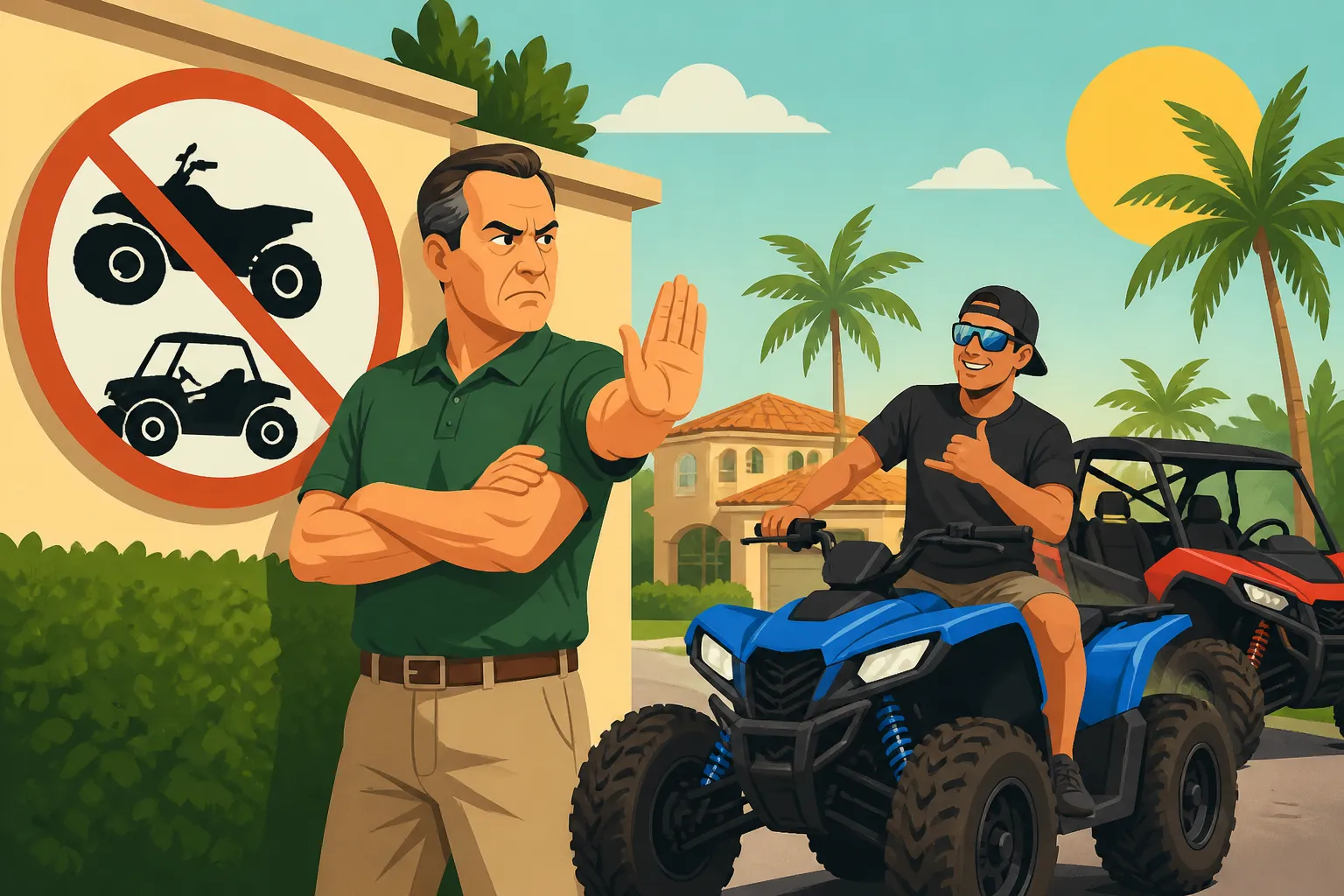
You bought that shiny new quad, imagining leisurely rides around your beautiful Florida community, only to hit a wall: your Homeowners Association (HOA) has a strict "no ATV" policy. It's frustrating, confusing, and leaves you wondering what your rights are and why this is even allowed. You've invested in a machine for fun, utility, or both, and now your own neighborhood feels off-limits. This guide is here to unravel the complexities of HOA regulations regarding ATVs and UTVs in Florida, helping you understand your options and how to navigate these often-tricky waters.
Understanding HOA Authority and ATV Restrictions in Florida
It’s easy to feel personally targeted when your HOA seems to be putting the brakes on your off-road fun. But understanding why and how they have this power is the first step in figuring out what you can do about it. HOAs aren't just a bunch of neighbors making rules on a whim; they operate under a specific legal framework that grants them considerable authority within their communities.
Where HOAs Get Their Power: Covenants and Bylaws
The foundation of any Homeowners Association's authority lies in its governing documents, primarily the Covenants, Conditions, and Restrictions (CC&Rs), along with the bylaws and rules and regulations. These documents are essentially a contract that every homeowner agrees to abide by when they purchase property within that community. Think of them as the constitution for your neighborhood.
These CC&Rs are recorded with the county and are legally binding. They cover everything from the color you can paint your house to the types of fences you can erect, and yes, often what kind of vehicles you can operate or store on the property. If your HOA's CC&Rs explicitly state that ATVs, UTVs, or other off-highway vehicles are prohibited from being operated or even stored in plain sight, then that rule carries legal weight. It's not uncommon for these documents to have broad language about "nuisance vehicles" or "non-street-legal vehicles" that implicitly or explicitly bans quads.
The initial frustration often comes from not realizing the depth of these rules when you first moved in. Many homeowners don't pore over hundreds of pages of legal text before buying. However, once you become an owner, you're bound by them, whether you read them or not. This is why it's so crucial to review these documents, especially if you're considering buying a quad or moving to a new community where you plan to ride.
The "Common Area" Conundrum and Your Private Property
One of the biggest areas of confusion for ATV owners in an HOA-regulated community is the distinction between common areas and their own private property. You might think, "It's my driveway, my yard, my house – I can do what I want!" And while that's true to a certain extent, an HOA's reach often extends further than you might imagine, especially when it comes to vehicles.
Common areas are typically the roads, parks, clubhouses, green spaces, and any other property owned and maintained by the HOA for the collective benefit of all residents. It's almost universally understood that the HOA has the authority to dictate what vehicles can and cannot be operated on these shared spaces. Since most ATVs and UTVs are not street legal for public roads in Florida, HOAs often extend this ban to their private common roads as a matter of safety, noise control, and liability. They don't want the risk of an accident on their property or the constant rumble of engines disturbing the peace.
However, the question often arises about operating your quad solely on your own property. If you have a large lot, you might want to zip around your yard or use your UTV for yard work. Here, the HOA's authority can still come into play. While they can't necessarily tell you what you can do on your private property, they can often regulate activities that create a "nuisance" for neighbors, violate noise ordinances, or negatively impact the community's aesthetic. Visible storage of an ATV, even on your own driveway, might be prohibited by an HOA that aims for a uniform, pristine look. This is where the nuanced rules of your specific HOA really matter, as some might have stricter visual or noise standards than others.
Navigating Florida State Law vs. HOA Rules for ATVs
The interplay between state law, local ordinances, and HOA rules can feel like a tangled web. It's vital to understand that an HOA's rules often supplement, and sometimes even supersede (within their private domain), broader state regulations, particularly when it comes to off-highway vehicles. You might be perfectly legal by state standards to own an ATV, but your HOA still has the right to say "not here."
The Big Divide: Public Roads vs. Private Community Streets
Let's get one thing straight right away: in Florida, ATVs and most UTVs are generally not street legal for use on public paved roads. Florida statutes, specifically those outlined in Section 316.2074, are quite clear on this. You cannot just hop on your quad and drive down a state highway or a city street to the gas station. There are very limited exceptions, such as crossing a paved road at a 90-degree angle or driving on unpaved roads specifically designated by a county or municipality. For a deeper dive into these rules, check out [Florida ATV Road Rules: Where You Can Legally Ride].
This state-level restriction is a major factor in why HOAs often ban ATVs. If a vehicle isn't even allowed on public roads, why would a private community, concerned with safety and quiet, permit it on its own roads? The roads within most gated or planned communities are private property, owned by the HOA, not by the state or county. This gives the HOA significantly more leeway to set rules. They are not bound to allow vehicles that the state prohibits on public thoroughfares.
However, a gray area can emerge with unpaved roads within some communities. If your HOA community has extensive unpaved or dirt roads, you might wonder if they fall under the "unpaved road" exception in state law. The key distinction here is that even if it's unpaved, it's still a private road belonging to the HOA, not a public one. The HOA's rules will almost certainly take precedence over any theoretical interpretation of state law for public unpaved roads. The only way you might find an exception is if your HOA specifically designates certain unpaved roads for ATV use, which is rare due to liability concerns.
When Local Ordinances Come into Play
Beyond state law and HOA covenants, local ordinances from your county or city can also impact how and if you can use your quad within your community, even if your HOA is silent on the matter (which is unlikely). These ordinances typically cover things like noise, hours of operation for loud machinery, and "nuisance" activities.
For example, a county might have a noise ordinance that prohibits loud engine noise after 7 PM. While your HOA might not have explicitly banned ATVs, continually operating a noisy quad in the evenings could lead to complaints from neighbors, which then fall under the local noise ordinance. This could result in citations from local law enforcement, regardless of your HOA's specific rules. Similarly, some counties have specific regulations regarding the operation of off-highway vehicles on any property within residential zones, even private land, if it creates a disturbance.
It's also worth noting that Florida allows counties to have "opt-out" clauses or specific designations for ATV use on roads. For more on this, see [Florida County ATV Opt-Outs: Why Rules Change at the Line]. While these typically refer to public roads, a local government's general stance on ATVs can sometimes influence how HOAs interpret and enforce their own rules, or how local law enforcement responds to complaints within private communities. So, while your HOA might be the primary regulator within its boundaries, local laws can act as an additional layer of restriction.
What to Do When Your HOA Bans Quads (and How to Potentially Overturn It)
Discovering your HOA has a ban on quads can be disheartening, but it's not necessarily the end of the road. There are steps you can take, both proactive and reactive, to understand your situation better and, potentially, work towards a solution.
Reviewing Your Governing Documents (Before You Buy!)
The absolute best time to address this issue is before you even buy a property in an HOA community, or certainly before you purchase an ATV. Many future frustrations can be avoided by simply doing your homework. When you're considering a home in an HOA, always ask for a complete set of the governing documents – the CC&Rs, bylaws, and rules and regulations.
Take the time to actually read through them, paying close attention to sections on vehicles, nuisances, common areas, and recreational equipment. Look for keywords like "ATV," "UTV," "off-highway vehicle," "motorized recreational vehicle," "non-street-legal vehicles," or even broad clauses about "vehicles that create a nuisance or noise." If you're not comfortable sifting through legal jargon, consider hiring an attorney specializing in real estate or HOA law to review them for you. It's a small investment that can save you huge headaches down the line. If you've already bought your home and are just now realizing the ban, you still need to get your hands on these documents. The HOA management company or board should be able to provide them. Knowing the exact wording of the ban is crucial for any next steps.
The Process of Challenging or Amending HOA Rules
So, you're already living in an HOA with an ATV ban, and you want to challenge it. This is where patience, diplomacy, and community organizing come into play. Directly confronting the board without preparation is usually a recipe for frustration.
First, identify the specific rule that prohibits ATVs. Is it a bylaw, a covenant, or a general rule? The process for amending each can differ. Typically, amending CC&Rs requires a significant percentage of homeowner votes (often 60-75%), while amending bylaws or rules might require less, or just a board vote. Attend HOA board meetings, listen to concerns, and respectfully voice yours during the appropriate time. Frame your argument around solutions, not just demands. Could you propose a designated trail area on common property if the community is large enough? Could you agree to specific hours of operation for utility use on private property? Emphasize the responsible use of ATVs, perhaps highlighting the utility benefits for large properties or the recreational opportunities for residents who might otherwise feel confined.
Gather support from like-minded neighbors. Strength in numbers can make a huge difference. If you can present a petition signed by a substantial number of homeowners, or demonstrate that many residents own or want to own quads, the board might be more receptive. You could also explore options for storing your ATV out of sight, such as in a garage, if the primary concern is aesthetics, rather than outright operation. Some of the parts and accessories from companies like SuperATV can help modify your machine to be quieter or more utilitarian, which might make it more palatable to an HOA if noise or appearance is a specific concern. Remember, the goal is often to find a compromise that addresses the HOA's concerns (safety, noise, aesthetics, liability) while allowing residents reasonable use of their property.
Practical Solutions and Alternatives for Florida Riders
If challenging or amending the HOA rules proves impossible or too difficult, it doesn't mean your Florida ATV adventures are over. It simply means you might need to adapt your approach.
One of the most common and effective solutions is to use a trailer to transport your ATV or UTV to legal riding areas. Florida is home to numerous fantastic public and private off-road parks. Places like [Croom Motorcycle Area: Florida's Biggest OHV Park] or the [Ocala National Forest ATV Trails in Florida] offer miles of diverse trails, from sand to mud, specifically designed for off-highway vehicles. By trailering your machine, you completely bypass the HOA's restrictions on operating it within the community. You might even find that the social aspect of riding with friends at a dedicated park is more enjoyable than riding around your neighborhood.
If you're actively looking for a new home and want to ensure you can use your ATV freely, seek out communities that are known to be "trail-friendly" or are specifically designed for larger lots where such activities are more common and accepted. Rural areas or communities without strict HOAs are often your best bet. Some large acreage communities might even have designated private trail systems. When considering new properties, always ask about [Florida Golf Cart Laws vs ATV Laws] as many communities permit golf carts (which have different legal classifications and uses) but not ATVs.
Finally, consider the primary purpose of your ATV. If it's mainly for utility tasks on your own large property, and the HOA's ban is focused on recreational riding or noise, there might be room for a dialogue about essential property maintenance use. Demonstrating responsible operation, perhaps with quieter exhaust systems or specific tires from brands like SuperATV that are less aggressive for yard work, could open a conversation. However, always get any such exceptions or agreements in writing from the HOA board to avoid future misunderstandings.
| Aspect of ATV Use | Regulating Authority (Primary) | Common Restrictions/Considerations |
|---|---|---|
| Public Roads (Paved) | Florida State Law | Generally illegal for ATVs/UTVs, regardless of HOA rules. |
| Public Roads (Unpaved) | Florida State Law / County Ordinance | Limited exceptions; requires specific state/county designation. HOA may still restrict access within private communities. |
| HOA Common Roads | HOA Covenants/Bylaws | Often banned by default due to safety, noise, liability. |
| HOA Common Property (e.g., parks) | HOA Covenants/Bylaws | Almost always banned for recreational use; significant liability concerns. |
| Your Private Lot (within HOA) | HOA Covenants/Bylaws | Noise, visible storage, operation hours, aesthetic impact can be regulated. |
| Designated OHV Parks | Park Rules / State Laws | Specific permits, safety gear, age limits, vehicle requirements (e.g., spark arrestors). |
Disclaimer
This article is for general informational purposes only and does not constitute professional advice. Laws, prices and regulations vary by location and change over time. Consult a qualified professional for guidance on your specific situation.