Trailering a Quad on Florida Highways
The open road calls, doesn't it? You've got your quad gassed up, your gear packed, and your buddies ready for an epic weekend tearing up the trails. But before you can feel that Florida sun on your face and mud on your tires, there's the inevitable hurdle: getting your precious machine from your driveway to the trailhead safely and legally. For many of us, this means trailering, and let me tell you, it comes with its own set of anxieties. This guide is here to walk you through everything you need to know about trailering your ATV or UTV on Florida highways, making sure your journey is as smooth as your ride.
Why Trailering Your Quad is the Smart Move
Let's be real, the thought of just riding your quad to the trailhead might cross your mind, especially if it's "just down the road." But Florida's rules for ATVs on public roads are pretty strict, and trying to skirt them can lead to hefty fines, an impounded machine, or worse, a dangerous accident. Trailering isn't just about legality; it's about preserving your machine and ensuring everyone's safety.
Avoiding Road Legality Issues
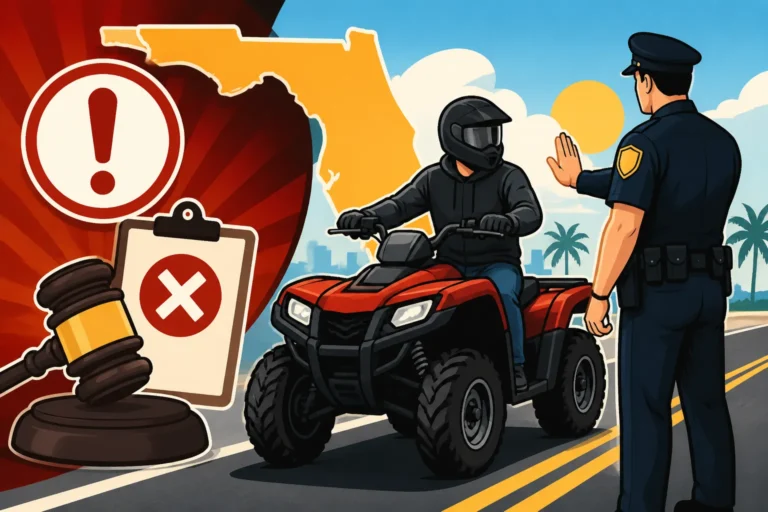
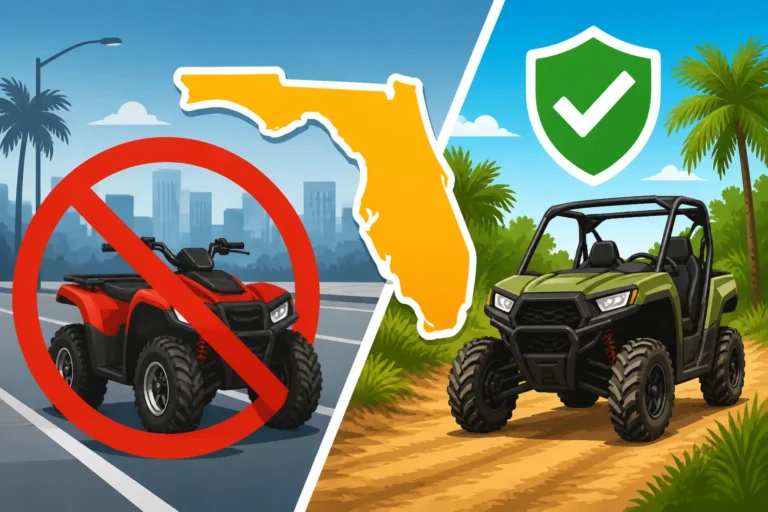
Florida's stance on ATVs and UTVs on paved public roads is pretty clear: it's generally a no-go. While there are some exceptions for unpaved roads in certain counties or agricultural use, you absolutely cannot just hop on your quad and cruise down US-19 or I-75. These machines are designed for off-road adventures, not highway speeds, and they lack the safety features required for street legal operation. Trying to ride your ATV on a state highway is like trying to use a screwdriver as a hammer – it's the wrong tool for the job, and it’s going to end badly. Getting caught can result in a ticket, and frankly, dealing with law enforcement on the side of a busy highway is nobody's idea of a fun start to a weekend. It's far better to use a trailer and avoid these headaches entirely. For a deeper dive into what you can and can't do, check out [Florida ATV Road Rules: Where You Can Legally Ride].
Protecting Your Investment and Preventing Wear and Tear
Your ATV or UTV is an investment, often a significant one. Every mile you put on it on pavement is a mile closer to needing new tires, suspension work, or engine maintenance that wasn't designed for road use. The knobby tires that give you incredible grip in the mud and sand will wear down quickly and unevenly on asphalt, costing you money and compromising their performance where it really counts: off-road. Furthermore, the suspension systems on most quads aren't built to absorb the constant, high-frequency vibrations of highway travel. Trailering keeps your machine in prime condition, saving you money on repairs and ensuring it's ready to tackle the toughest trails without being prematurely worn out by mundane road travel. Think of your trailer as a moving garage, shielding your quad from road debris, sun exposure, and the stress of inappropriate use.
Choosing the Right Trailer for Your Quad
Okay, so you're convinced trailering is the way to go. Now, which trailer is right for you? This isn't a one-size-fits-all decision. You need to consider the type of riding you do, how many machines you're hauling, and what your tow vehicle can handle. Making the right choice here is crucial for both safety and convenience.
Open vs. Enclosed Trailers
This is often the first big decision. Both have their pros and cons.
Open Trailers: These are typically less expensive, lighter, and easier to maneuver. They come in many forms, from simple utility trailers with a ramp gate to dedicated ATV trailers with multiple tie-down points. The biggest advantages are their affordability and ease of loading. You can usually see your quad in your rearview mirror, which provides a bit of peace of mind. However, your machine is exposed to the elements – rain, road grime, bugs, and curious eyes. If you’re hauling through a sudden Florida thunderstorm, your gear and machine will get soaked. Security can also be a concern if you leave your quad unattended for long periods at a rest stop, as it’s easily visible.
Enclosed Trailers: These offer superior protection from weather, road debris, and theft. They can also double as a mobile workshop, storage unit, or even a basic shelter at the trailhead. If you carry a lot of tools, extra fuel, and camping gear, an enclosed trailer keeps everything organized and out of sight. The downside? They are heavier, more expensive, and can be a beast to tow, especially in crosswinds or tight parking lots. They also require a more powerful tow vehicle. Plus, if you’re pulling into a dusty trailhead, you’ll likely still need to give your quad a good wash when you get home. When considering an enclosed trailer, make sure it’s tall enough to clear your roll cage if you have a UTV, and wide enough to accommodate your machine's width. Don't forget that [Florida UTV Titling for Side-by-Sides Over 55 Inches] has specific rules for larger machines, so knowing your UTV's dimensions is key even for transport.
Single vs. Tandem Axle
The number of axles on your trailer impacts its towing stability, weight capacity, and tire wear.
Single Axle Trailers: These are lighter, less expensive to maintain (fewer tires, fewer brakes), and easier to maneuver in tight spaces. They're ideal for hauling one smaller ATV or a light UTV. However, they have a lower weight capacity, and if you have a tire blowout, you're immediately on the side of the road with no spare wheel to keep you going. Weight distribution is also more critical on a single-axle trailer, as too much tongue weight or too little can cause dangerous sway. For a single quad or a small side-by-side, a single-axle trailer might be perfectly adequate, but always check the Gross Vehicle Weight Rating (GVWR) of the trailer against the loaded weight of your machine and gear.
Tandem Axle Trailers: These trailers have two axles, meaning four or more tires on the ground. They offer significantly higher weight capacities and much greater stability, especially at highway speeds or over bumpy terrain. If you experience a tire blowout on one axle, the other axle can often carry the load long enough for you to safely pull over. This redundancy is a huge safety advantage. Tandem axle trailers are the preferred choice for hauling multiple ATVs, larger UTVs, or if you frequently travel long distances. The trade-off is higher cost, more tires to maintain, and they can be a bit harder to maneuver in reverse. But for peace of mind on a long haul across Florida, a tandem axle is often worth the investment.
Trailer Size and Weight Capacity
Before you even think about buying a trailer, you need to know the dimensions and dry weight of your ATV or UTV. Measure its length, width, and height, and check the manufacturer's specs for its weight. Then, consider any accessories you've added (winch, heavy-duty bumper, larger tires, a full tank of gas) as these all add to the total weight.
Your trailer needs to have a Gross Vehicle Weight Rating (GVWR) that comfortably exceeds the total weight of your machine(s) plus all your gear. Don't cut it close; a loaded trailer pushing its weight limit is less stable and puts undue stress on the trailer and your tow vehicle. Florida has laws about trailer weights, and you don't want to be caught overloaded. Also, ensure the deck size is large enough to fit your machine(s) with plenty of room for tie-downs. A quad wider than 55 inches might require a different trailer setup than a narrower one, for instance, especially if you're trying to fit multiple machines. Always remember the rules on [A Quad Wider Than 55 Inches Is Not an ATV] if you're mixing machine types on one trailer.
Essential Equipment for Safe Trailering
Having the right trailer is only half the battle. The equipment you use to hitch up, load, and secure your quad is just as vital. Skimping here is inviting trouble, and believe me, you don't want your quad bouncing around – or worse, off – your trailer on I-4.
Tie-Downs and Wheel Chocks
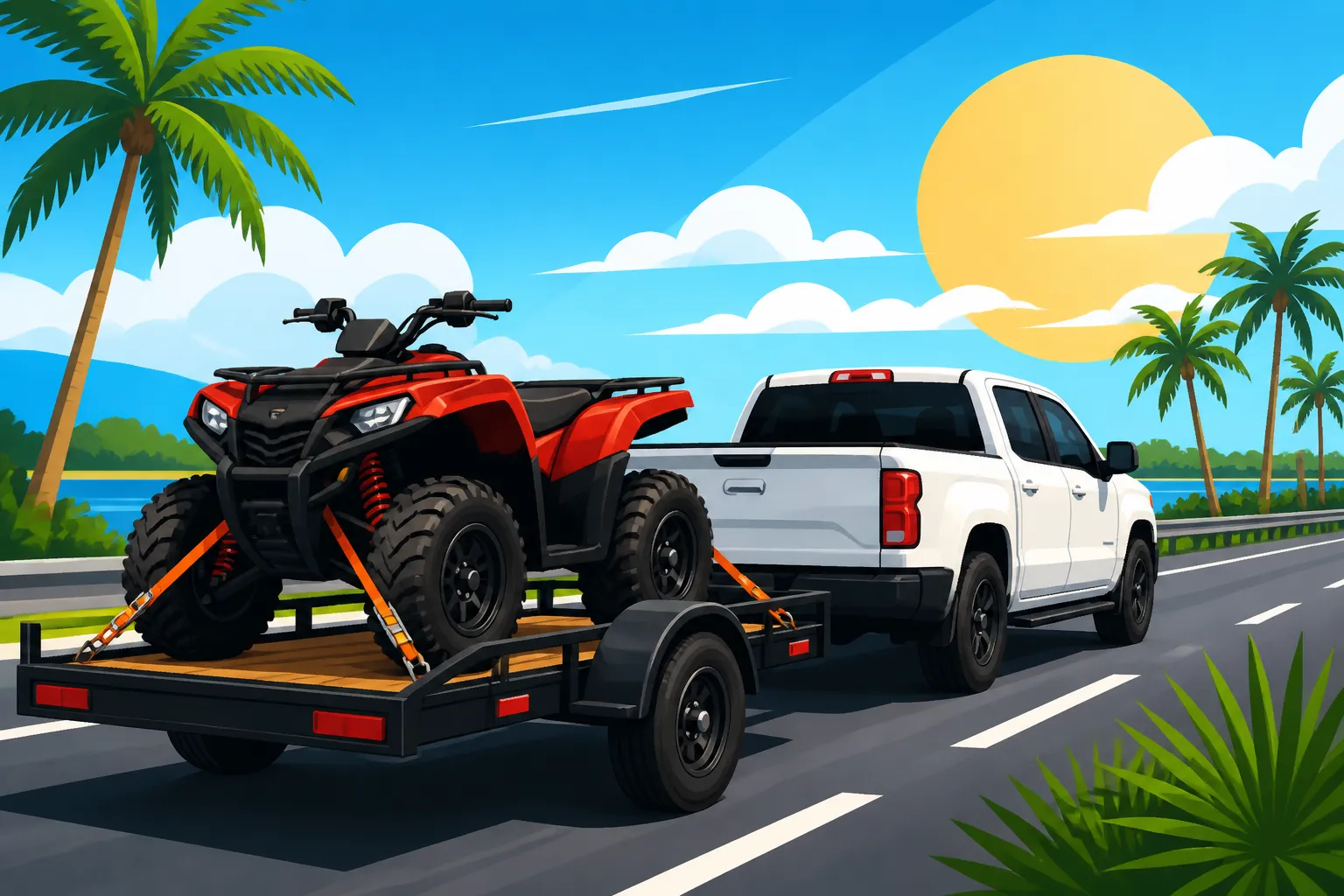
This is where many riders make critical mistakes. Don't grab those flimsy ratchet straps from the bargain bin; they won't cut it. You need heavy-duty, rated tie-down straps – preferably those with a wide webbing (2 inches or more) and robust hooks. Ratchet straps are generally preferred over cam buckles because they allow you to apply more tension. A good rule of thumb is to use at least four tie-down straps for each machine, one at each corner, pulling outwards and downwards. Many riders also add a fifth strap across the middle for extra security.
Think about where you're attaching the straps on your quad. Avoid wrapping them around suspension components that might compress or shift. Look for solid frame points or dedicated tie-down loops. For UTVs, a popular method is to use through-the-wheel straps, which secure the tires directly to the trailer deck, allowing the suspension to absorb road bumps without loosening the straps. Wheel chocks, either built into the trailer or separate, are also excellent for preventing forward or backward movement of the wheels before the straps are tightened. Brands like SuperATV offer a variety of robust tie-down solutions specifically designed for the rigors of off-road vehicle transport, so definitely explore their options for secure hauling.
Proper Hitch and Coupler
Your trailer hitch assembly is the direct connection between your tow vehicle and your trailer, so it must be correctly rated for the job. You'll find hitch classes (I through V), each with a maximum tongue weight and gross trailer weight rating. Ensure your vehicle's hitch meets or exceeds the GVWR of your fully loaded trailer. The ball mount and hitch ball also need to match the coupler on your trailer, both in size (e.g., 2-inch or 2 5/16-inch) and weight rating.
The coupler, the part of the trailer that connects to the hitch ball, should fit snugly and be locked in place with a pin or padlock. Always attach safety chains, crossing them under the tongue of the trailer to form a cradle. This prevents the tongue from digging into the pavement if the coupler disconnects. If your trailer has electric brakes (common on heavier tandem axle trailers), ensure the brake controller in your tow vehicle is properly installed and functioning. Having a breakaway cable is also crucial; this cable is designed to activate the trailer's brakes automatically if it separates from the tow vehicle, a critical safety feature often required by law.
Trailer Lights and Wiring
This is a non-negotiable safety item. Florida law requires all trailers to have working taillights, brake lights, turn signals, and side marker lights, especially if the trailer is of a certain length or width. Before every trip, double-check that every light is functioning. Corroded wiring, loose connections, or blown bulbs are common culprits for light failures, and a quick check can prevent a ticket or, more importantly, a rear-end collision.
The trailer wiring harness connects to your tow vehicle's electrical system, relaying signals for lights. There are different types (4-pin, 5-pin, 7-pin); make sure yours matches your trailer and vehicle. If your trailer has electric brakes, you'll need a 7-pin connector to transmit the brake signal. Carry a spare set of bulbs or fuses for your trailer lights, just in case. And if you're finding issues, it's worth investing in a good wiring test kit or having a professional inspect your setup. Nothing says "trouble" like pulling a trailer at night with no brake lights. Always make sure your [Trailer Lights That Keep You Out of Trouble] are functioning perfectly before you even think about hitting the highway.
Loading and Securing Your Quad
This is perhaps the most critical stage. A properly loaded and secured quad means a smooth, safe tow. A poorly loaded one can lead to dangerous sway, equipment damage, or even a catastrophic accident. Don't rush this part; take your time and do it right.
Safe Loading Techniques
First and foremost, use appropriate loading ramps. Whether they're built-in to your utility trailer's gate or separate aluminum ramps, ensure they are wide enough for your quad's tires and strong enough for its weight. Ramps should have a secure connection to the trailer and a grippy surface to prevent slippage. Loading on a flat, level surface is ideal. If possible, load with the trailer hitched to your tow vehicle; this prevents the trailer from tipping backwards under the weight of the quad.
When driving your quad onto the trailer, go slowly and steadily. Don't hit the ramps at full throttle. Many riders find it easier to back an ATV onto a trailer, especially a single one, as it can help with weight distribution, putting more weight over the tongue. For UTVs, driving forward is usually the only practical option. Always ensure you have enough clearance, especially with enclosed trailers. Once on the trailer, put the quad in park or in gear, engage the parking brake if it has one, and turn off the engine. If you're loading multiple quads, plan your sequence to maintain balance.
Strategic Weight Distribution
Weight distribution is key to preventing trailer sway, which can be incredibly dangerous at highway speeds. As a general rule, you want about 10-15% of the total trailer weight (including the quad and gear) to be on the tongue of the trailer. This is known as tongue weight. Too little tongue weight, and the trailer will sway violently. Too much, and it can overload your tow vehicle's rear suspension, affecting steering and braking.
For a single quad, typically loading it slightly forward of the trailer's axle (or slightly forward of the midpoint between two axles on a tandem trailer) will achieve the ideal tongue weight. If you're hauling multiple machines, strategically place the heavier machines where they contribute to proper tongue weight. For example, place the heaviest quad over the axles, and lighter machines closer to the front or back, adjusting as needed. You can use a bathroom scale (for lighter trailers) or a dedicated tongue weight scale to measure this. If your trailer is repeatedly swaying, don't just "drive through it" – pull over safely and adjust your load. This is a common issue that often goes unaddressed until it's too late.
The Art of the Tie-Down
Once your quad is positioned, it's time to secure it. This isn't just about making it "snug"; it's about making it immovable. As mentioned, use at least four heavy-duty ratchet straps, one at each corner. Attach the hooks to solid points on the quad's frame (not handlebars, plastic racks, or suspension components that can move or break) and to sturdy points on the trailer frame. Pull the straps outwards and downwards at an angle, not just straight down. This creates opposing forces that hold the quad firmly in place.
Tighten the straps evenly, alternating between corners. You want the quad's suspension to compress slightly, but don't overtighten to the point of damaging your machine's components. The goal is to make the quad part of the trailer, so it moves as one unit. After tightening, give the quad a good shake to ensure there's no play. Check again after driving a few miles, as things can settle. If you're hauling a UTV, consider SuperATV's secure tie-down points or wheel nets that can provide an even more robust hold. Remember, properly [Strapping a Quad Down for a Highway Tow] isn't just a suggestion, it's a safety imperative.
Florida Highway Regulations for Trailers
Ignorance of the law is no excuse, especially when it comes to towing. Florida has specific rules for trailers, and understanding them will keep you out of trouble and ensure your trailering setup is legal. These regulations cover everything from weight limits to required safety equipment.
Understanding Trailer Weight Limits
Florida generally follows federal guidelines regarding trailer weight and braking requirements. If your trailer, when loaded, weighs 3,000 pounds or more, it typically needs its own independent braking system. This is why many tandem axle trailers come with electric brakes. You'll also need a brake controller in your tow vehicle to operate these. Failure to have adequate brakes on a heavy trailer is a serious safety hazard and a legal violation.
Beyond brakes, the total weight of your trailer and its cargo must not exceed the towing capacity of your tow vehicle. This includes the gross vehicle weight rating (GVWR) of your tow vehicle (the maximum allowable weight of the vehicle itself, including passengers and cargo) and its Gross Combined Weight Rating (GCWR) (the maximum allowable weight of the tow vehicle and loaded trailer combined). Overloading your tow vehicle or trailer can lead to overheating, poor braking performance, reduced steering control, and rapid tire wear, creating a dangerous situation on the highway. Always err on the side of caution and stay well within your vehicle and trailer's stated weight limits.
Required Lighting and Safety Chains
As touched on before, proper lighting is paramount. Florida Statute 316.222 spells out the requirements: every trailer must have two taillamps, two stop lamps, and two turn signals, all working correctly. If the trailer is more than 80 inches wide, it needs clearance lamps. Side marker lamps are also generally required for trailers over a certain length. All lights must be visible from specific distances.
Safety chains are also a legal requirement. As mentioned, they must be crossed under the tongue of the trailer and securely attached to the tow vehicle's hitch receiver. The chains should be strong enough to hold the trailer if it separates from the hitch ball. Additionally, if your trailer has electric brakes, a breakaway system that activates the trailer brakes if it detaches from the tow vehicle is usually mandated by law for trailers over 3,000 pounds. These aren't just suggestions; they are critical safety features that Florida expects you to have.
Special Rules for Oversized Loads (If Applicable)
Most ATVs and UTVs on standard trailers won't constitute an "oversized load," which typically refers to dimensions that exceed legal width (usually 8 feet 6 inches), height, or length. However, if you're hauling an exceptionally wide UTV or a custom-built machine, or if you're hauling multiple machines on a very wide custom trailer, it's worth double-checking Florida's specific regulations for oversized loads. These typically require special permits, escort vehicles, and specific lighting/flags. While unlikely for a typical quad setup, it's important to be aware, especially if your UTV is wider than average. Always know your machine's dimensions, and if you're unsure, check with the Florida Department of Transportation.
Pre-Trip Checks and On-Road Best Practices
You've got the right trailer, the best equipment, and your quad is strapped down tight. But don't just hit the road yet! A comprehensive pre-trip inspection and smart driving habits are the final pieces of the puzzle for a safe and stress-free journey.
Before You Hit the Road
A thorough pre-trip checklist can save you a world of hurt. Make this a ritual before every haul, no matter how short the distance.
| Checkpoint | Description | Action Required |
|---|---|---|
| Tire Pressure | Check both tow vehicle and trailer tires. Improper pressure (too low or too high) can lead to blowouts, poor handling, and reduced fuel economy. | Inflate to manufacturer's recommended PSI (often higher for trailer tires than passenger car tires). |
| Lug Nuts | Ensure all lug nuts on both tow vehicle and trailer wheels are tight. Loose lug nuts can cause a wheel to detach. | Use a torque wrench to ensure proper tightness. |
| Lights and Wiring | Verify all trailer lights (taillights, brake lights, turn signals, marker lights) are working correctly. Check wiring for damage or loose connections. | Replace bulbs, fix wiring, or tighten connections as needed. |
| Hitch Connection | Confirm the coupler is securely seated on the hitch ball, the latch is locked, and the safety pin is in place. Ensure safety chains are crossed and attached. | Double-check all connections, use a locking pin/padlock. |
| Tie-Down Straps | Inspect all straps for fraying or damage. Tug on each strap to ensure maximum tension and that the quad is truly immobile. | Replace damaged straps, re-tighten if loose. |
| Brakes | If equipped, test the trailer's electric brakes. Ensure the brake controller in your tow vehicle is set correctly. Check tow vehicle brakes. | Adjust brake controller gain, test response, inspect brake lines. |
| Fluid Levels | Check engine oil, transmission fluid, coolant, and brake fluid in your tow vehicle. Towing puts extra strain on these systems. | Top off fluids as needed. |
| Mirrors | Adjust your side mirrors to ensure you have a clear view down both sides of the trailer and can see traffic behind you. Extended towing mirrors are highly recommended. | Adjust standard mirrors or install towing mirrors. |
During Your Drive
Towing a trailer significantly changes how your vehicle handles. Anticipation and smooth inputs are your best friends.
- Increase Following Distance: You'll need much more distance to stop safely when pulling a heavy trailer. Double or even triple your usual following distance, especially in heavy Florida traffic or wet conditions.
- Wider Turns: Trailers cut corners. Always swing wider than you normally would to prevent hitting curbs, signs, or other vehicles, especially in urban areas like Orlando or Jacksonville.
- Lower Speeds: While Florida highways might have high-speed limits, towing a trailer usually means reducing your speed. Consult your tow vehicle's manual for recommended towing speeds. High speeds increase sway risk and wear on your tires and components. For example, if you're traveling through the winding roads around the Ocala National Forest, a slower speed will make the drive much safer.
- Constant Mirror Checks: Frequently check your side mirrors to monitor your trailer and load. Look for shifting cargo, swaying, or tire issues. If you notice sway, gently apply your trailer brakes (if equipped) using the manual control on your brake controller, or slowly ease off the accelerator – do NOT hit your tow vehicle's brakes hard, as this can worsen sway.
- Anticipate Hills: Florida may be flat, but there are still inclines. Downshift proactively before climbing or descending a grade to manage speed and prevent your brakes from overheating.
When You Arrive
You've made it to the [Croom Motorcycle Area: Florida's Biggest OHV Park] or another fantastic Florida riding spot. But your job isn't quite done.
- Careful Unloading: Unload your quad slowly and safely, especially if you're on uneven ground. Ensure ramps are stable and properly secured.
- Re-check Straps: After unloading, re-check your tie-down straps. Even if you've made it safely, it's good practice to assess if any loosened, indicating a need for adjustment or stronger straps for the next trip.
- Secure Trailer: If you're leaving your trailer unattended, consider using a hitch lock and wheel chocks. If it's an enclosed trailer, ensure it's locked.
- Post-Trip Inspection: When you get back home, give your trailer another quick once-over. Check for any new damage, loose wires, or tire wear that might have occurred during the trip. Addressing small issues now can prevent bigger problems down the road.
Remember, getting to the trails is part of the adventure. By trailering your quad safely and legally on Florida highways, you're ensuring that the fun starts the moment you pull up to the trailhead, not ends on the side of the road.
Disclaimer
This article is for general informational purposes only and does not constitute professional advice. Laws, prices and regulations vary by location and change over time. Consult a qualified professional for guidance on your specific situation.