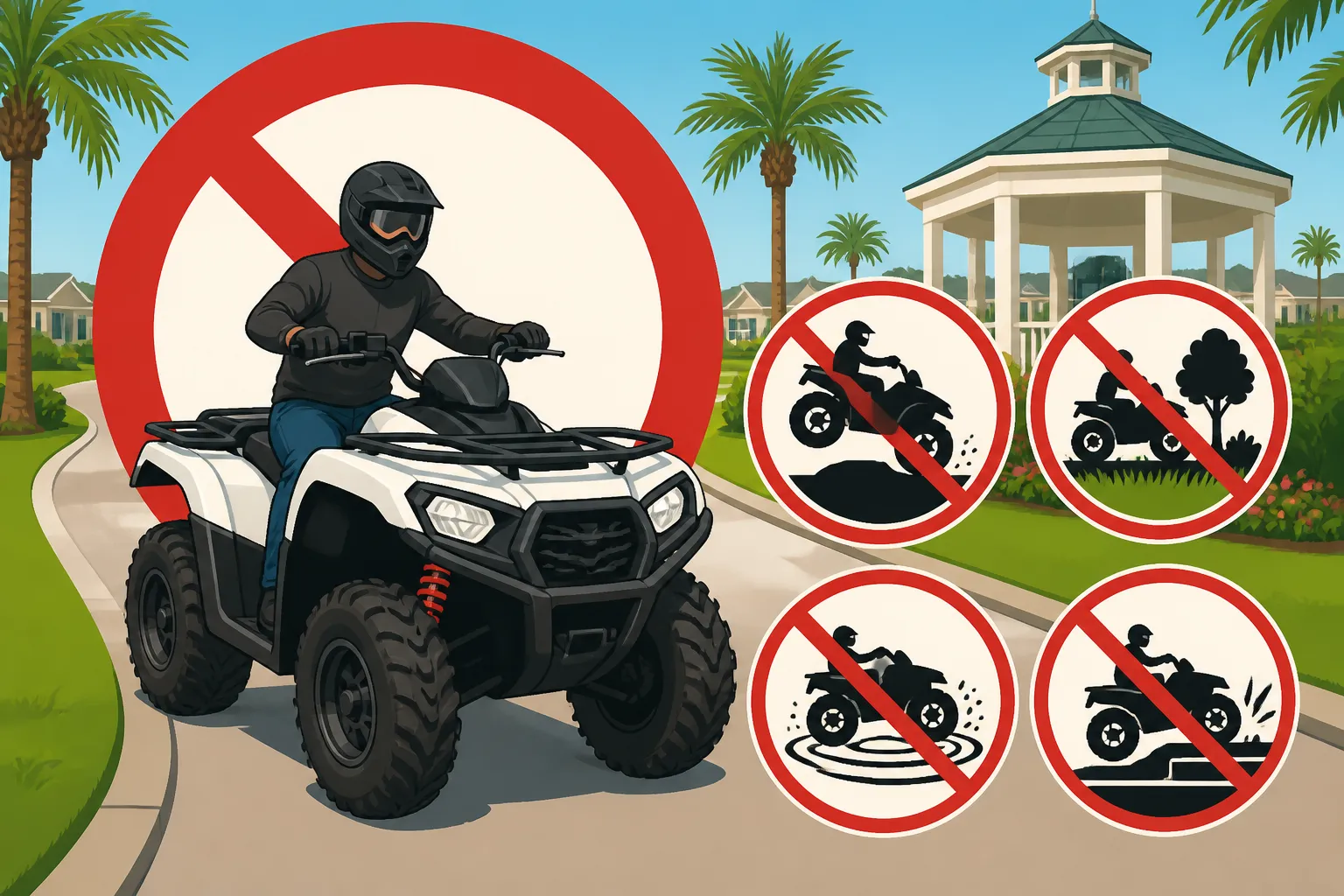
What ATVs Cannot Do on The Villages Cart Paths
It's a common dream for many who love the Florida lifestyle: picture yourself cruising through the beautiful, interconnected community of The Villages, not in a traditional golf cart, but on your powerful, go-anywhere ATV or UTV. The idea of using those convenient cart paths to get around on your off-highway machine might seem like the perfect blend of utility and fun. However, the reality is often a quick and frustrating wake-up call. This guide is here to shed light on exactly why ATVs and UTVs are strictly prohibited from The Villages' extensive golf cart path system, delving into the specific state laws and local regulations that create this firm boundary, and helping you understand where you can legally enjoy your machine.
The Villages' Unique Transportation Landscape
For anyone unfamiliar with it, The Villages in Florida is a truly unique place, famous not just for its sprawling retirement community but also for its incredibly intricate and widely used network of golf cart paths. This isn't just a few paths between holes; it's a legitimate alternative transportation system that residents rely on daily.
The Allure of Cart Paths and Their Purpose
The Villages has essentially built a miniature world where golf carts aren't just for the links—they're a primary mode of transport. Residents use them for everything from grocery shopping to visiting friends, getting to dinner, and, of course, playing golf. These paths are designed with specific dimensions, signage, and safety considerations in mind, catering to the relatively slow speed, light weight, and predictable handling of golf carts. The appeal of these paths is undeniable: they offer a way to navigate the community quickly and efficiently, often bypassing road traffic. It's easy to see why someone with an ATV or UTV might look at this expansive network and think, "Hey, my machine could handle this perfectly!"
Many residents, whether they've lived in The Villages for years or are new arrivals, have grown accustomed to the ease and accessibility these paths provide. The network is extensive, connecting neighborhoods, town squares, and commercial centers. They are a defining feature of the community, shaping the daily lives of its residents. The idea of extending that convenience to other types of personal recreational vehicles is a natural leap for many enthusiasts.
Why ATVs Don't Fit the Mold
While the thought of an ATV on these paths might be appealing for convenience, it immediately bumps up against a wall of legal definitions and, more importantly, safety considerations. The core issue isn't just about what can physically fit on the path, but what is legally and safely intended to operate there. Florida law, combined with local ordinances within The Villages, draws very clear lines regarding what constitutes an "off-highway vehicle" versus a "golf cart" or a "low-speed vehicle," and these distinctions are critical.
The paths are designed for a certain type of vehicle and a certain flow of traffic. Introducing machines like ATVs, with their different handling characteristics, power, and design, would fundamentally alter the safety and operational integrity of that system. It's not just a matter of "can it fit?" but "should it be there?" The answer from a regulatory standpoint is a resounding no, primarily due to the inherent differences in vehicle classification and purpose.
Florida's Legal Definitions: ATV vs. Golf Cart vs. LSV
To truly understand why your ATV can't cruise down a cart path in The Villages, you need to grasp the legal definitions that Florida applies to different types of recreational and transportation vehicles. The state doesn't lump everything with four wheels into one category, and these distinctions are paramount.
What Defines an ATV (and Why It Matters Here)
In Florida, an All-Terrain Vehicle (ATV) has a very specific legal definition. It's generally characterized as any motorized off-highway vehicle 55 inches or less in width, having a dry weight of 1,500 pounds or less, designed to travel on three or more non-highway tires, and manufactured for use by a single operator with no passengers, or a two-rider ATV that's specifically designed for an operator and one passenger. These machines are built for dirt, mud, sand, and rough terrain, not paved streets or community paths. You can read more about [Florida's 55-Inch ATV Definition and Why It Matters].
The crucial phrases here are "off-highway vehicle" and "non-highway tires." ATVs are engineered with knobby tires, high ground clearance, and suspensions meant to absorb impacts from rugged terrain. They don't typically have features like turn signals, rearview mirrors, or brake lights required for street-legal vehicles. Attempting to ride an ATV on a paved cart path, let alone a public road, instantly puts it in violation of these core definitions. Its design makes it inherently less stable on smooth, hard surfaces compared to a vehicle designed for such conditions. The very features that make it excel off-road make it a hazard on-road or on paved paths meant for golf carts. This also means that even if you have a [Three Wheels or Four: What Still Counts as an ATV], the core "off-highway" designation remains.
The Specifics of a Golf Cart
A golf cart, in Florida, is defined as a motor vehicle that has at least three wheels, an empty weight of less than 1,300 pounds, and is designed to operate at a maximum speed of 20 miles per hour. These vehicles are primarily intended for use on golf courses or for short-distance travel on public roads that have been designated for golf cart use by local ordinance. They have specific safety equipment requirements, which are much less stringent than those for full street-legal vehicles, but still ensure a basic level of safety for their intended environment.
Crucially, golf carts are engineered with smoother, harder tires, a lower center of gravity, and a suspension system optimized for paved or well-maintained paths. Their controls are typically simpler, and their speed is limited, all contributing to a safer, more predictable experience in shared-use community spaces. The legal distinction is clear: golf carts are purpose-built for their environment, and that environment includes The Villages' cart paths. Understanding [Florida Golf Cart Laws vs ATV Laws] really highlights these differences.
Understanding Low-Speed Vehicles (LSVs)
Then there's the Low-Speed Vehicle (LSV). This is where things can get a bit more nuanced, especially for UTV owners who might want to make their machine street legal. An LSV is a four-wheeled vehicle whose top speed is greater than 20 miles per hour but not greater than 25 miles per hour. Unlike golf carts, LSVs must be equipped with specific safety features to be considered street legal. These include headlamps, stop lamps, turn signals, tail lamps, reflex reflectors, a parking brake, a rearview mirror, a windshield, seat belts, and a vehicle identification number (VIN). They must also be registered and insured, just like a regular car, and can only be operated on public roads with a posted speed limit of 35 mph or less.
While a UTV (often wider and heavier than a typical ATV) might potentially be converted to meet LSV standards, a standard ATV almost never can due to its fundamental design. LSVs are designed to bridge the gap between golf carts and full-sized vehicles, offering slightly more speed and utility while still operating within community settings. Many modern side-by-sides, particularly those offered by brands like SuperATV which specialize in aftermarket parts, can be equipped with the necessary components to attempt LSV conversion, but this is a far cry from the original intent of an ATV. The important takeaway is that even if a UTV meets LSV requirements, it still has strict rules about where it can operate, which generally doesn't include golf cart-specific paths. If you're exploring [Florida Low-Speed Vehicle Rules for Side-by-Sides], you'll see the intricate details involved.
The Hard Truth: Why ATVs Are Prohibited on Cart Paths
Now that we've laid out the clear legal definitions, it becomes even more apparent why ATVs simply cannot operate on The Villages' cart paths. It boils down to a combination of safety, design, and legal enforcement that creates an impermeable barrier between these different classes of vehicles.
Safety Concerns and Design Differences
Imagine a golf cart, designed for smooth, flat surfaces, traveling at a leisurely 15-20 mph. Now picture an ATV, with its aggressive knobby tires, higher center of gravity, often more powerful engine, and quicker acceleration. The two are fundamentally different machines with different handling characteristics. An ATV's suspension is built for absorbing bumps and jumps off-road, not for smooth, stable cornering on pavement. Its tires are designed to dig into loose terrain, not provide maximum grip on asphalt or concrete. This translates directly into safety hazards on a cart path:
- Traction and Stability: Knobby off-road tires have less contact patch on pavement, leading to reduced grip and increased braking distances. The higher center of gravity of many ATVs, combined with a narrower stance than some UTVs or LSVs, can make them prone to tipping, especially during sharp turns or evasive maneuvers on hard surfaces.
- Speed and Acceleration: Even smaller ATVs can often achieve speeds far exceeding the typical 20 mph limit of golf carts, creating dangerous speed differentials with other users. Their rapid acceleration can also surprise other path users, leading to collisions.
- Driver Exposure: ATVs offer minimal protection to the rider, who is exposed to the elements and any potential impacts. Golf carts and LSVs, while not crash-proof, offer more enclosed space and often have windshields and roofs.
- Noise: ATVs tend to be much louder than electric golf carts, disrupting the peaceful atmosphere of The Villages and violating local noise ordinances.
The cart paths in The Villages are shared spaces, often frequented by pedestrians, cyclists, and slower-moving golf carts. Introducing a high-performance, off-road machine into this environment creates an unacceptable level of risk for all users. The design differences alone are enough to justify the prohibition.
Legal Ramifications and Enforcement
Beyond the safety aspects, there are explicit legal statutes and local ordinances that prohibit ATVs from these paths. Florida Statute 316.2123, which governs the operation of ATVs, is quite clear: "An all-terrain vehicle may not be operated on any public road, street, or highway of this state, except as provided in this section." The limited exceptions typically involve crossing a road or specific agricultural uses, not recreational travel on paved paths. The Villages, as a jurisdiction, likely has its own local ordinances reinforcing these state laws, making it unequivocally illegal to operate an ATV on their cart path system.
The enforcement is real. Law enforcement agencies, including the Sumter County Sheriff's Office which covers much of The Villages, are well aware of these rules. Ignorance of the law is not a defense. If you're caught operating an ATV on a cart path, you could face significant penalties. This might include fines, points on your driving record (if applicable), and even the impoundment of your vehicle. You can delve deeper into [Florida Penalties for Illegal ATV Road Riding] and understand what [Florida Sheriff Enforcement of ATV Road Rules] looks like. It’s not just a warning; it’s a citation.
The Villages' Local Ordinances
While state law forms the backbone of these prohibitions, specific communities like The Villages often enact their own local ordinances to further regulate traffic and vehicle types within their boundaries. These local rules can be even more restrictive than state law, tailored to the unique environment and needs of the community. In The Villages, maintaining the safe and orderly flow of golf cart traffic is paramount, given how central it is to daily life.
These ordinances will explicitly define what vehicles are permitted on cart paths, typically limiting access to golf carts and sometimes certain LSVs that meet specific criteria. ATVs, by their very definition and design, fall outside these permitted categories. The community association, along with local law enforcement, works to ensure these rules are followed, protecting the residents and the unique character of The Villages' transportation system. It's not just about what the state says; it's also about what the local community has decided is best for its unique infrastructure.
Where Can You Legally Ride Your ATV in Florida?
So, if The Villages' cart paths are a no-go, where can you legally enjoy your ATV in the Sunshine State? The good news is Florida has a wealth of opportunities for off-road enthusiasts, you just need to know where to look.
Designated Off-Highway Vehicle Areas
Florida is home to several fantastic designated off-highway vehicle (OHV) riding areas. These are places specifically managed and maintained for ATVs, UTVs, dirt bikes, and other off-road machines. They offer a variety of terrains, from deep sand to challenging mud holes, and are where your ATV is truly in its element.
-
State Forests: The Florida Forest Service manages several OHV areas within state forests. Popular spots include:
- Croom Motorcycle Area (Withlacoochee State Forest): This is arguably Florida's largest and most famous OHV park, offering miles of diverse trails, sand hills, and technical sections. It's a true playground for ATVs and dirt bikes. You can learn more about [Croom Motorcycle Area: Florida's Biggest OHV Park].
- Ocala National Forest OHV Trails: The Ocala National Forest also provides extensive trail systems like the Centennial OHV Trail, which winds through beautiful scrub and pine flatwoods. Here, you'll find designated trails that are perfect for a day of riding. Read up on [Ocala National Forest ATV Trails in Florida].
- Blackwater River State Forest (Clear Creek OHV Area): Located in the Panhandle, this area offers trails through natural forests, often with sandy sections and some tighter turns.
- Tate's Hell State Forest: Another Panhandle option, offering a different kind of challenge, often with swampier, more rugged terrain.
These areas often require day-use or annual passes, and may have specific rules regarding helmets, spark arrestors, and passenger limits. It's always wise to check the specific regulations before you go.
-
Private Mud Parks: Florida also boasts several privately owned mud parks that are hugely popular, especially for UTVs and larger, modified ATVs. These parks, like Hog Waller ATV Resort in Palatka or Redneck Mud Park near Punta Gorda, specialize in mudding events and often offer camping and other amenities. They set their own rules, but are designed for heavy-duty off-road fun.
These dedicated OHV areas are where you can unleash the full potential of your machine without worrying about legal restrictions or safety conflicts with golf carts.
Private Property and Agricultural Exceptions
If you own private land, or have explicit permission from a landowner, you can generally ride your ATV on that property. This is a common scenario for many Floridians, especially those with larger tracts of land, farms, or ranches. The key here is "explicit permission"—trespassing is illegal and can lead to serious legal consequences. Always get written permission if you're riding on someone else's private land.
Florida also has specific exemptions for the use of ATVs in agricultural operations. For instance, farmers might use ATVs on public roads for short distances when moving between fields or performing tasks directly related to their agricultural work. These are very specific, limited exceptions and do not apply to recreational riding in residential communities. Don't mistake agricultural exemptions for a green light to ride your ATV on public roads or paths for leisure. The [Florida Farm and Ranch ATV Road Exceptions] are strictly for work, not play.
Limited Unpaved Road Access
Florida law does allow for very limited operation of ATVs on specific unpaved public roads under certain conditions. These conditions are strict:
- The road must be an "unpaved roadway" as defined by statute.
- The ATV can only be operated during daylight hours.
- The operator must be at least 16 years old and possess a valid driver's license.
- If the operator is under 16, they must be under the direct supervision of a licensed adult and have completed a certified ATV safety course.
- The ATV must have proper lighting (headlights, taillights) if operated on a public road, even unpaved ones.
- Local counties have the authority to either allow or prohibit ATV use on their unpaved roads, so rules can vary significantly by county. Always check local ordinances!
It is critical to understand that "unpaved roads" are not the same as golf cart paths, which are often paved or specifically designated for golf carts, even if they sometimes cross unpaved sections. You cannot simply assume an unpaved road is open to ATVs. This specific allowance does not apply to paved golf cart paths or typical residential streets in communities like The Villages. For more details on these very specific rules, you might want to look into [Florida's Unpaved Road Rule for ATVs Explained] and [Florida ATV Road Rules: Where You Can Legally Ride].
Common Misconceptions and Frustrations
The desire to ride an ATV or UTV everywhere, including the convenient paths in The Villages, often stems from common misconceptions and understandable frustrations with the distinct legal classifications. Many riders feel that their machines should be able to do more, or they see similarities that confuse the legal distinctions.
"But My Side-by-Side Looks Like a Golf Cart!"
This is a really common sentiment, especially with the explosion in popularity of UTVs, or side-by-sides. Modern UTVs, particularly those designed for utility or recreational cruising, can indeed look very similar to a souped-up golf cart or an LSV. They often have roofs, windshields, comfortable seats for multiple passengers, and even turn signals or mirrors that might have been added as aftermarket accessories. You might even use a brand like SuperATV for your aftermarket parts, making your UTV even more versatile. However, appearances can be deceiving, and legally, a UTV is still typically classified as an off-highway vehicle (OHV) unless it has gone through the rigorous process of becoming a street-legal LSV.
The key differences often lie beneath the surface: engine size, suspension travel, weight, and especially the official classification on its title. A UTV often exceeds the 55-inch width or 1,500-pound dry weight limits that define a standard ATV, putting it into a different "off-highway" category, but still an off-highway one. Just because it looks like it could blend in, doesn't mean it's legally permitted to. [Florida UTV Titling for Side-by-Sides Over 55 Inches] clarifies how these machines are titled as OHVs, not golf carts or LSVs. Without full LSV conversion and registration, and without the specific path being designated for LSVs, it's still restricted.
The Wish for "Street Legal" ATV Conversions
Another common frustration comes from the desire to make an ATV or UTV truly "street legal." While it's relatively straightforward (though costly and detailed) to convert some UTVs into Low-Speed Vehicles (LSVs) by adding all the required safety equipment, this process is rarely applicable or practical for a traditional ATV. ATVs, by their very design, are not built for road use. Their single-rider focus, aggressive tires, and unstable nature on pavement make them fundamentally unsuitable for conversion to a recognized street-legal class like an LSV.
Even for UTVs that can be converted to LSVs, the rules are still strict: they can only be driven on roads with posted speed limits of 35 mph or less, and they still would not typically be allowed on dedicated golf cart paths unless those paths are specifically designated for LSV use by local ordinance, which is rare in golf cart communities. The temptation to add a SuperATV street-legal kit to your UTV might be strong, but it's essential to understand the limitations and ensure that the conversion meets all Florida LSV requirements and that the specific paths you wish to use permit LSVs. This isn't a shortcut to riding your off-road machine wherever you please.
The Impact on Community Harmony
Finally, the rules exist not just for safety and legal compliance, but also to maintain the quality of life and community harmony in places like The Villages. The extensive golf cart path network is a cornerstone of the community's appeal and functionality. Disrupting this with vehicles that are louder, faster, and less predictable can lead to significant problems:
- Noise Pollution: ATVs and UTVs are inherently noisier than electric golf carts, generating complaints from residents and undermining the peaceful environment.
- Safety Concerns: Incidents, or even near-misses, involving ATVs on cart paths create fear and anxiety among other path users (pedestrians, cyclists, golf cart drivers), who expect a certain level of safety and predictability.
- Increased Enforcement: Repeated violations force law enforcement to dedicate more resources to patrolling and ticketing, which can strain community relations and lead to even stricter local ordinances.
- Erosion of Trust: When rules are flouted, it can erode trust within the community and lead to a less pleasant environment for everyone.
Ultimately, the restrictions on ATVs and UTVs on The Villages' cart paths are a multifaceted issue rooted in legal definitions, safety priorities, and a commitment to preserving the community's unique character. While the desire to use these machines for convenience is understandable, adhering to the rules ensures safety and harmony for all.
Here's a quick comparison of the different vehicle types:
| Feature | ATV (All-Terrain Vehicle) | Golf Cart | LSV (Low-Speed Vehicle) |
|---|---|---|---|
| Primary Use | Off-highway recreation (trails, mud, sand) | Golf courses, short-distance community transport | Short-distance community transport (on public roads) |
| Width Limit | ≤ 55 inches (for standard ATV definition) | Generally no specific width limit, compact | No specific width limit, but must fit road lanes |
| Dry Weight | ≤ 1,500 pounds | < 1,300 pounds | No specific weight limit (must be 4-wheeled) |
| Max Speed | No upper limit (can exceed 50 mph) | ≤ 20 mph | > 20 mph but ≤ 25 mph |
| Tires | Non-highway, knobby off-road | Smooth, harder, for paved/turf | Highway-rated, pneumatic |
| Street Legal? | No (with very limited, specific exceptions for roads) | Only on designated local roads/paths | Yes, on roads ≤ 35 mph (with full equipment & registration) |
| Path Access | No (prohibited on golf cart paths and most paved paths) | Yes (on designated paths) | No (typically, unless path is specifically designated) |
| Required Equip. | Headlight, taillight (often basic for off-road) | Basic safety (lights, horn, etc., by local rule) | Headlamps, turn signals, mirrors, seat belts, VIN, etc. |
Disclaimer
This article is for general informational purposes only and does not constitute professional advice. Laws, prices and regulations vary by location and change over time. Consult a qualified professional for guidance on your specific situation.