Railroad Crossings and Florida ATV Riders
It can be incredibly confusing and even a little intimidating to encounter railroad tracks when you’re out enjoying a ride on your ATV or UTV in Florida. You might be on what feels like a perfectly legal dirt road, only to find yourself facing a railway crossing, and suddenly, you’re not sure if you’re allowed to proceed, what the rules are, or even if it’s safe. This guide is here to clear up that confusion, help you understand the laws, and ensure you cross any tracks safely and legally.
The Unique Legal Landscape of Railroad Crossings for ATVs in Florida
Navigating Florida's diverse terrain on your ATV or UTV is one of the great joys of owning these machines. But let's be real, the legal framework for where you can and cannot ride can feel like a tangled web, especially when you encounter something specific like a railroad crossing. It’s not as simple as paved roads, which are generally off-limits for ATVs. Railroad tracks present their own distinct set of rules and, more importantly, hazards.
Many riders mistakenly assume that if they’re on an unpaved road that crosses tracks, it must be permissible. Unfortunately, this isn't always the case, and assuming could lead to serious consequences. The fundamental truth about railroad tracks in Florida, and really across the nation, is that they are considered private property. Railroad companies own the tracks and a significant right-of-way on either side. This distinction is absolutely critical for ATV riders to understand because it colors every other rule and safety consideration. You might be legally riding on an unpaved county road, for example, but the moment you enter the railroad's right-of-way without explicit permission, you're on private property. This is why it's vital to know [Florida ATV Road Rules: Where You Can Legally Ride] in general, to avoid unintentional trespassing.
Understanding the "Private Property" Rule for Railroads
Imagine you're out exploring a new trail that connects two sections of a state forest. You come across a seemingly abandoned railroad line, overgrown with weeds, and it looks like a natural extension of the path. It’s tempting to think, "No one uses this anymore, it's probably fine." But that perception can be incredibly dangerous and legally problematic. Even disused tracks are almost always still owned by a railroad company, and their right-of-way remains private. This means riding on the tracks, or even parallel to them within the designated right-of-way, is trespassing.
This isn't just about avoiding a fine; it's about respecting the infrastructure that serves a vital purpose, even if you don't see trains on it regularly. Railroad companies have a vested interest in keeping their property clear for maintenance and potential future use, and they certainly don't want recreational vehicles damaging their lines or creating unsafe situations. Therefore, while you might legally cross certain unpaved roads, the railroad corridor itself is generally off-limits unless it’s a clearly marked, legal public crossing. Understanding this core principle can save you a lot of grief and keep you on the right side of Florida's [Florida Trespass Law for ATV Riders].
When Unpaved Roads Cross Railroad Lines
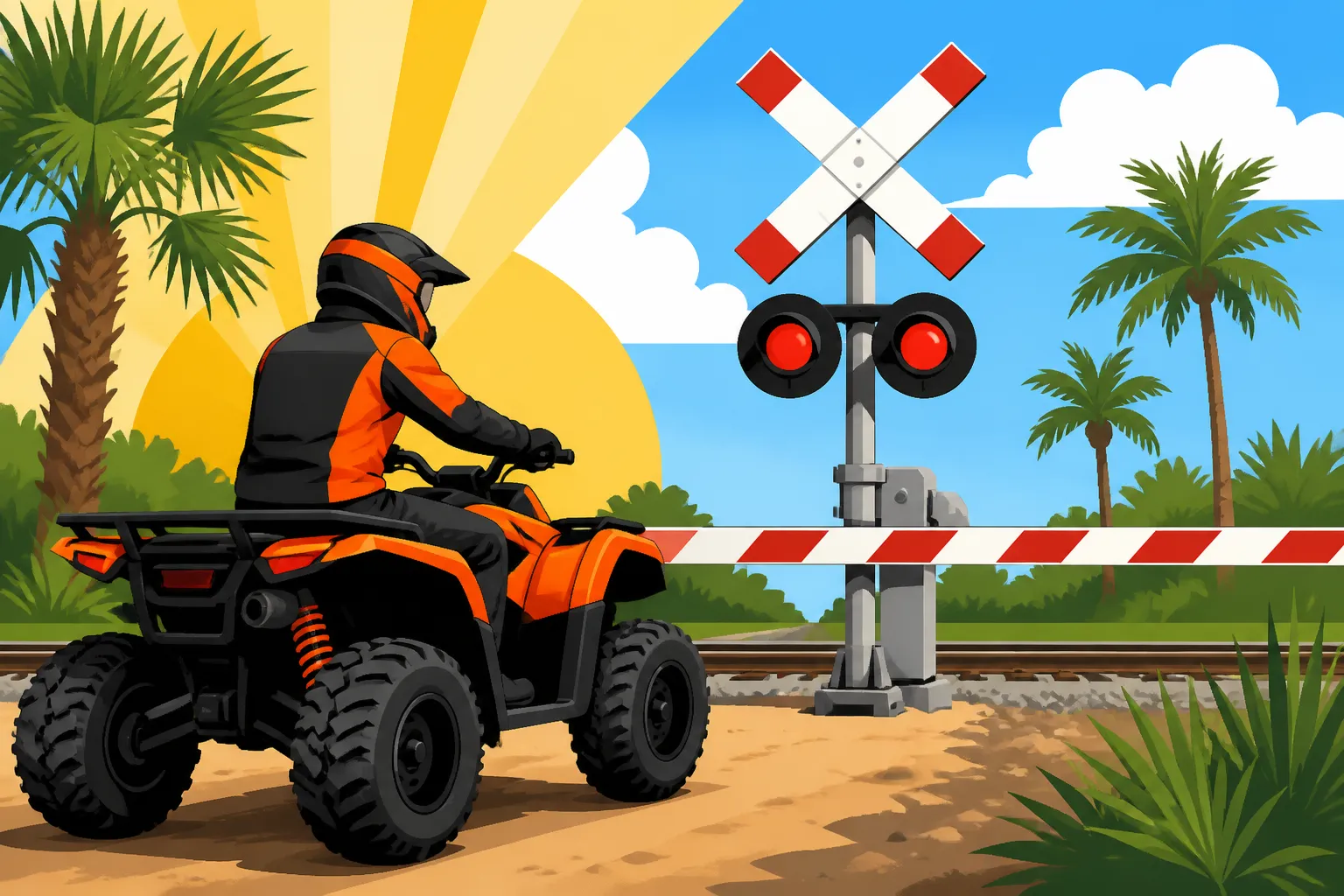
So, what about those legitimate intersections where an unpaved road, which you might be legally allowed to ride on, actually crosses railroad tracks? In these instances, the crossing is usually designated and maintained as a public crossing. This means the railroad company has an agreement or easement with the local municipality or county to allow vehicle traffic to cross their tracks at that specific point. These are typically marked with railroad crossing signs – the familiar "X" sign, and often a yield or stop sign.
When you encounter such a crossing, your ATV or UTV is essentially treated like any other vehicle that might use that road. You must obey all traffic laws pertinent to that intersection, including stopping, looking both ways, and yielding to any approaching trains. The challenge for ATV riders here lies not in the legality of the crossing itself (assuming it's a public crossing), but in the unique handling characteristics of an ATV or UTV over uneven and potentially treacherous railroad tracks. While [Florida ATV Speed Limit on Unpaved Roads] might give you an idea of how fast you can go on the approach, the crossing itself requires a much more cautious and specific approach. The "unpaved roadway" you're on might be legal, but the transition onto and over steel tracks introduces significant safety factors that cars don't typically contend with.
Safety First: Best Practices for ATV Riders at Railroad Crossings
Okay, so you’ve established that you’re at a legal public crossing, and you know you’re allowed to proceed. Now, it's absolutely paramount to prioritize safety. Railroad crossings, even legitimate ones, present unique hazards for ATVs and UTVs that are very different from what a standard car or truck experiences. The combination of steel rails, wooden or concrete ties, gravel ballast, and potentially uneven approaches can quickly turn a routine crossing into a dangerous situation. Your vigilance and proper technique are your best defenses.
Approaching the Crossing: Look, Listen, and Slow Down
You’ve probably heard "Look, Listen, Live" since childhood, but it’s not just a catchy slogan; it's a critical directive, especially for ATV riders. As you approach any railroad crossing, whether it's clearly marked or even if you just suspect tracks are ahead, start slowing down significantly. This gives you ample time to assess the situation. First, look both ways, well before you reach the tracks. Don't rely solely on warning signals or gates, as these can malfunction, or not exist at less-trafficked rural crossings. Sweep your gaze up and down the tracks as far as you can see.
Next, listen. Turn off your engine or put your machine in neutral for a moment if you need to, especially if you're wearing a full-face helmet that might muffle sounds. A train can be surprisingly quiet until it's very close, especially if the wind is blowing in the wrong direction or you're surrounded by other sounds. The rumble and horn of an approaching train are unmistakable once you hear them, but you need to actively listen. This isn't the time to be distracted by your riding buddies or thinking about your next turn. Maintain a safe distance from the tracks while you're looking and listening, always ready to stop if necessary.
Crossing the Tracks: Angle, Speed, and Surface Awareness
Once you've confirmed no train is approaching and the crossing is clear, the actual maneuver of crossing the tracks requires precision. The golden rule for ATVs and UTVs is to approach the tracks as perpendicularly as possible – aim for a 90-degree angle. This minimizes the chance of your tires getting caught in the flangeway (the gap next to the rail) or sliding along the rail itself, which can easily cause a loss of control, especially on wet or loose surfaces. Some riders might even lean slightly forward to shift their weight, giving more stability as the front tires make contact.
Maintain a steady, moderate speed – not too fast that you lose control, but not so slow that you risk getting stuck or having your momentum killed by the uneven terrain. The ground around tracks is often loose gravel, dirt, or even broken concrete, which can shift under your tires. Be hyper-aware of your surroundings; look for potholes, exposed ties, or sections where the ballast is particularly deep or uneven. If your ATV has low ground clearance, or if you're riding a UTV that's been customized with larger tires, ensure you won't high-center on the raised rails. A solid skid plate, perhaps from a reputable brand like SuperATV, can provide some protection against unexpected impacts, but prevention is always best. Think of it as a brief, controlled obstacle course.
What to Do if There's a Train Approaching or Present
This might seem obvious, but it's worth reiterating: if you see or hear a train approaching, STOP. Do not, under any circumstances, try to "beat" the train. It's a risk that is never, ever worth taking. Trains are much faster and closer than they appear, and they cannot stop quickly. Always stop a safe distance away from the tracks – at least 15 feet – and wait for the train to pass completely. Once it has passed, look and listen again for a second train before proceeding, as sometimes two trains can run on parallel tracks or in opposite directions.
If the crossing has gates, wait for them to fully retract before proceeding. Never go around lowered gates, even if you don't see a train. Those gates are there for a reason, and bypassing them is not only illegal but extremely perilous. Remember, the [Florida Sheriff Enforcement of ATV Road Rules] can extend to these crossings, and violations carry serious penalties. Patience is a virtue, and in this case, it could very well save your life.
Here's a quick reference table for safe crossing practices:
| Action | Safe Practice | Unsafe Practice |
|---|---|---|
| Approach | Slow down, look both ways, listen for trains. | Speeding up, ignoring signs, relying solely on signals. |
| Train Presence | Stop at least 15 feet from tracks, wait for train to pass, check again. | Trying to beat a train, going around lowered gates, not checking for a second train. |
| Crossing Angle | Cross at a 90-degree angle to the tracks. | Crossing at a shallow angle, which can trap tires or cause slides. |
| Speed | Maintain a steady, moderate speed, just enough for momentum. | Crossing too fast (loss of control) or too slow (getting stuck). |
| Surface Awareness | Watch for loose gravel, potholes, exposed ties, uneven ballast. | Ignoring surface conditions, assuming a smooth ride. |
| Equipment | Ensure tires have good grip, consider skid plates for protection. | Riding with worn tires, ignoring potential for high-centering. |
Common Misconceptions and Risky Behaviors Around Railroads
Even with all the warnings and safety advice, some common misconceptions and risky behaviors persist among ATV and UTV riders when it comes to railroad crossings. These often stem from a misunderstanding of the law, an underestimation of the danger, or simply an "it won't happen to me" mentality. As a seasoned lifestyle blogger, I've heard all the stories, and trust me, the consequences of these missteps are rarely minor.
"These Tracks Look Abandoned – They Must Be Fair Game!"
This is perhaps one of the most dangerous assumptions a rider can make. Just because tracks are overgrown, rusty, or you haven't seen a train on them recently doesn't mean they are abandoned or open for recreational use. As we discussed, railroad tracks are almost universally private property. Even if a line is officially "out of service," the land itself and the tracks are still owned by a railroad company, or by another entity that acquired the right-of-way.
Riding on these seemingly abandoned tracks is still trespassing, and it comes with all the legal repercussions, including potential fines and your machine being impounded, leading to [Florida Penalties for Illegal ATV Road Riding]. Beyond the legal issues, there are physical dangers: dilapidated tracks can have unstable ties, missing rails, or hidden hazards that can damage your machine or cause an accident. Never assume tracks are "fair game" without explicit, written permission from the owner, which is exceedingly rare for recreational riding.
Ignoring Warning Signs and Signals
We've all seen them: the classic crossbuck "Railroad Crossing" sign, sometimes accompanied by a "Yield" or "Stop" sign, and often flashing lights and gates at more active crossings. Yet, it's not uncommon to see riders (and drivers of other vehicles) either ignore these signs or treat them as mere suggestions. For an ATV rider, skipping a stop or trying to sneak across a crossing with flashing lights is an enormous gamble.
A train could be much closer than you think, and its speed is often misjudged. Those signs and signals are not there for decoration; they are legally mandated safety devices designed to prevent catastrophic accidents. Failing to obey them is a direct violation of traffic law. This could result in a hefty [Florida ATV Ticket Cost for Illegal Road Riding], points on your driver's license (if you have one and are required to use it for road crossings), and potentially the impoundment of your ATV. More importantly, it puts your life at extreme risk.
Riding Parallel to Tracks Within the Right-of-Way
Another behavior that often leads to trouble is riding along the tracks, rather than just crossing them. Whether it's because the path seems smooth, or it's simply a convenient shortcut, riding parallel to active or even disused railroad lines within the railroad's right-of-way is trespassing. This strip of land on either side of the tracks is specifically reserved for railroad operations, maintenance, and safety.
Not only is this illegal, but it's incredibly dangerous. You could encounter unexpected obstacles, maintenance crews, or even a train that you didn't anticipate. Maintenance equipment can be very quiet, and workers might not expect an ATV in their operational zone. Stick to designated trails and roads, and if you see railroad tracks, cross them safely and legally at a designated crossing, then continue on your way far from the railway property.
Equipment Considerations for Crossing Tracks
While safety practices and legal adherence are paramount, your machine's setup can also play a role in making railroad crossings safer. The right tires, suspension, and even undercarriage protection can provide an extra layer of confidence and capability when tackling these tricky sections. It’s about being prepared for the unexpected jolts and uneven terrain that railroad crossings inherently present.
Tire Choice and Inflation
The type of tires you have on your ATV or UTV can significantly impact how well your machine handles the abrupt changes in terrain at a railroad crossing. Aggressive mud tires, while fantastic for slinging through Florida's infamous mud holes, might have lugs that are too wide and could potentially get hung up in the flangeway or provide less stable contact on smooth steel rails. Conversely, tires that are too smooth won't give you the necessary grip on loose gravel or the wooden ties.
You want a tire with a good all-around tread pattern that offers a balance of traction and stability. More importantly, proper tire inflation is key. Over-inflated tires will bounce more and offer less contact patch, reducing grip. Under-inflated tires might roll off the rim or offer too much flex, making precise steering difficult. Check your owner's manual for recommended PSI, and adjust slightly for the terrain if you know you'll be encountering varied surfaces. Some riders might even opt for a tire from a brand like SuperATV that is known for its durability and versatility across different terrains, giving them confidence over varied surfaces like those found at crossings.
Suspension Setup and Ground Clearance
Railroad crossings are rarely perfectly level. You'll likely encounter a series of small bumps as you go over the rails and ties, and the approach on either side can be significantly uneven or rutted. A properly tuned suspension system can absorb these impacts, keeping your tires on the ground and maintaining control. If your shocks are worn out or improperly adjusted, your ATV might bounce uncontrollably, making it harder to steer straight and increasing the risk of losing balance.
Additionally, consider your ground clearance. While most ATVs have ample clearance, some lower-slung UTVs or highly modified machines might risk high-centering, especially if the tracks are significantly raised above the surrounding terrain. If you regularly ride in areas with such obstacles, investing in a lift kit or more robust suspension components can be a wise choice. This ensures that your undercarriage, including critical components like your engine case or driveshaft, doesn't strike the rails or ties, which could cause expensive damage.
Underbody Protection
Given the potential for unexpected impacts from rails, ties, or hidden debris within the ballast, robust underbody protection is a smart addition, especially if you anticipate frequent encounters with railroad crossings. Skid plates made from durable materials like aluminum or UHMW (ultra-high molecular weight polyethylene) can shield your machine's vital components. These plates protect the frame, engine, transmission, and differential from direct hits, preventing punctures, cracks, or other damage that could leave you stranded.
While factory skid plates offer some protection, many aftermarket options from companies like SuperATV provide more comprehensive coverage and thicker materials, designed to withstand more abuse. Think of it as insurance for the underside of your machine – you hope you never need it, but you're glad it's there if you do. This kind of protection is crucial, particularly if you're riding a UTV that has a longer wheelbase and might be more prone to scraping its belly on uneven terrain like a raised railroad crossing.
Consequences of Illegal or Unsafe Crossings
The romanticized image of riding an ATV across open fields and through winding trails often glosses over the very real and sometimes severe consequences that can arise from illegal or unsafe actions, particularly around railroad crossings. It's not just about getting a slap on the wrist; we're talking about legal penalties, financial burdens, and, most critically, the very real threat of serious injury or worse.
Fines, Penalties, and Impoundment
Crossing railroad tracks where you shouldn't, failing to yield to a train, or ignoring warning signals are all serious traffic violations in Florida. These aren't minor infractions. The [Florida ATV Ticket Cost for Illegal Road Riding] can be substantial, often comparable to what you'd pay for serious moving violations in a car. Beyond the immediate fine, you could also accrue points on your driver's license if you're operating your ATV on a public road where a license is required, which can impact your insurance rates or even lead to license suspension.
Perhaps even more distressing for any rider is the possibility of having your ATV or UTV impounded. Law enforcement, including the [Florida Sheriff Enforcement of ATV Road Rules], has the authority to seize your machine if you're operating it illegally, especially on private property like railroad tracks or in a manner that endangers public safety. Getting your machine out of impound can be a lengthy, frustrating, and expensive process, involving impound fees, storage charges, and administrative costs, on top of any fines. This effectively puts your riding hobby on hold and can drain your wallet faster than a mud bog drains a battery.
Accidents and Injuries: The Ultimate Risk
While the legal and financial consequences are certainly deterrents, they pale in comparison to the ultimate risk: an accident. Colliding with a train is almost always fatal, given the immense size, speed, and lack of maneuverability of a locomotive. Even a near miss can cause an ATV rider to panic, swerve, and crash, leading to severe injuries. The forces involved are simply not survivable.
Beyond train collisions, the uneven and treacherous nature of railroad crossings themselves poses a significant injury risk. A tire catching in the flangeway, a sudden drop over an exposed tie, or losing traction on loose ballast can easily lead to a rollover or a rider being thrown from the machine. These types of accidents can result in broken bones, head injuries, spinal trauma, or other debilitating injuries. Remember, even with the best protective gear, the physics of an ATV hitting an immovable steel rail are unforgiving. Understanding [Why Florida ATVs Cannot Use Paved Streets] due to their different handling characteristics should reinforce the idea that even more caution is needed on specific hazards like railroad tracks.
What if a Crossing is on Private Land or a Designated Trail?
Sometimes, riders encounter railroad tracks in less conventional settings than a typical public road crossing. You might be on private land with permission, or on a designated off-highway vehicle (OHV) trail that happens to have a railroad line running through or alongside it. While the context might be different, the core principles of safety and legality around railroad property remain largely unchanged.
The Importance of Permission: Beyond Just the Landowner
Let's say you're riding on a friend's sprawling ranch in rural Florida, and their property is bisected by an old railroad spur. Your friend has given you full permission to ride anywhere on their land. It's easy to assume that this permission extends to crossing the tracks that lie within their property boundaries. However, this is a critical misunderstanding. Even if the tracks physically cross your friend's land, the railroad company almost certainly retains ownership of the tracks themselves and a surrounding right-of-way through an easement.
This means your friend's permission to ride on their land does not automatically grant you permission to ride on the railroad's property. To legally cross or ride near those tracks, you would need separate, explicit permission from the railroad company, which is incredibly rare for recreational purposes. Without it, you are still trespassing on railroad property, regardless of the landowner's consent for their own acreage. This highlights the importance of understanding specific property rights and easements, as detailed in Florida's [Florida Trespass Law for ATV Riders]. Always err on the side of caution and assume railroad property is off-limits unless you have direct, verifiable permission from the railroad company itself.
Designated OHV Trails and Railroad Encounters
Florida has some fantastic designated OHV riding areas, such as those within the state forests or private mud parks. These areas are specifically designed and maintained for off-road recreation. Occasionally, you might find a designated trail that has a controlled crossing with an active or disused railroad line. In these cases, the trail managers have typically worked out agreements with the railroad company to ensure safe and legal passage.
When riding on such a trail, always follow any specific signage or instructions related to the railroad crossing. These might include mandatory stops, specific crossing procedures, or even advisories about train schedules. Trust that if the trail is officially open and includes a railroad crossing, the necessary safety measures and legal agreements are in place. However, it's still your responsibility as the rider to exercise extreme caution, follow all posted warnings, and remain vigilant for trains or maintenance equipment. Don't let the "designated trail" status lull you into a false sense of security; the inherent dangers of railroad tracks still apply. Remember, even on designated trails, [Carrying Proof of Ownership on the Trail] and any relevant passes is always good practice, especially if you encounter law enforcement.
Disclaimer
This article is for general informational purposes only and does not constitute professional advice. Laws, prices and regulations vary by location and change over time. Consult a qualified professional for guidance on your specific situation.