What Ocala National Forest Staff Can Ask to See
It can feel a little nerve-wracking to be out on the trails in Ocala National Forest, enjoying the ride, only to see a Forest Service vehicle pull up. Your mind starts racing: Did I do something wrong? Am I supposed to have something specific with me? This guide is here to put your mind at ease, outlining exactly what Ocala National Forest staff are authorized to ask for and check when you're riding your ATV or UTV on their beautiful trails, so you can ride with confidence and stay compliant.
Understanding Ranger Checks and Why They Happen
When you're out riding your ATV or UTV in a public area like the Ocala National Forest, you're not just out in the wild – you're in a managed recreational area with specific rules designed to protect both the environment and the riders. Forest Service staff, rangers, and even local law enforcement are there to ensure everyone is following those rules. These checks aren't usually about catching you doing something wrong; they're primarily about education, safety, and verifying compliance.
Imagine a situation where there's been an increase in unregistered machines or accidents on the trails. A ranger might increase their presence to make sure everyone is properly equipped and permitted. They're often looking for a few key things that prove your machine is legally allowed on the trails and that you, as the rider, are meeting safety requirements. Think of it less as a hassle and more as a way to maintain the quality and safety of the riding experience for everyone who loves these natural spaces. They want to prevent issues like resource damage from illegal riding or injuries from unsafe practices. Plus, having the proper documentation can be incredibly helpful if your machine ever gets lost or stolen, providing clear proof of ownership.
The Role of Forest Staff on the Trails
Forest Service staff aren't just there to hand out tickets; they play a crucial role in maintaining the forest for all users. This includes trail maintenance, wildlife protection, and enforcing regulations that keep areas like Ocala National Forest enjoyable and sustainable. When they conduct a check, they're acting as custodians of this natural resource. They might stop you to verify that you have a valid OHV pass, that your machine meets sound limits, or that young riders have completed their safety courses. Their presence helps deter illegal activity, which, in turn, preserves the trails for legitimate riders. It’s all part of the larger effort to manage these precious lands responsibly, ensuring that the next generation of riders can also enjoy the unique Florida scrub and pine flatwoods.
Essential Proof of Ownership and Machine Identification
One of the most fundamental things Ocala National Forest staff will want to see is proof that you legitimately own or have permission to operate the ATV or UTV you're riding. This isn't just a formality; it's a critical step in deterring theft and ensuring that if an incident occurs, the responsible party can be identified. Having your documents in order also streamlines the process if there's ever an accident or an inquiry about your machine. It’s generally a good idea to carry copies rather than originals, in case they get lost or damaged on the trail.
Verifying Ownership with a Title or MSO
For any ATV or UTV ridden on public lands in Florida, including Ocala National Forest, it must be titled. This means Forest staff can ask to see your Florida OHV title. This document proves you are the legal owner of the machine. If your quad is brand new, you might still have the Manufacturer's Certificate of Origin (MSO) in lieu of a title, as it can take some time for the title to be processed after purchase. The MSO serves as the initial proof of ownership from the manufacturer to the first retail buyer.
It’s crucial that the name on the title or MSO matches your identification, or that you have a [Florida ATV Bill of Sale: What It Needs to Say] if you've recently purchased it from a private seller and haven't yet transferred the title. This bill of sale, especially one created using a reputable service like LawDepot, can bridge the gap while you wait for the official title transfer to be completed. Remember, transferring a title promptly after buying a used machine is not just a good idea, it's often legally required within a certain timeframe. Don't forget to review [Reading a Manufacturer's Certificate of Origin] for details on what information these critical documents contain.
What About a Bill of Sale or Registration?
While a bill of sale can act as temporary proof of ownership, especially right after a private sale, it doesn't replace a state-issued title for long-term ownership verification. However, if you're in the process of titling a recently purchased machine, a well-documented bill of sale, perhaps one you drafted with the help of a template from LawDepot, alongside your driver's license, might suffice during a trailside check. This is particularly relevant if you're dealing with a situation where you're buying a used ATV in Florida and are still in the process of [Buying a Used ATV in Florida: Transferring the Title].
It's important to understand that while Florida titles ATVs and UTVs, it does not typically register them with annual decals or license plates for off-highway use, unlike cars or boats. So, a "registration" document like you might carry for a car simply won't exist for an OHV here. The title is the primary document proving legal ownership. Staff will cross-reference the Vehicle Identification Number (VIN) on your machine with the VIN on your title or MSO to ensure they match. If you don't have these documents, it can lead to questions and potential issues, including being asked to remove your machine from the trails until proper ownership can be established. Carrying [Carrying Proof of Ownership on the Trail] is a simple step that can save you a lot of trouble.
Your Riding Permits and Passes
Beyond proving ownership of your machine, you must also prove you have the right to ride on the specific trails within the Ocala National Forest. This is where OHV passes come into play. These passes are essential for funding trail maintenance, safety programs, and administrative costs associated with managing the riding areas. Without a valid pass, you could be cited and asked to leave the forest.
Florida National Forest OHV Pass
To ride any designated OHV trail in the Ocala National Forest, you need a valid Florida National Forest OHV Pass. These passes come in various durations: 3-day, 7-day, or annual. Forest staff will ask to see this pass, which is usually a physical card or printout that you carry with you. It’s your ticket to accessing the hundreds of miles of trails that weave through the Ocala National Forest. You can purchase these passes online through Recreation.gov or sometimes at specific ranger stations or kiosks located near trailheads. Always check the official Ocala National Forest website before your trip to confirm where and how to obtain your pass, and what the current [Florida National Forest OHV Pass Prices] are.
Displaying Your Pass (If Applicable)
While some passes might have a sticky back to adhere to your machine, often for state parks or certain private areas, the Florida National Forest OHV Pass typically doesn't require permanent display on your ATV or UTV. Instead, it's a document you carry with you, much like your driver's license or title. When a ranger approaches you, be ready to present it. If you're riding with a group, each machine needs its own pass. It’s not a one-pass-per-group situation.
Consider a scenario: you planned a weekend trip with friends to ride the [Ocala National Forest ATV Trails in Florida]. You bought a [The $10 Three-Day Forest Pass] online and printed it out. A ranger stops your group and asks for passes. Everyone quickly pulls theirs out. This simple act keeps your day flowing smoothly. If someone in your group forgot or didn't get one, it could lead to them being turned away from the trails, potentially ruining the outing for everyone. Having documentation readily available, perhaps even a digital copy on your phone to back up a physical one, is always a good practice. This also reinforces the importance of knowing what Forest staff can ask to see before you even unload your machine.
Safety Certifications and Personal Gear
Safety is paramount when riding off-road, and Ocala National Forest staff are authorized to check for compliance with certain safety regulations. These rules are in place to minimize accidents and injuries, particularly among younger riders. It's not about being overly strict, but about creating a safe environment for everyone who uses the trails.
ATV Safety Course Certificate for Minors
Florida has specific requirements for young riders on public lands. If you are under 16 years old and operating an ATV or UTV on public lands like Ocala National Forest, you must possess a valid ATV safety course certificate issued or approved by the Florida Department of Agriculture and Consumer Services (FDACS). Forest staff are well within their rights to ask for this certificate. This rule is designed to ensure that young riders have a basic understanding of safe operation, trail etiquette, and potential hazards.
If a minor is riding and cannot produce this certificate, it could result in them being unable to continue riding and potentially a citation for the supervising adult. This is a non-negotiable safety requirement. For comprehensive details on this, refer to [Florida ATV Safety Course Requirements for Riders Under 16]. It's highly recommended to carry the physical certificate or a clear, legible photo of it on your phone.
Helmets and Eye Protection
While not always explicitly asked for as a "document" in the same way as a title or pass, Ocala National Forest staff will certainly observe if riders are wearing the required safety gear. For riders under 16, a U.S. Department of Transportation (DOT) compliant helmet is mandatory at all times when operating an ATV or UTV on public land in Florida. Additionally, all riders under 16 must wear eye protection. While there isn't a strict "helmet law" for adults over 16 on ATVs, it's strongly encouraged for everyone, and it's a primary safety check for younger riders. Forest staff prioritize safety, and non-compliance with these visual requirements can certainly lead to a stop and further questioning. [Helmets Required for Everyone at Croom] is a good general guideline for all managed OHV areas in Florida.
Machine-Specific Safety Equipment (Spark Arrestors)
Another key item Forest staff will look for, especially during a [Florida Ranger Checks at a Trailhead], is a U.S. Forest Service approved spark arrestor on your exhaust system. This is a critical piece of equipment designed to prevent wildfires by trapping sparks that could escape from your engine. Florida's dry season, with its abundance of pine needles and dry scrub, makes fire prevention incredibly important.
If your machine doesn't have a spark arrestor, or if it's clear the one you have is damaged or not effective, you'll be asked to leave the trails immediately. This isn't just a recommendation; it's a federal requirement for OHVs operating on National Forest land. Many aftermarket exhausts come with spark arrestors, but always double-check yours to ensure it's USFS-approved. Understanding [Spark Arrestors and Why Rangers Look] can help you prepare.
What Happens During a Check and How to Be Prepared
Encountering Forest staff on the trails can be a quick, polite interaction if you're prepared. They’re simply doing their job to keep the forest safe and properly managed. Knowing what to expect and how to respond can make the experience smooth and stress-free.
Standard Operating Procedures for Trailside Checks
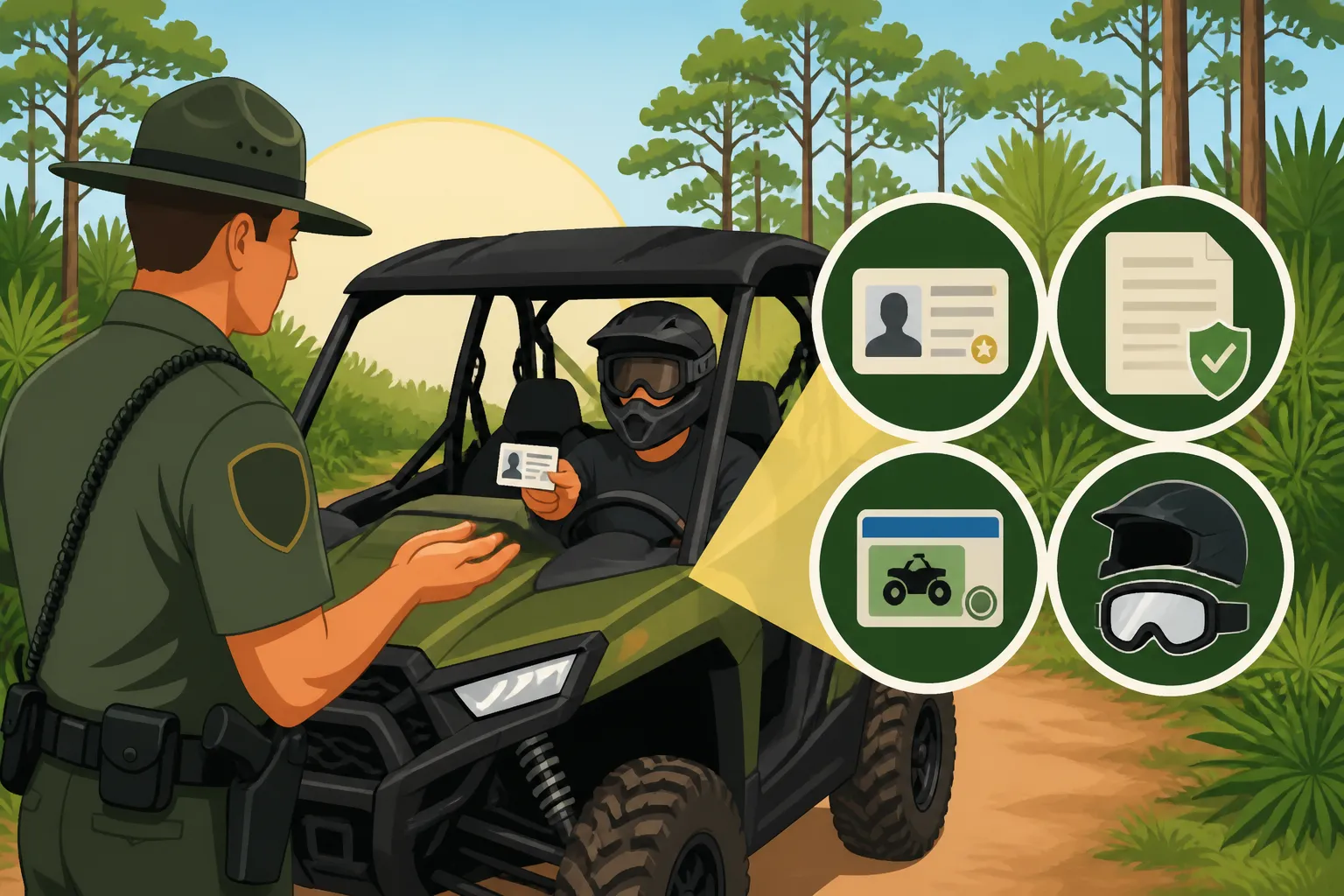
When Forest staff approach you, they'll typically identify themselves and state the reason for the stop, which is usually a routine compliance check. They might ask you to safely pull over to the side of the trail. They'll then request to see your documentation:
- Proof of Ownership: Your ATV/UTV title or MSO.
- OHV Pass: Your Ocala National Forest OHV pass.
- Identification: A driver's license or other valid photo ID.
- Safety Certificate: For riders under 16.
They may also visually inspect your machine for things like the presence of a spark arrestor or compliance with width restrictions if you're riding a UTV, as [Florida UTV Titling for Side-by-Sides Over 55 Inches] mentions width is a defining characteristic for vehicle classification. Be polite, answer their questions truthfully, and present your documents clearly. If you are using a bill of sale as temporary proof of ownership, such as one you created with LawDepot, ensure it is complete and accurate.
A Table of What to Carry
To help you remember, here's a quick rundown of the essential items Forest staff might ask to see or check for:
| Document/Item | Who Needs It | Why It's Needed | Where to Keep It |
|---|---|---|---|
| Florida OHV Title / MSO | All ATV/UTV owners/operators | Proof of legal ownership | Waterproof bag on machine/rider |
| Valid Photo ID (Driver's License) | All adult operators | Personal identification | Wallet |
| Ocala National Forest OHV Pass | All ATV/UTV operators on designated trails | Permission to ride on specific federal land trails | Waterproof bag on machine/rider |
| ATV Safety Course Certificate | Riders under 16 years old | Proof of safety education | Waterproof bag on machine/rider |
| Spark Arrestor (USFS Approved) | All ATV/UTV machines | Fire prevention (visual inspection) | Attached to exhaust (visual check) |
| DOT-Compliant Helmet | Riders under 16 (required), Adults (highly recommended) | Head protection (visual check) | Worn on head |
| Eye Protection | Riders under 16 (required) | Eye protection (visual check) | Worn on face |
| Bill of Sale (Temporary) | Recent private sale buyers | Interim proof of ownership before title transfer | Waterproof bag on machine/rider |
Keeping Your Documents Accessible and Safe
It’s best practice to keep all your important documents in a waterproof bag or container, secured on your person or within a compartment on your ATV or UTV. A clear, zip-top plastic bag inside a small backpack or fanny pack works wonders for preventing water damage from splashes or unexpected rain showers. Avoid keeping originals in easily lost places. A high-quality bill of sale, potentially generated using a service like LawDepot, should also be stored securely if you're relying on it temporarily.
Imagine you're deep on the trails of Ocala National Forest, and a sudden Florida downpour hits. If your paper documents are just shoved into a pocket, they'll be ruined. Having them laminated or sealed in a durable, waterproof pouch ensures they remain legible and intact, making any ranger interaction a breeze. Being prepared means you can quickly present what's asked for, confirm your compliance, and get back to enjoying your ride.
Disclaimer
This article is for general informational purposes only and does not constitute professional advice. Laws, prices and regulations vary by location and change over time. Consult a qualified professional for guidance on your specific situation.