Putting a Florida Quad in an LLC’s Name
Thinking about putting your beloved Florida quad or UTV into the name of an LLC can feel like stepping into a legal maze. You're probably wondering if it's even worth the hassle, or if you'll just end up with more paperwork than protection. This guide is here to untangle that confusion, walking you through the whys and hows of titling your off-highway vehicle under a Limited Liability Company in the Sunshine State, so you can make an informed decision without feeling overwhelmed.
Why Consider an LLC for Your Florida Quad?
When you own an ATV or UTV, especially if you're serious about riding, you might naturally think about protecting your assets. It’s not just about keeping your prized machine safe from theft, but also about safeguarding your personal finances from potential liabilities. That's where an LLC, or Limited Liability Company, can come into play. Many riders in Florida, particularly those who use their machines for business, multiple family members, or frequently on public lands, start to explore this option for some very solid reasons. It's a way to separate your personal financial life from the potential risks associated with owning and operating a powerful off-road vehicle.
Personal Asset Protection: Shielding Your Wallet
Let's face it, accidents happen. Even the most careful rider can find themselves in an unforeseen situation, whether it's a fender bender on a designated [Florida ATV Road Rules: Where You Can Legally Ride] or an unfortunate incident on a private trail. If your quad is personally owned and an accident occurs where you're deemed at fault, your personal assets – like your home, savings, or other vehicles – could be at risk. This is the biggest draw for many riders considering an LLC. By titling your quad under an LLC, you create a legal buffer between yourself and the machine. The LLC itself is a separate legal entity. This means that, in most cases, if someone sues over an incident involving your ATV, they would pursue the LLC's assets, not necessarily your personal wealth. It's a layer of protection that many find incredibly reassuring, especially when you've worked hard to build up your personal nest egg.
Think of it like this: your personal assets are in one box, and your ATV is in another box, the LLC box. If something goes wrong with the ATV, the legal ramifications primarily stay within the LLC box, leaving your personal asset box untouched. This isn't a bulletproof vest against all liability, especially in cases of gross negligence, but it's a significant safeguard that's worth exploring. It takes away some of that nagging worry that comes with every ride, knowing you've taken steps to mitigate potential financial disaster.
Business Operations and Tax Implications
For some, an ATV or UTV isn't just for fun; it's a tool for a small business. Perhaps you run a guided tour company in the Ocala National Forest, using UTVs to show tourists the sights, or maybe you use a quad on your farm for agricultural work. In these scenarios, an LLC becomes even more relevant. When your quad is used for business purposes, titling it under the LLC streamlines the accounting process and can offer tax advantages. Expenses related to the quad – maintenance, fuel, insurance – can be legitimately deducted as business expenses. This simplifies tracking income and outgoings and can lead to a healthier bottom line for your venture.
Beyond deductions, owning the quad within a business entity can influence how your business income is taxed. While I can't give specific tax advice (always consult a tax professional!), an LLC offers flexibility in how it's taxed – it can be treated as a disregarded entity (like a sole proprietorship), a partnership, or even elect to be taxed as an S-corporation or C-corporation. This flexibility allows you to choose the tax structure that best suits your business needs and can potentially reduce your overall tax burden. It also lends a professional air to your business, demonstrating a clear separation between your personal hobbies and your professional endeavors.
Estate Planning and Transferability
Estate planning might sound like something only for the super-rich, but it's a practical consideration for anyone with significant assets, including a high-value quad. If your ATV is titled in your name, upon your passing, it becomes part of your personal estate and might go through probate, which can be a lengthy and public legal process. When your quad is owned by an LLC, its transferability can be much simpler. The ownership of the quad is tied to the LLC, and the LLC itself is typically governed by an operating agreement. This agreement can specify how the ownership interests of the LLC (and thus, the assets it holds) are transferred upon the death of a member.
This can mean a smoother, faster, and more private transfer to your designated heirs or business partners, bypassing the probate court entirely. It's about ensuring your wishes are honored efficiently and minimizing stress for your loved ones during an already difficult time. For families who share riding passions, or for partners in an ATV-related business, this aspect of an LLC can be a huge peace of mind, knowing the machine can continue to be used and enjoyed without unnecessary legal hurdles.
The Process: Titling Your Quad in a Florida LLC's Name
So, you've weighed the benefits and decided that putting your quad in an LLC's name makes sense for you. Now, let's talk about the actual steps. It's not as complex as it might seem, but it does require attention to detail and following the correct procedures. Whether you're starting fresh with a new machine or transferring one you already own, the journey begins with establishing your LLC in Florida. Remember, the goal is to have the LLC, a legal entity distinct from you, be the official owner on paper.
Forming Your Florida LLC First
Before you can title anything in an LLC's name, you absolutely must establish the LLC itself. This is the foundational step. You'll need to register your LLC with the Florida Department of State, Division of Corporations. This involves filing Articles of Organization, which is a fairly straightforward document. It will ask for basic information like the name of your LLC, its principal address, and the name and address of its registered agent (a person or entity designated to receive legal documents on behalf of your LLC). You'll also need to decide on an operating agreement, which, while not filed with the state, is crucial for outlining how your LLC will be managed, who its members are, and how decisions will be made. Many riders find online services like LawDepot incredibly helpful for generating these legal documents, including the Articles of Organization and a comprehensive operating agreement, ensuring all the necessary legal language is in place without needing to start from scratch. Once your Articles of Organization are filed and approved, your LLC officially exists, and you'll receive a confirmation. This is your green light to proceed with titling your quad.
Transferring an Existing Quad Title to Your LLC
If you already own an ATV or UTV and it's currently titled in your personal name, you'll need to transfer that title to your newly formed LLC. This process is similar to buying a used quad from a private seller, but you're effectively selling it to your own company. You'll need to sign the existing title over to the LLC. On the assignment of title section, where it asks for the buyer's name, you will write the full legal name of your LLC. You'll also need a bill of sale, documenting the transfer from yourself as an individual to your LLC. Even if no money is changing hands (you're simply moving it from one of your pockets to another, legally speaking), you should list a nominal sales price, like $1, to satisfy the requirement for a consideration in the bill of sale.
When you take these documents to your local Florida tax collector's office, you'll fill out a new [Florida ATV Title Application Explained] form, listing the LLC as the new owner. You'll likely pay sales tax on the transaction (unless you can claim an exemption, which is rare for this type of transfer), and the standard titling fees. Don't forget that you'll also need proof of your LLC's existence, like a copy of your filed Articles of Organization, to show that the LLC is a legitimate entity capable of owning assets. This process ensures that the state's records accurately reflect the new owner of your off-highway vehicle. You can read more about this in [Florida ATV Title Transfer After a Private Sale].
Titling a Newly Purchased Quad Directly to Your LLC
Buying a brand-new quad or a used one directly into your LLC's name simplifies things a bit, as you skip the personal-to-LLC transfer step. When you purchase the ATV from a dealer, simply inform them that the buyer is your LLC. The dealer will then prepare all the necessary paperwork, including the Manufacturer's Certificate of Origin (MCO) or the existing title for a used machine, in the name of your LLC. They'll typically handle the initial titling application on your behalf, ensuring the LLC is listed as the owner from day one. This means your [What a Dealer Files on Your Behalf After a Sale] will reflect the LLC as the purchaser, and the MCO or previous title will be assigned directly to your LLC.
If you're buying a used quad from a private seller, you'll need to ensure the bill of sale clearly states the LLC as the buyer. The seller will sign the existing title over to your LLC. Then, you'll take these documents – the signed-over title, the bill of sale, and proof of your LLC's existence – to the tax collector's office. You'll complete the [Florida ATV Title Application Explained] with your LLC's information as the owner, pay the applicable sales tax (if any) and titling fees. It's crucial to ensure all paperwork correctly identifies the LLC by its full legal name, avoiding any confusion or delays in processing your new title. Understanding [Florida Off-Highway Vehicle Title Rules Explained] is always a good idea, regardless of who the owner will be.
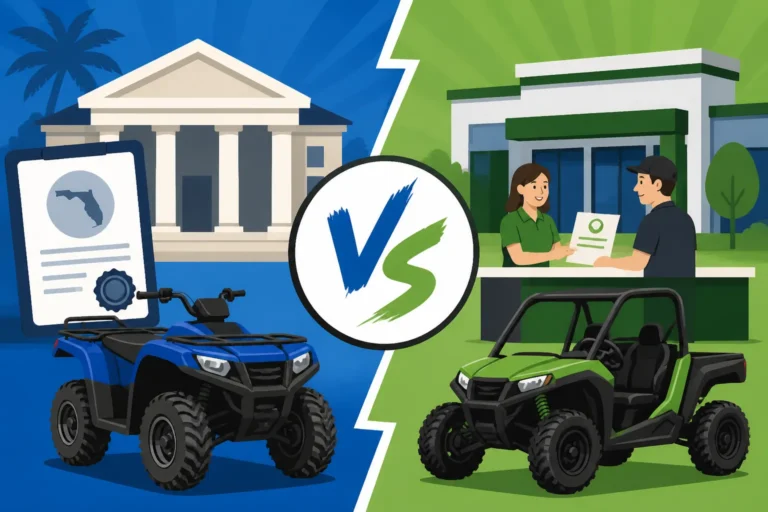
Here's a quick comparison of the two main titling scenarios:
| Scenario | Key Action | Documents Needed | Ownership History |
|---|---|---|---|
| Existing Quad (Personal to LLC) | Transfer title from individual to LLC | Original Title (signed over), Bill of Sale (individual to LLC), LLC Docs | Personal -> LLC |
| Newly Purchased Quad (Dealer) | Dealer titles directly to LLC | MCO/Original Title (assigned to LLC), Dealer Sales Agreement, LLC Docs | Manufacturer/Previous -> LLC |
| Newly Purchased Quad (Private) | Seller signs title over directly to LLC | Original Title (signed over to LLC), Bill of Sale (seller to LLC), LLC Docs | Previous Owner -> LLC |
Practical Considerations and Potential Pitfalls
While putting your Florida quad in an LLC's name offers many advantages, it's not a set-it-and-forget-it solution. There are ongoing responsibilities and potential challenges you should be aware of. Just like riding your quad requires constant attention to the trail, managing an LLC requires ongoing adherence to legal and administrative requirements. Ignoring these can undermine the very protections you sought to establish.
Ongoing Compliance and Costs
An LLC is a legal entity, and maintaining its good standing requires ongoing compliance. In Florida, this generally means filing an annual report with the Department of State. This report confirms basic information about your LLC, like its registered agent and principal address. Failing to file this report can lead to administrative dissolution of your LLC, which means it ceases to exist as a legal entity, and its asset protection benefits could be lost. There are also associated fees for the annual report. These are recurring costs that you need to budget for, in addition to the initial filing fees for forming the LLC.
Beyond the state-level requirements, you also need to ensure you operate the LLC correctly. This means "piercing the corporate veil" is a genuine risk. If you treat the LLC's assets and finances as your own personal ones, a court could decide that the LLC is just an alter ego and hold you personally liable. This is why it's crucial to maintain clear separation: have a separate bank account for the LLC, use the LLC's name in all transactions, and formally document important decisions. Using resources like LawDepot for drafting official meeting minutes or resolutions, even for a single-member LLC, can help maintain this distinction and solidify your LLC's legal standing. This administrative upkeep is part of the deal when you choose the LLC route.
Insurance Implications for LLC-Owned ATVs
Insurance is another critical piece of the puzzle. Just because your quad is owned by an LLC doesn't mean you can skip liability insurance; in fact, it makes it even more important. When the LLC owns the vehicle, the insurance policy should also be in the LLC's name. This means that if an incident occurs, the LLC's insurance policy will respond to claims against the LLC. You'll want to discuss this specifically with your insurance provider. They may offer commercial ATV or UTV policies, or specific endorsements for recreational vehicles owned by an LLC.
The type of use will also heavily influence your insurance needs. Is the quad strictly for recreational riding? Or is it used for a business purpose, like guiding tours or farm work? Commercial use will almost certainly require a different, often more comprehensive, policy than a purely recreational one. It's also wise to ensure that your personal liability umbrella policy, if you have one, covers incidents involving vehicles owned by an LLC, or to get a separate umbrella policy for the LLC. Don't assume anything – have a frank conversation with your agent about how your LLC-owned quad will be used and what coverage is appropriate to protect both the LLC and, indirectly, your personal assets. Remember, [Do Florida ATVs Need Insurance to Be Titled] is a common question, but for an LLC, robust insurance is about protecting the entity, not just satisfying a state requirement.
Lender Requirements and Liens
If you're financing your quad, either initially or if you plan to refinance an existing loan, the lender will have specific requirements about LLC ownership. Most lenders will allow an LLC to be the borrower, but they will almost certainly require a personal guarantee from you, the individual member of the LLC. This means that if the LLC defaults on the loan, you, personally, would still be responsible for the debt. This can feel like it undermines the asset protection, and in this specific instance, it does – but it's a common practice for small business loans where the LLC might not have a long credit history or significant assets beyond the vehicle itself.
When the title is issued, the lienholder's information will be recorded on the title, just as it would for a personally owned vehicle. This ensures that the lender's interest in the quad is protected. If you're transferring an existing quad with a lien from your personal name to your LLC, you'll need to work closely with your lender. They will have a process for modifying the loan agreement to reflect the new owner (the LLC) and for you to provide the necessary personal guarantee. This usually involves paperwork with the lender before you can officially [Recording a Lien Release on an OHV Title] and transfer the title at the tax collector's office. Make sure all parties are on the same page to avoid any hiccups in the titling or financing process.
Disclaimer
This article is for general informational purposes only and does not constitute professional advice. Laws, prices and regulations vary by location and change over time. Consult a qualified professional for guidance on your specific situation.