Non-Highway Tires and How They Define an ATV
Ever found yourself staring at your quad or side-by-side, wondering if those knobby tires actually make it different in the eyes of Florida law? It's a really common point of confusion, and frankly, it can be frustrating when you just want to understand the rules for your machine. This guide is here to untangle the often-overlooked but incredibly important role that non-highway tires play in defining your ATV or UTV in Florida, impacting everything from how you title it to where you can legally ride.
The Heart of the Matter: Why Tires Define Your ATV in Florida
It might seem overly specific, but in the Sunshine State, the type of tires on your all-terrain vehicle (ATV) or utility vehicle (UTV) isn't just a detail for off-road performance—it's a fundamental part of its legal definition. This distinction is crucial because it directly impacts how your machine is classified by the state, which then dictates its titling requirements and, most importantly, where you can actually operate it without running into trouble. The Florida statutes are quite particular, and understanding this isn't just about avoiding a ticket; it's about ensuring you're a responsible and compliant rider.
The Statute's View: Beyond Just "Off-Road"
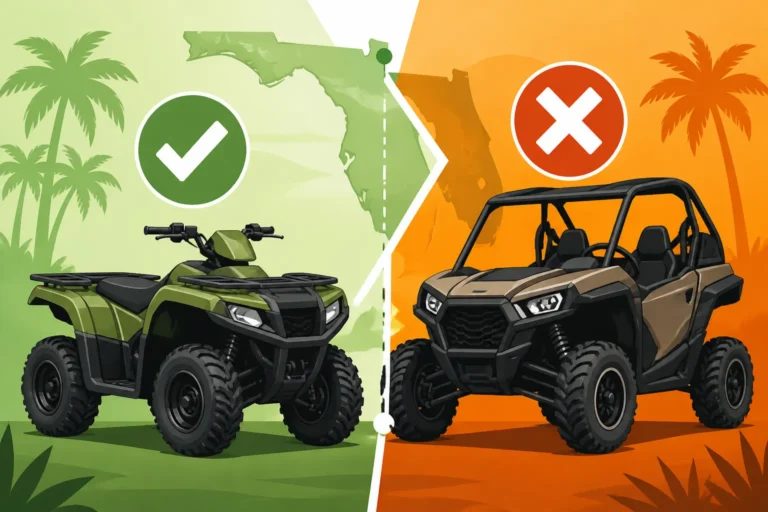
When Florida law talks about an ATV, it’s not simply using a casual term for "anything that goes off-road." The legal definition is precise, and a major component is the stipulation that it must be equipped with "non-highway tires." This isn't just a suggestion; it's a cornerstone of what separates an ATV from, say, a golf cart, a standard automobile, or even a low-speed vehicle (LSV), which might also be driven on unpaved surfaces. These non-highway tires signal to the state that the vehicle is primarily designed and intended for operation on unpaved surfaces, not for sharing the asphalt with cars and trucks.
Think of it this way: a typical passenger car, even if it has all-terrain tires, is still designed for highway travel. A golf cart, while often used off-road, typically has turf-friendly tires designed for minimal impact and lower speeds, and crucially, they are not classified as non-highway tires in the same vein as those on a true ATV. These distinctions are critical because a vehicle with non-highway tires is generally restricted from public paved roads, while vehicles with highway-approved tires are allowed (with proper registration and licensing). This foundational understanding is the first step in knowing whether your machine even qualifies for an [Florida Off-Highway Vehicle Title Rules Explained].
What Makes a Tire "Non-Highway" in the Sunshine State?
So, what exactly defines a "non-highway tire" in Florida? Generally speaking, these are tires characterized by their aggressive, open-lug tread patterns designed for maximum traction in dirt, mud, sand, and other loose or uneven terrain. They typically lack the "DOT" (Department of Transportation) stamp that signifies a tire is approved for highway use, and their construction often prioritizes flexibility and grip over sustained high-speed durability on pavement. You'll notice they often have very deep, widely spaced treads that would be incredibly noisy and wear down quickly on asphalt, not to mention providing less stable handling.
Contrast this with tires found on typical street-legal vehicles, which have shallower, more continuous tread patterns for better contact with hard surfaces, heat dissipation, and longevity at highway speeds. Even if you consider a side-by-side that could theoretically fit highway-style tires, its original factory-installed tires—and the vehicle's overall design for things like suspension travel, ground clearance, and lack of certain safety features—usually place it firmly in the "non-highway" category from the get-go. This is why manufacturers ship these machines with those distinctive knobby or paddle-style tires, making it clear they're built for adventure off the beaten path, not for the daily commute.
The Practical Impact: Titling and Operating Your Machine
Understanding the definition of non-highway tires isn't just academic; it has very real, practical implications for how you interact with your ATV or UTV in Florida. From the moment you purchase your machine to every time you consider where to ride, the tire type plays a silent but significant role in the legal framework surrounding your vehicle. Ignoring this definition can lead to headaches, fines, and even the impoundment of your beloved off-road companion.
How Tire Type Influences Your Florida ATV Title Application
When you go to title your ATV or UTV in Florida, the state implicitly expects your machine to meet the statutory definition of an off-highway vehicle, and those non-highway tires are a key part of that. For brand-new machines, this process is usually seamless. The dealer handles the initial paperwork, presenting a Manufacturer's Certificate of Origin (MSO) that clearly classifies the vehicle as an "off-highway vehicle" and often details its specifications, including tire type. This MSO is the primary document used to generate your [Florida Off-Highway Vehicle Title Law Explained] and record initial ownership.
However, the situation can get trickier if you're buying a used machine from a private seller, especially if the ownership history is a bit murky, or if you're trying to title something that falls into an ambiguous category, such as a homemade or highly modified vehicle. In these instances, the presence of non-highway tires helps solidify its classification as an OHV. A vehicle equipped with highway tires, regardless of its off-road capabilities, is generally not eligible for an OHV title. Instead, it would be treated as a motor vehicle, golf cart, or LSV, each with its own distinct titling and registration process. Knowing this distinction is essential before you begin the [Florida ATV Title Application Explained] process.
Riding Rules and Enforcement: Where Your Tires Take You (or Don't)
Perhaps the most immediate and impactful consequence of having non-highway tires is the restriction on where you can legally ride in Florida. The short answer is: ATVs are generally [Are ATVs Street Legal in Florida?]. Those aggressive treads that grip so well in the mud and sand are precisely what keep you off paved public roads. This isn't just about safety, though that's a factor; it's about the fundamental design and purpose of the vehicle as defined by state law. Riding on paved roads with non-highway tires can result in significant penalties, including traffic citations, hefty fines, and the possibility of your machine being impounded by law enforcement.
Florida law does provide very specific, limited exceptions for ATVs to operate on public roadways, such as directly crossing a paved highway at a designated intersection, or using certain designated unpaved roads in counties that have opted to allow it. But these are exceptions, not the rule. The general principle remains: non-highway tires mean off-highway use. This contrasts sharply with golf carts or LSVs, which, due to their different design, speed limitations, and often less aggressive tires (even if not strictly "highway" in the car sense), are permitted on certain public roads under specific conditions. Always double-check [Florida ATV Road Rules by County] before venturing onto any public road.
Common Questions and Misconceptions About ATV Tires
It's easy to get tangled up in the nuances of vehicle classifications, especially when it comes to ATVs and UTVs. The lines can feel blurry, and many riders try to find ways to make their machines more versatile. However, Florida law is quite clear, and addressing some common misconceptions can help prevent costly mistakes and keep you riding safely and legally.
My Side-by-Side Has "Street Legal" Tires – Is It an ATV?
This is a really common point of confusion, especially for side-by-side owners. You might have seen aftermarket tires advertised as "DOT approved" or "street legal" and wondered if putting them on your UTV changes its legal classification. Unfortunately, it typically doesn't. Even if you equip your UTV with tires that could technically be used on the highway, the vehicle's original classification on its Manufacturer's Certificate of Origin (MSO) generally dictates its legal identity in Florida. The MSO specifies the vehicle's type, weight, width, and intended use. If it came from the factory as an Off-Highway Vehicle (OHV), it's likely going to remain an OHV in the eyes of the state, regardless of subsequent tire swaps.
Trying to re-classify a true ATV or UTV as a low-speed vehicle (LSV) or a street-legal vehicle involves far more than just changing tires. It typically requires specific safety equipment upgrades—such as headlamps, taillamps, stop lamps, turn signals, reflective devices, rearview mirrors, a windshield, seat belts, and a vehicle identification number (VIN)—and a rigorous inspection process to ensure it meets LSV standards. These conversions are complex and not always feasible or cost-effective. Simply changing your tires usually won't grant you the privilege of driving your side-by-side on paved public roads; it will still be considered an OHV restricted to off-road use, with the limited exceptions we've discussed. Understanding [Florida Low-Speed Vehicle Rules for Side-by-Sides] can help clarify this further.
What if I Have a Homemade or Rebuilt ATV?
Titling a homemade or rebuilt ATV in Florida presents its own unique set of challenges, especially when the "original MSO" might be missing or nonexistent. In these scenarios, proving that your machine is indeed an ATV and meets the non-highway tire characteristic becomes absolutely crucial during the VIN inspection process. Florida will want to verify that your creation is genuinely an off-highway vehicle designed for unpaved terrain. You'll need to provide as much documentation as possible, such as a detailed [Florida ATV Bill of Sale: What It Needs to Say] (even if between individuals for parts), receipts for major components, and any other paperwork that helps establish the machine's history and its intended use.
The VIN inspection, which is mandatory for untitled or out-of-state vehicles, will involve an officer or certified inspector verifying the vehicle's identification numbers and often its physical characteristics, including the type of tires. They'll be looking to ensure that the machine aligns with the definition of an ATV or UTV, which includes having tires specifically designed for off-highway use. For these kinds of situations, having well-prepared documentation can make the process smoother. Services like LawDepot can be incredibly helpful for creating custom, legally sound bills of sale or other ownership affidavits if you’re building your own paper trail for a unique machine. This meticulous approach ensures that even your one-of-a-kind build can get a proper [Titling a Homemade or Rebuilt ATV in Florida].
The Role of Manufacturers and Aftermarket Choices
From the factory floor to your local custom shop, decisions about tires are made with purpose. Manufacturers build their machines with specific uses in mind, and that intent carries through to the legal classification. As riders, we often customize our machines for better performance, but it's important to remember that these personal choices don't necessarily override the initial legal definitions.
How Manufacturers Build and Classify
Manufacturers play a pivotal role in initially defining your ATV or UTV. When they design and produce these machines, they are built specifically for off-highway use, and that includes equipping them with non-highway tires right off the assembly line. This initial design and purpose are then clearly documented on the Manufacturer's Certificate of Origin (MSO), which is the very first document you receive that establishes legal ownership and classification of your new machine. The MSO is critical for [Who Must Title an ATV in Florida], as it's the foundation upon which your Florida OHV title is issued.
The MSO explicitly states that the vehicle is an "off-highway vehicle" and often contains warnings or disclaimers about its unsuitability for public road use. This isn't just a suggestion; it's a legal classification that the state tax collector's office will reference when processing your title application. This initial classification, rooted in the vehicle's design and factory-installed non-highway tires, is very difficult to change later, even if you make significant modifications. The state relies heavily on this primary documentation to ensure that vehicles are titled and operated according to their intended design and safety standards.
Aftermarket Tires: Enhancing Performance Without Changing Classification
It's completely natural for riders to want to upgrade or change their tires. Whether you're chasing better traction in the deep Florida sugar sand, looking for aggressive mud tires for a weekend at Hog Waller, or seeking a smoother ride over rocky terrain, the aftermarket is brimming with options. These tire changes can dramatically enhance your machine's performance and tailor it to your specific riding style and local conditions. However, it's crucial to understand that while these modifications improve your off-road experience, they do not alter your vehicle's fundamental legal classification in Florida.
If your machine was originally titled as an Off-Highway Vehicle (OHV) based on its factory specifications and non-highway tires, it remains an OHV, regardless of whether you've swapped those knobbies for even knobbier ones, or even some "pseudo-street legal" hybrid tire. The rules governing where you can and cannot ride on public roads still apply. Aftermarket tires are about optimizing for adventure—getting through that deep bog or climbing that steep bank—not about making your machine street legal. So, embrace the vast world of aftermarket tires to get the most out of your off-road adventures, but always remember that your Florida OHV title dictates its legal status, not your latest tire purchase.
| Characteristic | ATV/UTV (Off-Highway Vehicle) | Low-Speed Vehicle (LSV) | Golf Cart (Traditional) | Standard Automobile (Car/Truck) |
|---|---|---|---|---|
| Tire Type | Non-highway (aggressive tread, no DOT) | DOT-approved (moderate tread) | Turf-friendly (smooth tread) | DOT-approved (highway tread) |
| Primary Use | Off-road, unpaved surfaces | Local streets, low-speed areas | Golf courses, private communities | Public roads, highways |
| Top Speed | Varies widely, often 40-70+ mph | 20-25 mph | Typically under 20 mph | Varies, highway speeds |
| Titling Required | Yes, as an Off-Highway Vehicle (OHV) | Yes, as an LSV | No, typically not titled | Yes, as a motor vehicle |
| Registration | Not registered for road use (titled only) | Yes, registered and plated | No | Yes, registered and plated |
| Road Legality | Restricted to specific unpaved roads, crossings only | Yes, on roads 35 mph or less | Yes, on roads 25 mph or less | Yes, on all public roads |
| Insurance | Optional (often recommended off-road) | Mandatory for road use | Optional (often homeowners covers) | Mandatory liability insurance |
Disclaimer
This article is for general informational purposes only and does not constitute professional advice. Laws, prices and regulations vary by location and change over time. Consult a qualified professional for guidance on your specific situation.