Carrying Proof of Ownership on the Trail
Oh, the open trail! There's nothing quite like the thrill of exploring Florida's beautiful backroads and designated OHV areas on your ATV or UTV. But amidst all the excitement of gearing up and heading out, many riders overlook one crucial detail that can save them a world of trouble: carrying proper proof of ownership. Imagine being stopped by a deputy, perhaps at the gate of a state forest, or worse, having your machine recovered after a theft, only to realize you can't readily prove it's yours. This guide is here to walk you through exactly what documents you need to carry, why they're so important, and how to keep them safe and accessible while you're out enjoying the ride.
The Critical Importance of Carrying Proof of Ownership on Florida Trails
It's easy to think of your ATV or UTV as "just a toy," especially if you mostly ride on private land. But the moment you venture onto public trails, designated riding areas, or even cross a public road as permitted by law, your machine steps into a more regulated environment. Just like your car, your off-highway vehicle is a valuable asset, and being able to prove you legally own it isn't just a suggestion; it's a smart practice that protects you in numerous situations.
Avoiding Legal Headaches with Law Enforcement
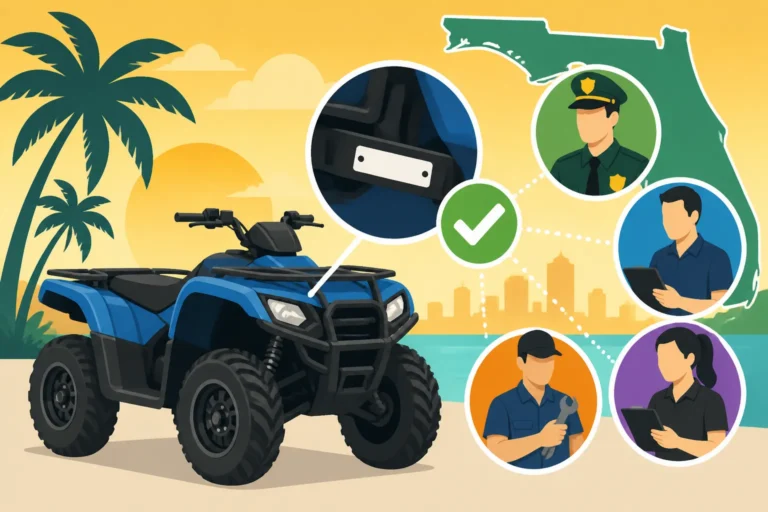
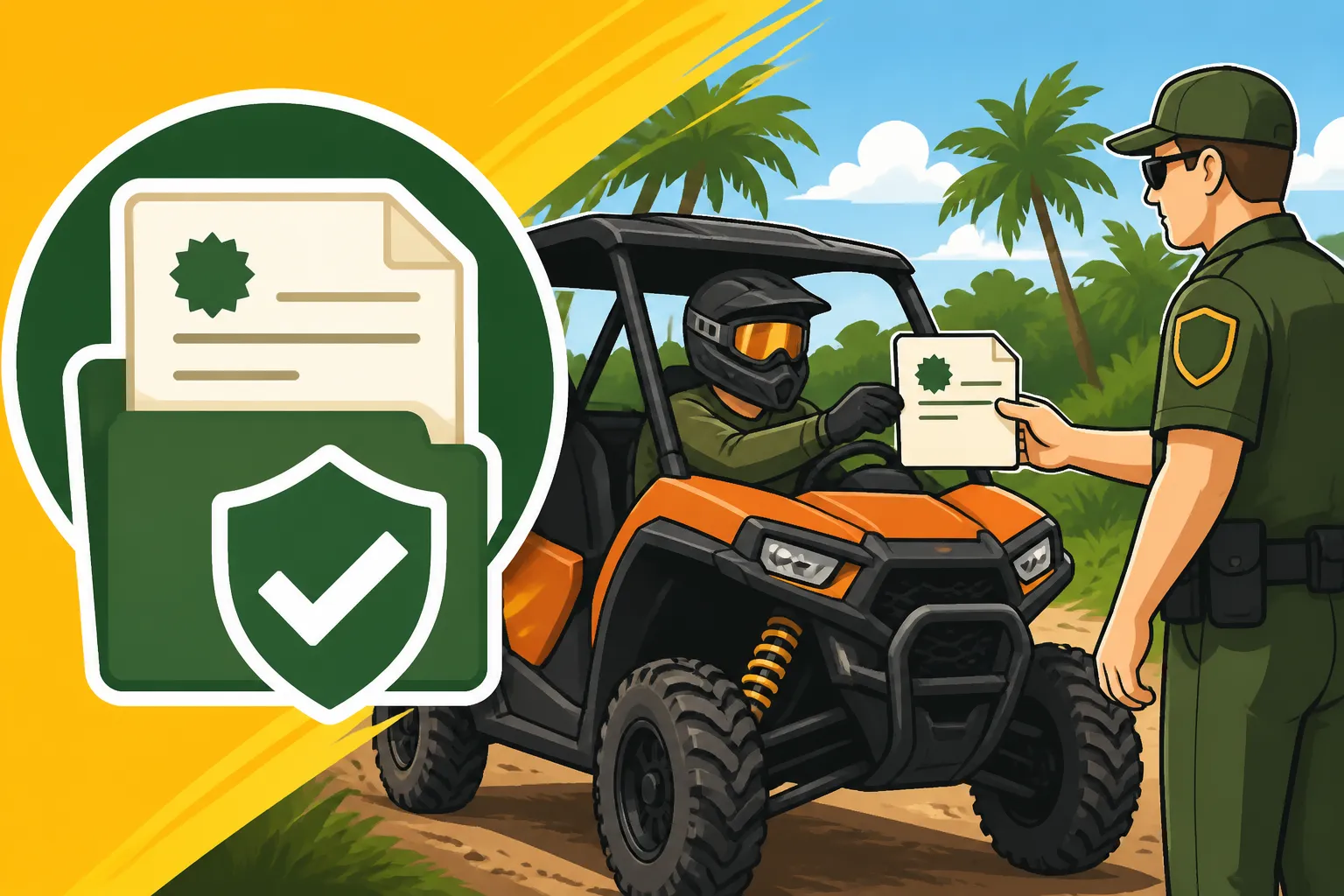
Picture this: You're riding with friends at a popular spot like the Croom Motorcycle Area. A Florida Fish and Wildlife Conservation Commission (FWC) officer or a county deputy pulls you over for a routine check, maybe to ensure you have the proper [Florida OHV Permits: What You Need Before You Ride] or that your machine meets [Florida's 55-Inch ATV Definition and Why It Matters]. The first thing they might ask, right after seeing your permit, is to verify ownership. If you can't provide immediate, credible proof, you could face delays, questioning, or even the inconvenience of having your machine temporarily impounded until ownership can be verified. This isn't because they think you've stolen it, necessarily, but because they have a duty to enforce state laws regarding vehicle ownership and prevent theft. Having your title or other verifiable documents readily available streamlines the interaction and shows you're a responsible rider.
It’s about more than just avoiding a ticket; it's about avoiding suspicion. In Florida, specific laws govern the titling of ATVs and UTVs, particularly if you plan to ride them on public lands. Officers are trained to look for certain documents, and a lack thereof can raise red flags, leading to a much longer and less pleasant interaction than it needs to be. They might ask [What Ocala National Forest Staff Can Ask to See] when you enter. Having your paperwork in order signals that you respect the rules and have nothing to hide.
Protecting Your Investment Against Theft and Disputes
Unfortunately, ATV and UTV theft is a real concern across Florida. These machines are valuable, relatively easy to transport, and often stored in less secure locations than a family car. If your pride and joy is stolen, the first thing law enforcement will ask for is proof of ownership. Without it, reporting the theft and proving that the machine is indeed yours becomes significantly harder. Your official Florida ATV title is the strongest evidence you possess. When an officer recovers a stolen machine, they need to match it to its rightful owner, and a clear, unencumbered title makes that process swift and certain.
Beyond outright theft, ownership disputes can arise. Perhaps you lent your ATV to a friend, or you bought a used machine in a private sale and there's a question later about the legitimacy of the transaction. Clear documentation held by you minimizes these risks. Having a solid [Florida ATV Bill of Sale: What It Needs to Say] when you buy or sell can prevent a lot of heartache down the road, and carrying proof of the actual title in your name solidifies your claim. While a dealer will handle some of the initial [Florida Dealer Paperwork When You Buy a New ATV], the final title in your hand is the ultimate proof.
What Happens During an Accident or Incident
Nobody wants to think about it, but accidents can happen, even on the safest trails. Whether it's a collision with another rider, an incident involving property damage, or a solo accident requiring emergency services, having your ownership documents can be surprisingly helpful. If your machine needs to be towed or transported, the tow company will want to confirm you are the owner before taking responsibility for your valuable property. Furthermore, if there's an insurance claim involved, your insurance company will undoubtedly require proof of ownership to process the claim. While [Do Florida ATVs Need Insurance to Be Titled] is a common question, proof of ownership is always needed for insurance claims.
Consider a scenario where you're involved in a minor fender-bender with another ATV at [Croom Motorcycle Area: Florida's Biggest OHV Park]. Exchanging information smoothly requires you to provide details about your machine and, ultimately, your ownership. A deputy investigating the scene will also need this information for their report. Having all your ducks in a row – including a copy of your title and perhaps your insurance information – will make a stressful situation a little bit easier to navigate.
Your Toolkit of Ownership Documents for Florida ATVs and UTVs
So, what exactly counts as "proof of ownership" in the eyes of Florida law, and what should you realistically carry with you on the trail? It's not always just one piece of paper, and depending on your situation, different documents might take precedence.
The Florida ATV Title: Your Gold Standard
The single most important document you possess, proving ownership of your ATV or UTV in Florida, is the official certificate of title issued by the Florida Department of Highway Safety and Motor Vehicles (FLHSMV). This document is like the deed to your house; it officially records you as the legal owner. When you go through the process of [How to Title an ATV in Florida], this is the document you receive. It includes critical information about your machine, such as the Vehicle Identification Number (VIN), make, model, year, and your name as the owner.
For security reasons, many riders are hesitant to carry the original title on the trail, and that's a valid concern. Losing a physical title, or having it stolen with your machine, could complicate matters. This is where good judgment comes in. While the original paper title is the ultimate proof, a clear photocopy or even a digital image stored securely on your phone can often suffice for routine checks. However, in situations like theft recovery, the original title will be crucial. Understanding the difference between a paper title and an [Electronic Title vs Paper Title for a Quad] is also important, as you may need to [Requesting a Paper Copy of an Electronic Title] for certain situations.
Beyond the Title: Supporting Documents for Every Scenario
While the title is king, other documents can serve as valuable supporting evidence or even primary proof in certain situations, especially if your title is still being processed or is electronic only.
- Manufacturer's Certificate of Origin (MSO): For a brand-new ATV or UTV, before the title is officially issued, the MSO is your initial proof of ownership. This document comes from the manufacturer and states the first owner (usually the dealer). When you purchase a new machine, the dealer will use the MSO to apply for your title. If you've just bought your machine and haven't received your title yet, a copy of the MSO, along with your bill of sale, is essential. Remember, [When an MSO Beats a Bill of Sale] in terms of official origin, but your name on the bill of sale is what links you to it.
- Bill of Sale: Whether you bought your machine new from a dealer or used from a private seller, a detailed bill of sale is critical. This document establishes the transfer of ownership from the previous party to you. It should include the VIN, purchase price, date of sale, and the names and signatures of both the buyer and seller. A well-crafted bill of sale can be very important if you're [Buying a Quad With No Title From a Neighbor] or dealing with specific scenarios like [Buying a Quad From a Craigslist Seller With No Title]. Services like LawDepot offer templates that can help you create a comprehensive bill of sale, ensuring all necessary legal details are included for a clear transaction.
- Photo Identification: Always, always carry a valid government-issued photo ID, such as your driver's license or state ID card. This allows law enforcement to confirm that the name on your ownership documents matches your identity. It seems obvious, but it’s a foundational piece of any roadside interaction.
- Insurance Card: If you carry insurance on your ATV or UTV – and it’s highly recommended, even if not always legally mandated for off-road use – have your insurance card handy. It's further proof of your connection to the machine and valuable in accident scenarios.
Special Cases: New Purchases and Untitled Machines
Sometimes, you might be riding a machine that's brand new and the title hasn't come back from the state yet. In this case, a copy of your purchase agreement, the MSO (if applicable), and your temporary registration paperwork (if issued) should be carried. This demonstrates that you've initiated the titling process.
What if you have an older ATV that, for whatever reason, was never titled in Florida, and you're just now realizing you need to comply with the [Florida Off-Highway Vehicle Title Rules Explained]? Or maybe you purchased it from someone who never titled it? [Selling an Untitled ATV in Florida] can be tricky, and [Buying a Quad With No Title From a Neighbor] presents its own challenges. If you're in the process of titling an older, previously untitled machine, carry all available documentation, such as old bills of sale, a notarized affidavit of ownership (templates for which can be found on legal document services like LawDepot), and proof that you've submitted your title application to the FLHSMV. The more historical documentation you have, the better your position. Even if you only ride on private land, you might still need proof of ownership to address issues like [A Missing VIN Plate on a Florida Quad] or to simply prove the machine is yours.
Smart Strategies for Safely Storing and Accessing Your Paperwork
Now that you know what to carry, let's talk about how to carry it. The goal is to have your documents safe, secure, and readily available, without risking the loss or damage of irreplaceable originals.
Physical vs. Digital: Weighing the Options on the Trail
The debate between physical and digital copies is ongoing.
- Physical Copies (Photocopies): Many riders opt to carry clear, legible photocopies of their title, bill of sale, and insurance card. This is a fantastic compromise. You have the necessary information on hand for a deputy or park ranger, but if the copies get wet, lost, or damaged, your original documents are safe at home. It’s a good idea to keep these photocopies in a waterproof bag or container.
- Digital Copies (on your phone): Taking photos of your documents and storing them on your smartphone is incredibly convenient. In many situations, a digital image will be accepted by law enforcement. However, there are downsides: your phone battery could die, you might be in an area with no signal to access cloud storage, or your phone could be damaged in a fall. If you rely on digital copies, make sure they're stored directly on your device (not just in the cloud) and consider having a backup power source for your phone. Always have your photo ID physically on you, regardless.
The best practice is often a hybrid approach: carry a physical photocopy set, and also have digital copies on your phone as a redundant backup.
Securing Your Documents from Elements and Loss
Florida weather is famously unpredictable. A sunny morning can turn into a torrential downpour in minutes, and dust, mud, and water are constants on the trails. Protecting your documents from the elements is paramount.
- Waterproof Bags/Containers: Invest in a good quality, heavy-duty waterproof pouch or a small Pelican-style case that can be securely stored on your ATV or UTV. These are relatively inexpensive and can protect not only your documents but also your phone, keys, and wallet. Look for pouches with robust sealing mechanisms, like roll-tops or zip-lock closures designed for marine use.
- Secure Storage Location: Think about where you store your documents on your machine. Avoid open pockets or areas where they can easily bounce out or get soaked. A dry box, a glove compartment (if your UTV has one), or a securely mounted storage bag are ideal. Ensure it's easily accessible but also somewhat out of sight to deter casual theft.
- Laminating Copies: While not necessary, laminating paper copies can add an extra layer of protection against tearing and moisture, making them more durable for repeated use and exposure to the elements.
Remember that Carrying Proof of Ownership on the Trail is also about carrying proof of your identity, so your driver's license should be in a secure, waterproof location on your person or in your machine.
Steps to Take When You Can't Locate Your Proof
What if you're out on the trail and realize you forgot your documents, or perhaps your title got lost somewhere between the mailbox and your secure file? Don't panic, but understand you might face some inconvenience.
If stopped by law enforcement without immediate proof, be polite and cooperative. Explain your situation calmly. They may be able to look up your vehicle information by VIN, especially if it's properly titled in Florida. However, this isn't a guarantee and can take significant time. They might ask you to retrieve the documents within a certain timeframe or present them at a local office. If your original title is lost or damaged, you'll need to apply for a duplicate. The process for [Florida ATV Title Lost or Damaged: Getting a Duplicate] involves submitting form HSMV 82101 and paying a fee. Services like LawDepot might offer assistance with general affidavit forms if you need to create a sworn statement about lost documents for other purposes, though a duplicate title goes through the FLHSMV.
Ultimately, proactive preparation is your best defense. Before every ride, do a quick check: Do I have my ID? Do I have my proof of ownership (at least a photocopy or digital image)? Do I have my [Florida OHV Permits: What You Need Before You Ride] if riding on public land? Making this a routine will save you potential headaches and allow you to focus on what really matters: enjoying the fantastic riding opportunities Florida has to offer.
Disclaimer
This article is for general informational purposes only and does not constitute professional advice. Laws, prices and regulations vary by location and change over time. Consult a qualified professional for guidance on your specific situation.