Municipal Streets in Florida and Quad Access
The dream of quickly running to the corner store or heading out to a nearby trail on your ATV or UTV, cruising down the familiar municipal streets, is a common one for many Florida enthusiasts. However, the reality of Florida's laws regarding where these off-highway vehicles can and cannot operate on local streets is often confusing and fraught with potential legal headaches. This comprehensive guide will help clear up the ambiguity, empowering you with the knowledge to navigate Florida's municipal street regulations safely and legally.
Understanding Florida's General Road Rules for ATVs and UTVs
Before we dive into the specifics of municipal streets, it’s crucial to grasp the overarching state-level rules that govern ATV and UTV use on Florida’s public roads. These regulations form the foundation upon which all local ordinances are built, and understanding them is your first step to staying compliant.
The Statewide Prohibition on Paved Streets
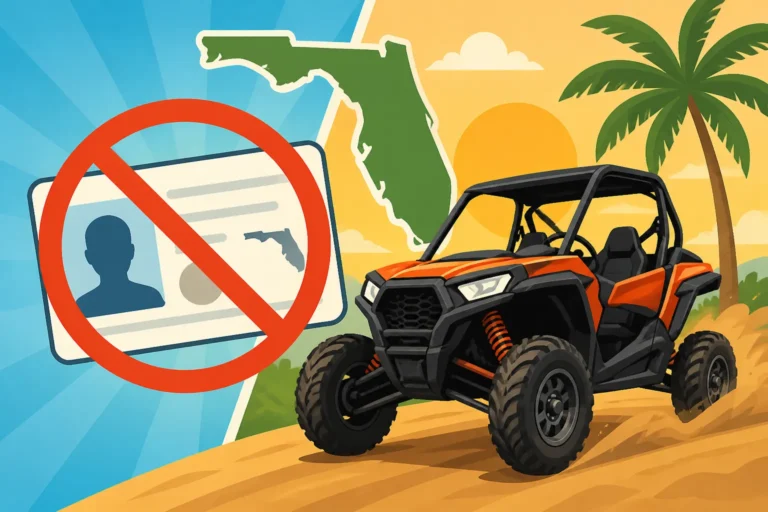
Let's get straight to the point: as a general rule, Florida law explicitly prohibits the operation of ATVs and UTVs on paved public roads, which includes the vast majority of municipal streets. This isn't just a recommendation; it's a firm legal stance enshrined in Florida statutes. The reason behind this strict prohibition is primarily safety. Off-highway vehicles like ATVs and UTVs are engineered for rugged, unpaved terrain – their tires are designed for traction in dirt, mud, and sand, not for the smooth, high-friction surfaces of asphalt or concrete. Their suspension systems, steering mechanisms, and braking capabilities are optimized for off-road performance, making them inherently less stable and predictable when interacting with typical road hazards, other vehicles, and traffic speeds.
Think about it: most ATVs and UTVs lack standard road safety features that are mandatory for street-legal vehicles, such as turn signals, rearview mirrors, proper headlights and taillights for road visibility, and Department of Transportation (DOT) approved tires. Trying to adapt an off-road machine to paved conditions often compromises its handling and significantly increases the risk of accidents, not just for the rider but for other motorists and pedestrians. For a deeper dive into this, you might want to read [Are ATVs Street Legal in Florida?].
Unpaved Roads and Specific Exceptions
While paved roads are largely a no-go zone, Florida law does offer a sliver of nuance when it comes to unpaved roads. The statewide statute acknowledges that in certain limited circumstances, off-highway vehicles might be used on unpaved public roads. However, this isn't a carte blanche permission. These exceptions are typically tied to specific conditions, such as crossing a highway (at designated crossing points and safely), or when operating on unpaved roads that have been specifically designated for OHV use by local authorities.
It’s a complicated patchwork, as these unpaved road allowances are often determined at the county level, with local governments having the power to "opt-in" or "opt-out" of allowing OHVs on their unpaved thoroughfares. This means that what's permissible on an unpaved county road in a rural part of the state might be completely forbidden on a similar road within city limits. This is where understanding your local rules becomes absolutely critical. To learn more about this nuanced area, check out [Florida's Unpaved Road Rule for ATVs Explained] and [Florida ATV Road Rules: Where You Can Legally Ride].
Defining Your Machine: ATV, UTV, or LSV?
The legal implications of riding on municipal streets depend heavily on the specific type of off-highway vehicle you own. It's not just "a quad" anymore; Florida law distinguishes between several categories, and these distinctions are paramount for understanding your access rights.
An All-Terrain Vehicle (ATV), commonly known as a quad, is typically designed for a single rider, though some models are built for two. They're generally narrower and built for agility and maneuverability on diverse terrain. A Utility Terrain Vehicle (UTV), often called a side-by-side (SxS), is a wider machine that usually seats two or more people side-by-side, often featuring a cargo bed for hauling gear. While both ATVs and UTVs fall under the "off-highway vehicle" (OHV) umbrella and are primarily intended for off-road use, UTVs sometimes have more potential for conversion into a different class of vehicle.
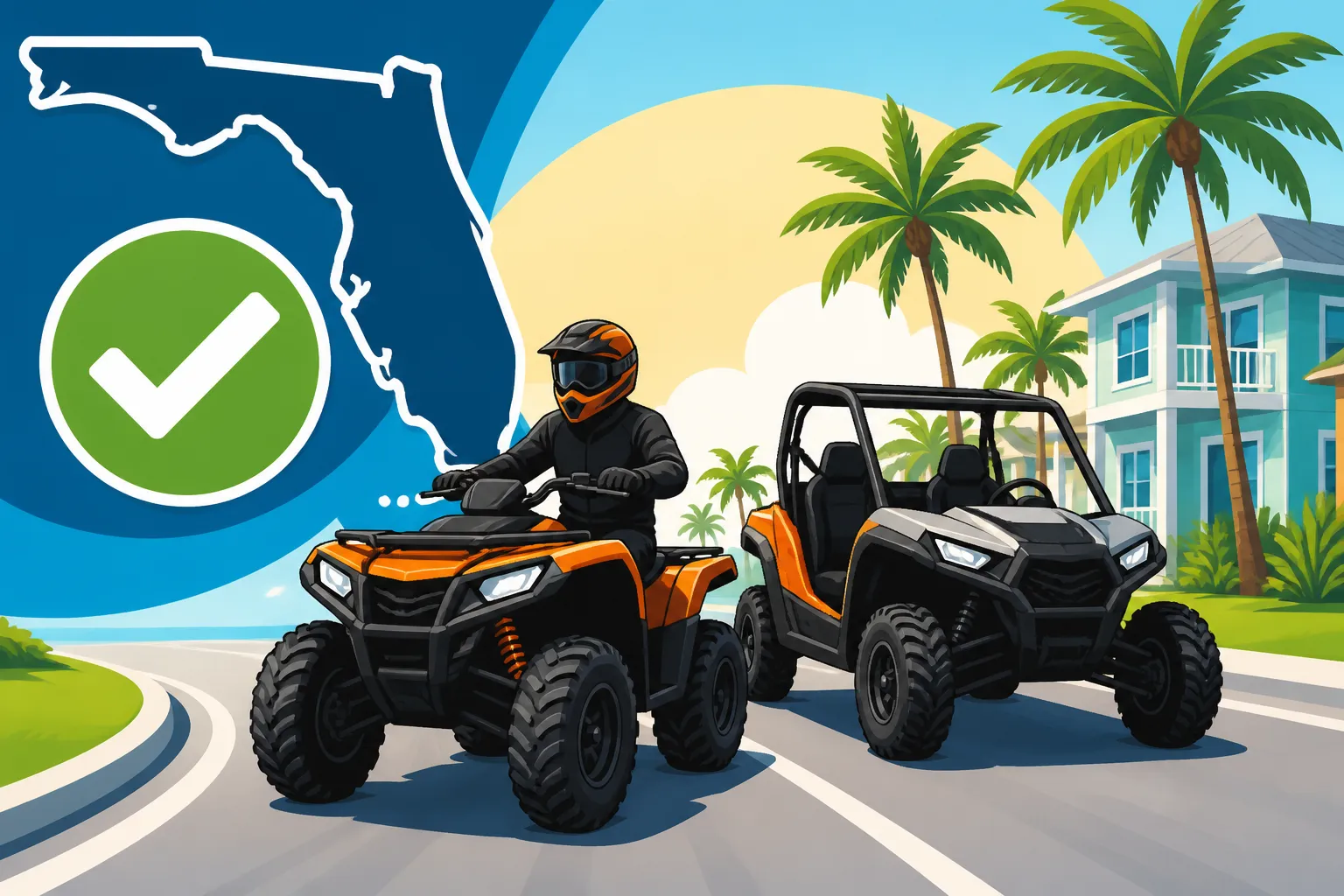
That brings us to Low-Speed Vehicles (LSVs). This is a distinct category of vehicle defined by Florida law as having a top speed between 20 mph and 25 mph, and weighing less than 2,500 pounds. Crucially, LSVs are specifically designed and equipped to be street legal on roads where the posted speed limit is 35 mph or less. They must meet stringent safety requirements including headlights, taillights, stop lights, turn signals, mirrors, a windshield, seatbelts, and a Vehicle Identification Number (VIN). Understanding if your machine is an ATV, UTV, or has the potential to become an LSV is the key to unlocking certain municipal street access. You can find more information about these categories in [Is a UTV Street Legal in Florida?] and [Florida Low-Speed Vehicle Rules for Side-by-Sides].
Navigating Municipal Streets: Local Ordinances and Designated Access
Now that we've covered the statewide fundamentals, let's zoom in on what this means for your ability to ride on municipal streets – the roads within a city, town, or village. This is where the landscape can get particularly complex due to local variations.
The Power of Local Control: County and Municipal Ordinances
While the state sets the general framework, individual counties and, within those counties, specific municipalities (like the City of Orlando, the Town of Jupiter, or the Village of Wellington) possess the authority to enact their own ordinances regarding ATV and UTV use on local roads. This means that what's allowed on a municipal street in a small, rural town might be strictly prohibited in a more densely populated city, even if they're in the same county. It’s a classic case of home rule, where local governments tailor regulations to their specific community needs and traffic patterns.
For instance, a rural county like Okeechobee might designate certain unpaved roads, including some municipal ones within its smaller towns, for ATV use to support agricultural activities or allow residents easier access to trails. In such areas, you might even see official signage indicating permitted OHV routes. However, travel to a bustling urban center like Fort Lauderdale, and you’ll find that riding an ATV on any municipal street, paved or unpaved, is almost universally prohibited due to traffic density, safety concerns, and the sheer volume of vehicles. This local control can create a confusing patchwork of rules across the state. It's why relying on what you saw someone else do in a different town is a risky gamble. To get a better grasp of these local differences, consider reading [Florida County ATV Opt-Outs: Why Rules Change at the Line] and [Florida Counties That Designated ATV Roads].
From OHV to LSV: Converting for Street Legality
For UTV owners, in particular, the idea of making their side-by-side street legal on municipal roads is a powerful incentive. Florida law does provide a pathway for UTVs to be converted and registered as Low-Speed Vehicles (LSVs), which can then legally operate on roads with a posted speed limit of 35 mph or less. This conversion isn't just a matter of slapping on a few accessories; it requires meeting specific safety equipment standards set by the state.
To become an LSV, your UTV would need to be outfitted with things like headlights, tail lights, stop lights, turn signals, reflex reflectors, rearview mirrors, a parking brake, a windshield, seatbelts for all designated seating positions, and a VIN. The vehicle must also have a top speed between 20 and 25 mph. Once these requirements are met and verified, the UTV can be registered as an LSV and receive a proper license plate, unlocking access to many municipal streets within the speed limits. This is where high-quality aftermarket parts become essential. Companies like SuperATV offer a wide range of accessories, from full windshields to complete signal kits, that can help UTV owners achieve the necessary specifications for an LSV conversion. While the initial investment might seem significant, the ability to legally operate your UTV on local roads for errands or short commutes can be a game-changer for many owners. For a detailed guide on this process, see [Turning a Side-by-Side Into a Florida LSV] and [Florida Rules for a Quad With Headlights and Turn Signals].
Limited Use: Agricultural and Emergency Exceptions
Even if your ATV or UTV isn't an LSV and your local municipality generally prohibits OHV use on its streets, there are a few highly specific and limited circumstances where operation might be allowed. These are not general permissions for recreational riding but rather functional allowances.
The most common exception relates to agricultural purposes. If you're a farmer and need to cross a municipal street to get from one field to another, or if you're using your ATV/UTV directly for agricultural operations on a public right-of-way (like maintaining a fence line along a road), Florida law often provides an exception. These uses are usually tied to working agricultural land and require the vehicle to be operated in the most direct and safest manner possible across or along the roadway. Similarly, during declared emergencies, such as hurricane cleanup or disaster response, local authorities might temporarily authorize the use of ATVs and UTVs on municipal streets to assist with critical operations. However, these are typically temporary authorizations and would require explicit permission or designation from emergency management officials. It's crucial to understand that these are narrow exceptions, not loopholes for general riding. You can learn more about specific agricultural exemptions in [Florida Agricultural Property ATV Exceptions].
Overview of OHV vs. LSV Road Access in Florida
To help clarify the distinctions and regulations we've discussed, here's a comparison of how different vehicle types are generally permitted on Florida's roads:
| Feature | All-Terrain Vehicle (ATV) / Utility Terrain Vehicle (UTV) | Low-Speed Vehicle (LSV) (Converted UTV) |
|---|---|---|
| Paved Municipal Streets | Generally Prohibited Statewide | Permitted on roads 35 mph or less, if properly registered and compliant |
| Unpaved Roads (County/Municipal) | Generally Prohibited, unless specifically designated by local ordinance | Permitted on roads 35 mph or less, if properly registered and compliant |
| Agricultural Use Exception | Yes, under specific, strict conditions | N/A (LSVs are road-legal for general use within speed limits) |
| Required Equipment | Minimal (e.g., lights if riding at night on permitted land) | Headlights, tail lights, stop lights, turn signals, windshield, seatbelts, mirrors, parking brake, VIN |
| Registration/Title | OHV Title Required for Public Land Use | LSV Registration, Tag, and Title Required |
| Driver's License Needed | Not required for off-road use by adults | Yes, valid driver's license required |
Practical Considerations, Enforcement, and Safety on Local Roads
Beyond the legal definitions and local ordinances, there are serious practical implications for choosing to ride your ATV or UTV on municipal streets. Understanding these can help you make informed decisions and avoid costly mistakes.
Enforcement and Penalties for Illegal Use
Florida law enforcement agencies, including municipal police departments and county sheriff’s offices, are increasingly cracking down on the illegal operation of ATVs and UTVs on public roads. In many urban and suburban municipal areas, officers are specifically tasked with addressing complaints about OHV noise, reckless driving, and general unauthorized use on streets. If you're caught operating an ATV or UTV on a prohibited municipal street, the consequences can be severe.
Penalties often include significant fines that can quickly add up, court costs, and in many cases, the impoundment of your vehicle. The cost of retrieving an impounded ATV or UTV, including towing fees, storage fees, and potential impoundment release fees, can easily run into hundreds or even thousands of dollars – far outweighing any perceived convenience of a short street ride. Furthermore, repeat offenses can lead to more serious charges or even loss of driving privileges. It's a common misconception that "I didn't know" is a valid defense; unfortunately, ignorance of the law is rarely an excuse in the eyes of the court. When a deputy pulls you over, they are looking for specific violations. Learn more about what they check in [What Florida Deputies Check at a Roadside Stop] and understand the potential consequences by reading [Florida Penalties for Illegal ATV Road Riding] and [Florida Sheriff Enforcement of ATV Road Rules].
Safety Risks on Paved Municipal Streets
Beyond the legal and financial penalties, the most critical consideration for riding an ATV or UTV on paved municipal streets is safety. These machines are inherently designed for off-road environments, and their characteristics make them ill-suited for the demands of paved roads and shared traffic.
The knobby, low-pressure tires common on ATVs and UTVs provide excellent traction on loose surfaces like sand and dirt, but they offer very poor grip and stability on hard, paved roads. This can lead to unpredictable handling, especially when turning or braking, and significantly increases the risk of a rollover. The suspension systems, while great for absorbing bumps off-road, can make the vehicle feel "tippy" on pavement. Furthermore, the lack of standard automotive safety features like crumple zones, airbags, and robust roll cages (in many ATV models) means that riders are highly vulnerable in a collision with a car or truck. Even if you've added aftermarket accessories like a sturdy SuperATV bumper or an upgraded light bar for better visibility, the core design limitations for paved road use remain. These machines simply aren't built to safely interact with high-speed traffic. For more on this, check out [Why Florida ATVs Cannot Use Paved Streets].
Checking Before You Ride: The Best Approach
Given the variability of local ordinances, the best advice we can give you is this: always verify the rules with the specific municipality's police department or the county sheriff's office before you ever consider riding your ATV or UTV on a municipal street. Do not rely on hearsay, outdated information, or what you've seen others do. A quick, polite phone call or a visit to the local government's website can save you immense trouble, time, and money. It ensures you're riding legally and safely, respecting both the law and your community. When in doubt, it’s always better to transport your machine to a designated off-road riding area rather than risking a violation on public streets.
The Future of ATV/UTV Access in Florida's Towns
It's important to recognize that the dialogue surrounding ATV and UTV access on Florida roads is not static. Rider advocacy groups and industry organizations often engage with local governments to explore possibilities for expanded, responsible access, especially in rural areas where these vehicles serve essential utility or recreational functions. However, balancing these interests with public safety concerns in urban and suburban municipal settings remains a significant challenge.
For riders, staying informed is key. Attending local county commission meetings or municipal council sessions, or simply reviewing their published agendas and minutes, can provide insights into any proposed changes to road access rules in your specific area. Laws can and do evolve, and a proactive approach ensures you're always operating within the most current legal framework.
Disclaimer
This article is for general informational purposes only and does not constitute professional advice. Laws, prices and regulations vary by location and change over time. Consult a qualified professional for guidance on your specific situation.