Charlotte County Roads Near Punta Gorda
Figuring out where you can legally and safely ride your ATV or UTV on the roads in Florida can feel like navigating a swamp in the dark – confusing and potentially dangerous if you make a wrong turn. Especially when you're in an area like Charlotte County, near the beautiful coastline and rural expanses around Punta Gorda, the rules can seem even hazier. This guide is here to shine a light on the nuances of Florida's off-highway vehicle (OHV) laws and how they apply to your riding adventures in and around Charlotte County, giving you the confidence to ride responsibly.
Understanding Florida's General ATV Road Rules: The State Level
Let's be real, the idea of just hopping on your quad and cruising down any road in Florida is a fantasy for most riders. Florida's laws are pretty specific about where and when you can operate an ATV or UTV on public roads. It’s not like driving your car; there are distinct rules that often get overlooked, leading to frustrating encounters with law enforcement. Understanding these statewide guidelines is your first step to staying out of trouble, particularly in a diverse area like Charlotte County where you might encounter both developed and undeveloped stretches.
The "Unpaved Roadway" Exception
Florida Statute 316.2123 is the key piece of legislation that creates a narrow window for off-highway vehicle use on public roads. It specifically states that ATVs and UTVs (often referred to as ROVs in the statute) can be operated on an "unpaved roadway" that is owned and maintained by a county, provided certain conditions are met. Now, what exactly constitutes an "unpaved roadway"? It's not just your typical dirt road. It can also include roads made of shell, gravel, or even sandy tracks that aren't paved with asphalt or concrete. Think about some of those long, shell-rock driveways leading to agricultural properties or the less-traveled sandy lanes cutting through undeveloped parcels you might find in the outskirts of Punta Gorda or deeper into Charlotte County.
This exception is crucial because it immediately limits your riding options. You cannot, under any circumstances, take your ATV or UTV onto a paved state road, highway, or even most paved county roads unless specifically designated otherwise by local ordinance – and those are rare. This means those beautiful, smooth roads leading to the beach or downtown Punta Gorda are strictly off-limits for your quad. The intent of this law is largely to accommodate agricultural and rural use, allowing easier access to fields or remote properties without needing to trailer the machine everywhere. Remember, just because a road looks "rustic" doesn't automatically make it legal; it must be an unpaved roadway that is county-maintained. This is where the distinction between private land and public county land becomes critical. If you're riding on private property, the rules are different, but the moment you hit a county-maintained right-of-way, even if unpaved, state law kicks in. For a deeper dive into this, check out [Florida's Unpaved Road Rule for ATVs Explained].
Age, Supervision, and Equipment Basics
Beyond where you can ride, Florida law also dictates who can ride and what equipment your machine must have, even on an unpaved county roadway. For starters, if you’re operating an ATV or UTV on any public land, including these permissive unpaved county roads, riders under the age of 16 are generally required to wear a U.S. DOT approved helmet and eye protection. While the helmet law specifically calls out minors, it's always a smart idea for riders of all ages to wear appropriate safety gear. It's not just about compliance; it's about protecting yourself. You wouldn't hit the trails without it, so why would you ride on a county road, even an unpaved one, unprotected?
Furthermore, a person operating an ATV or UTV on an unpaved county roadway must possess a valid driver's license. This is a common point of confusion, especially for younger riders who might ride off-road without a license. But the moment you put a tire on a county-maintained roadway, a driver's license becomes mandatory. This is a significant difference from private property riding. Your machine also needs to be equipped with functioning headlights and taillights if you are riding between sunset and sunrise, though as we'll discuss, night riding on these roads is generally prohibited anyway. For more information on driver requirements, you might find [Do You Need a Driver's License for an ATV in Florida?] helpful.
What You Cannot Do: Paved Roads and Night Riding
It bears repeating because it's the most common infraction: ATVs and UTVs are not permitted on paved public roads in Florida, with very limited exceptions for crossing or specific designations that vary by county. This means you cannot take your quad to the grocery store, cruise down U.S. 41, or even use it as a shortcut through a residential subdivision on paved streets in Punta Gorda. Violating this rule can result in significant fines and even impoundment of your machine. You can find more details on this topic by reading [Are ATVs Street Legal in Florida?].
Equally important is the restriction on night riding. Even on unpaved county roads where ATVs and UTVs might be permitted, operation is generally restricted to "daylight hours." This means from sunrise to sunset. While your machine might have bright headlights and taillights, the law is clear about when you can use these roads. Trying to sneak a ride in after dusk, even on a remote dirt road, could lead to a citation. The goal of these restrictions is primarily safety, as ATVs and UTVs are not designed for the same visibility or interaction with other vehicles as street-legal vehicles. The consequences of illegal road riding can be severe, so understanding these limitations is crucial. For information on potential financial impacts, refer to [Florida ATV Ticket Cost for Illegal Road Riding].
Navigating Charlotte County's Specific ATV & UTV Rules Near Punta Gorda
While Florida sets the baseline, counties have the authority to further regulate or even prohibit ATV and UTV use on their roads. This is where Charlotte County's specific ordinances come into play, potentially adding another layer of complexity for riders near Punta Gorda. It's not enough to know the state law; you also need to know if your local jurisdiction has imposed additional rules or, conversely, opened up specific roads.
Local Ordinances and Designated Roads
Florida law allows counties to designate certain unpaved roads for ATV and UTV use, or even to ban them entirely. This means that what might be legal on an unpaved road in one county could be strictly forbidden just across the county line in Charlotte County. The Charlotte County Commission would be the body responsible for enacting such ordinances. These decisions are usually made after public hearings, where community input, safety concerns, and the needs of various user groups are considered.
Finding out if Charlotte County has any designated roads can be a bit of a treasure hunt. You won't typically find signs saying "ATV Allowed Here" on every permissible road. Instead, you'll need to consult the Charlotte County Code of Ordinances or directly contact local authorities. Historically, many counties opt for stricter enforcement or do not explicitly open roads, leaning on the general state prohibition for paved roads and the narrow unpaved exception. If Charlotte County has designated specific roads, they would be clearly outlined in a county ordinance. This is why always checking with local authorities is the most reliable way to stay informed. Don't rely on hearsay or what someone else told you; laws change, and interpretations vary.
Common Riding Scenarios in the Punta Gorda Area
Charlotte County, especially outside the immediate urban core of Punta Gorda, offers a mix of rural landscapes, agricultural areas, and undeveloped tracts. This means riders might encounter various types of unpaved roads.
- Agricultural Access Roads: Many farms and ranches in the county rely on ATVs and UTVs for work. These properties often have unpaved access roads leading to fields or outbuildings. While riding on the private roads of a farm with permission is fine, the moment you transition onto a county-maintained unpaved road, even for a short distance, the state laws apply.
- Shell Rock or Gravel Roads: You'll find these leading to more remote residential areas, fishing camps, or smaller communities outside of town. If these are indeed county-maintained and unpaved, they might fall under the state's exception, but again, verification with Charlotte County is paramount.
- Private Community Roads: Many gated communities or large residential developments have their own internal road networks, which might be a mix of paved and unpaved. These are typically private roads, and rules for ATV/UTV use are set by the homeowner's association (HOA) or property management. State and county road laws wouldn't apply here, but you'd need explicit permission from the property owner or HOA.
The key takeaway is that you should never assume. Just because a road "looks" like it might be permissible doesn't mean it is. Erring on the side of caution and getting definitive answers is always the best approach. You might find a discussion of how other counties handle this in [Florida Public Hearing Process for County ATV Rules].
Where to Get Official Local Information
When in doubt, always go to the source. For definitive answers regarding ATV and UTV use on Charlotte County roads, you should contact the Charlotte County Sheriff's Office or the Charlotte County Board of County Commissioners.
- Charlotte County Sheriff's Office: They are the primary enforcement agency and can provide clarity on local ordinances and how they enforce state laws. They're often the first point of contact for riders seeking to understand the rules.
- Charlotte County Board of County Commissioners: The County Clerk's office, under the Board of County Commissioners, can provide access to the official county ordinances. Look for sections related to traffic, motor vehicles, or off-highway vehicles. These are the legal documents that would spell out any specific allowances or prohibitions beyond state law.
- Florida Highway Patrol (FHP): While FHP primarily patrols state roads, they can offer insights into the interpretation of state statutes as they apply to county roads.
Remember, laws can change, so a quick phone call or visit to the county's official website for their code of ordinances is always recommended before you ride. This proactive approach saves you from potential fines and legal trouble. Understanding [Florida Sheriff Enforcement of ATV Road Rules] can give you a better idea of what to expect if you encounter law enforcement.
The Difference Between ATVs, UTVs, and LSVs on Florida Roads
It's easy to lump all off-road vehicles into one category, but Florida law is quite specific about the distinctions between ATVs, UTVs (or ROVs), and Low-Speed Vehicles (LSVs). These classifications are incredibly important because they directly impact whether and how your machine can legally operate on certain roads, especially when considering the unpaved roads around Punta Gorda in Charlotte County. Trying to treat them all the same is a recipe for a citation.
Defining Your Machine
Let's break down the definitions that Florida uses:
- ATV (All-Terrain Vehicle): These are typically single-rider or two-rider machines, designed for off-road use, with handlebars for steering, a seat that is straddled by the operator, and four wheels. Florida law specifically defines them as having a dry weight of less than 1,500 pounds and a width of 55 inches or less. If your machine is wider than 55 inches, it's generally not considered an ATV under Florida law, which has huge implications for its legal status on roads.
- UTV / ROV (Utility Terrain Vehicle / Recreational Off-highway Vehicle): These are side-by-side vehicles, designed for off-road use, with a steering wheel, side-by-side seating, and typically a roll cage. Florida statute generally defines them as being wider than 55 inches but not greater than 80 inches, and with a dry weight of 3,500 pounds or less. They are distinct from ATVs and have their own set of rules, though often grouped with ATVs under the general "off-highway vehicle" umbrella for unpaved road exceptions. For more on this, check out [Florida ROV Definition: 80 Inches and 3,500 Pounds].
- LSV (Low-Speed Vehicle): This is where things get interesting for UTV owners hoping for more road access. An LSV is not inherently an off-road vehicle. It's a street-legal vehicle designed to travel at speeds greater than 20 mph but not greater than 25 mph. To be an LSV, a vehicle (which could be a UTV that has been modified) must be properly registered, titled, and insured as an LSV and equipped with specific safety features required by federal and state law, such as headlights, taillights, turn signals, stop lights, reflex reflectors, mirrors, a parking brake, a VIN, and safety belts. This is a complete reclassification from an off-road vehicle to a street-legal vehicle.
Understanding which category your machine falls into is the first critical step. An ATV that meets the width and weight limits might have different allowances than a wider UTV, and both are vastly different from an LSV in terms of road legality.
Converting for Road Use: The LSV Path
Many UTV owners, frustrated by the limitations of off-road vehicle road laws, explore converting their UTV into an LSV. This is a legitimate path to gain more access to certain public roads in Florida, including paved ones where LSVs are permitted (typically roads with a posted speed limit of 35 mph or less). However, it's not a simple bolt-on conversion; it requires specific modifications and a formal reclassification process with the Florida Department of Highway Safety and Motor Vehicles (FLHSMV).
To convert your UTV to an LSV, you'll need to install or ensure your machine has:
- Headlights: Must meet specific brightness and aiming standards.
- Taillights and Stop Lights: Essential for visibility and signaling.
- Turn Signal Lamps: For both front and rear.
- Reflex Reflectors: Red on the rear, amber on the sides.
- Mirrors: Both interior and exterior side mirrors are typically required.
- Parking Brake: A functioning parking brake system.
- VIN (Vehicle Identification Number): Required for title and registration.
- Safety Belts: For all seating positions.
- Windshield: Often required, and must be DOT-approved automotive safety glass.
- Speed Capability: Must be able to go between 20 mph and 25 mph.
Once these modifications are complete, you'll need to apply for a new title and registration, declaring your vehicle as an LSV. This process often involves inspections to verify compliance with safety equipment standards. Companies like SuperATV offer a wide range of aftermarket parts and kits that can help with many of these modifications, from LED lighting kits to mirrors and turn signal assemblies, making them a popular choice for riders looking to make their UTV more versatile. However, it’s critical to ensure any parts you use meet DOT standards and that the entire conversion process is done according to FLHSMV guidelines. After conversion, you'll also need proper insurance, just like any other street-legal vehicle. This can be a substantial investment in time and money, but for some, the expanded road access is well worth it. You can explore [Is a UTV Street Legal in Florida?] and [Florida LSV Registration and Insurance Rules] for more details on this process.
| Feature / Category | ATV (Off-Road) | UTV (ROV – Off-Road) | LSV (Street Legal) |
|---|---|---|---|
| Typical Width | <= 55 inches | > 55, <= 80 inches | Varies (usually wider like UTV) |
| Dry Weight | <= 1,500 lbs | <= 3,500 lbs | No specific weight limit, but low speed |
| Steering | Handlebars | Steering Wheel | Steering Wheel |
| Seating | Straddled | Side-by-side | Side-by-side |
| Primary Use | Off-road recreation, utility | Off-road recreation, utility | Street legal, low speed |
| Paved Roads | Generally NO | Generally NO | YES (35 mph limit) |
| Unpaved Roads (County) | YES (with conditions) | YES (with conditions) | YES (35 mph limit) |
| Driver's License | YES (on public roads) | YES (on public roads) | YES (on public roads) |
| Title/Registration | OHV Title only | OHV Title only | Vehicle Title & Registration |
| Insurance | Not required by FL for OHV title | Not required by FL for OHV title | Required (PIP, PDL) |
| Required Equipment (Road Use) | Head/Taillights, Helmet/Eye Protection (minors) | Head/Taillights, Helmet/Eye Protection (minors) | Head/Taillights, Turn Signals, Brake Lights, Mirrors, Seatbelts, Windshield, etc. |
Penalties for Misinterpreting the Rules
The stakes are high when you don't follow the rules. Misinterpreting Florida's complex ATV, UTV, and LSV laws can lead to serious consequences. A common scenario might be someone from out of state, or even a local, assuming that a wide-open dirt road in Charlotte County is fair game, only to find out it's technically a paved county road with a thin layer of sand on top, or that it's privately owned and they're trespassing.
Penalties can range from a simple traffic citation with a hefty fine to the impoundment of your vehicle. Operating an unregistered or improperly equipped vehicle on public roads can also incur additional penalties. Repeat offenses can lead to even more severe consequences. It's not just about the monetary cost; it's about the time and hassle of dealing with law enforcement, vehicle recovery, and potential legal fees. Moreover, operating a vehicle illegally often voids insurance policies, leaving you personally liable in case of an accident. Always remember, ignorance of the law is not a valid defense. Taking the time to understand the specifics for your machine and the roads in Charlotte County is an investment in your peace of mind and your wallet. For context on costs, [Florida ATV Ticket Cost for Illegal Road Riding] can be a helpful read.
Practical Advice for Riding Safely and Legally
Riding an ATV or UTV in Florida, especially in areas like Charlotte County, offers incredible opportunities for adventure and utility. But to truly enjoy it without unnecessary stress, a proactive and responsible approach is key. This isn't just about avoiding tickets; it's about ensuring your safety and preserving access for all riders.
Planning Your Route and Staying Informed
Before you even load your machine, the most crucial step is planning your route. This means more than just looking at a map for dirt roads.
- Consult Official Maps and Ordinances: Look for official county maps that might indicate road classifications. More importantly, search the Charlotte County Code of Ordinances for any sections related to OHVs. Some counties may have designated specific roads, and these will be detailed in official documents.
- Verify Road Status: If you're unsure about a specific unpaved road, try to determine if it's county-maintained or private. Often, private roads will have signage, but it's not guaranteed. When in doubt, call the Charlotte County Public Works Department or the Sheriff's Office.
- Look for Signage: While not always present, keep an eye out for signs indicating "No OHVs" or "Private Road." Conversely, if a county has taken the step to open a road, there might be signage, but don't count on it as your sole source of information.
- Check for Trail Systems: Instead of trying to find legal road access, consider utilizing dedicated off-road trail systems. Florida has several fantastic OHV parks and trails, many of which are specifically designed for ATVs and UTVs. While some of these might require permits or fees, they offer a legal and enjoyable riding experience, often far superior to a random dirt road.
Essential Gear and Preparedness
Even if you're riding legally, preparedness is vital. This goes beyond just what the law requires.
- Safety Gear: Always wear a U.S. DOT-approved helmet, eye protection (goggles or a face shield), long pants, long sleeves, gloves, and over-the-ankle boots. This gear protects you from unexpected spills, flying debris, and even sun exposure.
- Machine Maintenance: Ensure your ATV or UTV is in top working order. Check tires, brakes, lights, fluid levels, and spark arrestors. A well-maintained machine is safer and less likely to break down far from help.
- Emergency Kit: Carry a basic first-aid kit, water, snacks, a fully charged cell phone (though service can be spotty in rural Charlotte County), a small tool kit, and a tire repair kit.
- Proof of Ownership and Safety Course: Always carry your ATV's title (or a copy), your driver's license, and if applicable, proof of completing a Florida ATV safety course (especially for riders under 16 on public land). This paperwork is crucial if you're stopped by law enforcement.
- Spark Arrestor: For any public land riding, including unpaved county roads, a U.S. Forest Service approved spark arrestor is typically required to prevent wildfires. Check your exhaust system to ensure it's equipped. Some brands like SuperATV offer exhaust systems and accessories that are designed with these requirements in mind, ensuring compliance while potentially enhancing performance.
Respecting Private Property and Local Communities
Responsible riding extends beyond just following the letter of the law. It's about being a good neighbor and respecting the environment.
- Private Property: Never, ever trespass on private land. If you want to ride on someone else's property, get explicit permission in writing. Fences, "No Trespassing" signs, or even just undeveloped land should be taken as a clear indication that it's private. Unauthorized riding can lead to legal trouble and reflects poorly on the entire riding community.
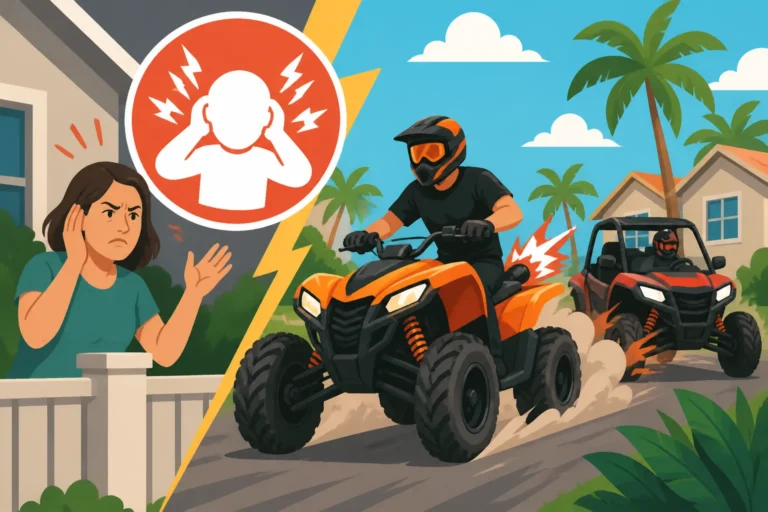
- Noise and Dust: Be mindful of noise levels, especially if riding near residential areas. While your machine might be stock, excessive noise can be a nuisance. Similarly, kicking up excessive dust can affect visibility and bother residents. Slow down when passing homes or other vehicles.
- Environmental Impact: Stick to established trails and roads. Avoid riding through sensitive habitats, wetlands, or private agricultural fields. Florida's environment is delicate, and irresponsible riding can cause significant damage.
- Trail Etiquette: If you encounter other riders, hikers, or equestrians, slow down, be courteous, and yield the right of way as appropriate. Share the roads and trails responsibly.
By being informed, prepared, and respectful, you can ensure your ATV and UTV riding experiences in Charlotte County, near Punta Gorda, are both legal and enjoyable, contributing positively to the riding community.
Disclaimer
This article is for general informational purposes only and does not constitute professional advice. Laws, prices and regulations vary by location and change over time. Consult a qualified professional for guidance on your specific situation.