Spark Arrestors and Why Rangers Look
A spark arrestor is easy to overlook when you’re getting an ATV or UTV ready for a Florida trail, especially if the exhaust is stock or the machine has been modified. Knowing what the device does, how to check yours, and why land managers may inspect it can help you avoid trailhead delays and reduce fire risk.
What a Spark Arrestor Does
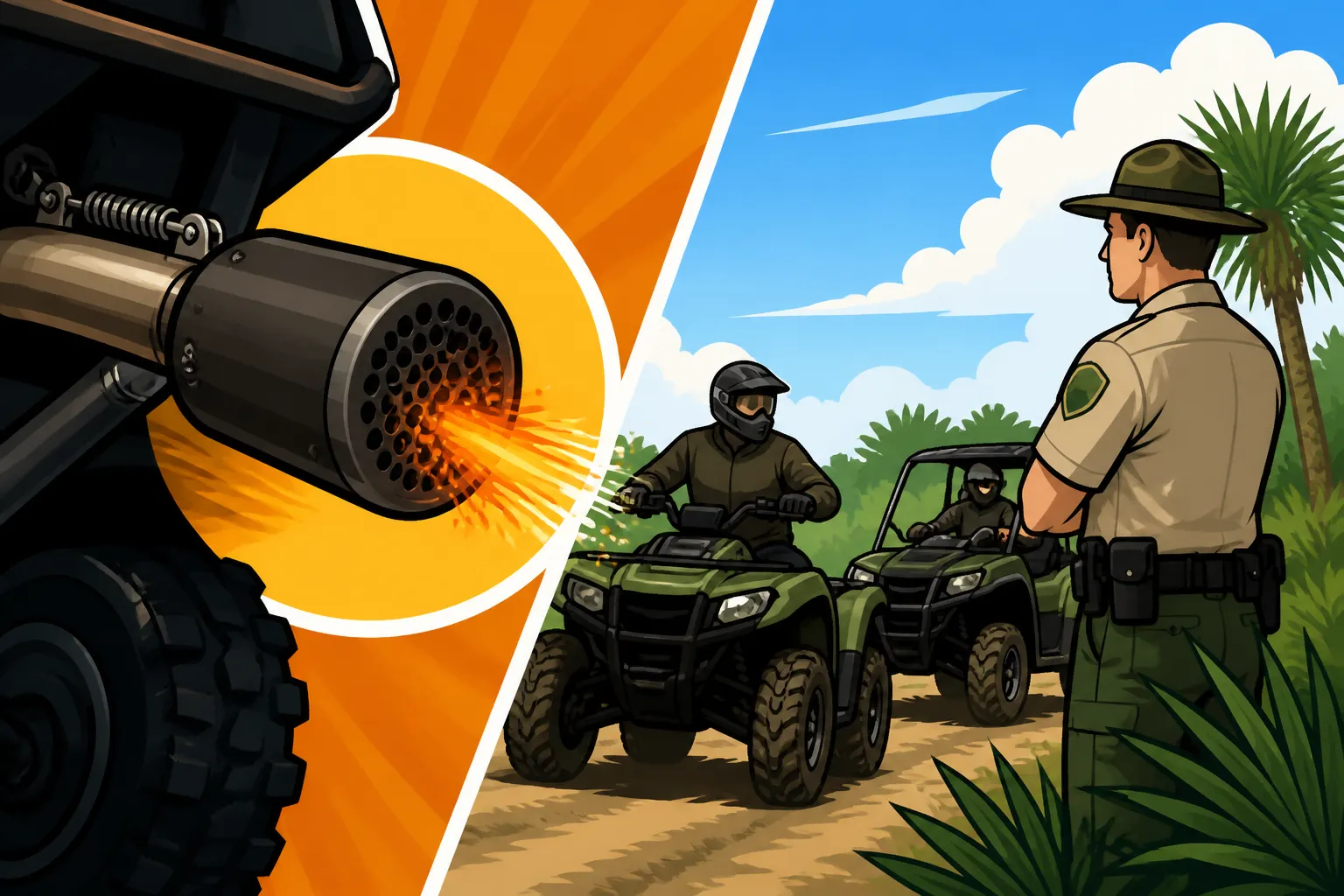
A spark arrestor is a device in the exhaust system designed to stop hot carbon particles from leaving the exhaust and landing in dry vegetation. Those particles can start a fire under the right conditions. The arrestor reduces that risk, but it does not make a machine fireproof or guarantee that a fire cannot start.
On many machines, the arrestor is built into the muffler or exhaust assembly. It may use a screen or another internal design to catch or cool particles. Because it is often hidden inside the exhaust, a quick glance at the tailpipe may not tell you whether it is installed.
A spark arrestor is not the same thing as a muffler. The muffler reduces exhaust noise; the arrestor is intended to contain sparks. One component may perform both functions, but having a muffler does not, by itself, prove that a machine has a functioning spark arrestor.
It also isn’t the same as a catalytic converter. These parts serve different purposes, and one should not be assumed to replace another. If you are unsure what is fitted to your ATV or UTV, look up the exhaust assembly in the owner’s manual or ask the manufacturer or a qualified repair shop.
Spark arrestors matter on public land because riders travel through areas where dry grass, leaves, pine needles, and other vegetation can catch fire. Florida’s conditions vary by place and season. A trail that looks damp in one spot may pass through dry ground nearby, and weather or local restrictions can change the risk. A properly maintained exhaust system is one part of responsible riding, alongside following closures and fire rules.
Why Rangers May Check Your Exhaust
A land manager may set equipment requirements for machines using a trail or riding area. Those requirements can differ by location, land type, and current conditions. A rule that applies at one forest or park should not be treated as automatically applying everywhere in Florida.
Rangers or other staff may look at exhaust equipment during a trailhead check, an inspection, or an enforcement stop. They may be checking whether required equipment is present and whether the machine appears to meet the site’s rules. A missing component, a visibly modified exhaust, or an uncertain setup can lead to questions. The exact inspection process and consequences depend on the land manager and the applicable rules.
Spark arrestors are also part of a broader effort to reduce fire hazards. During dry conditions, land managers may impose additional restrictions, close trails, or limit access. An arrestor does not give you permission to ride during a closure, ignore a fire restriction, or travel off designated routes.
Before heading out, check both the equipment requirements and the current status of the riding area. Florida OHV Permits: What You Need Before You Ride explains why having a permit is only one part of getting ready for public-land riding. You should also check for current closures in Florida Trail Closures You Should Check First. Requirements can vary between national forests, state forests, and other sites, as explained in Florida National Forest Riding vs State Forest Riding.
| What to check | Why it matters | Practical next step |
|---|---|---|
| Whether the riding area requires a spark arrestor | Rules may differ by land manager and site | Check the current rules for the specific area |
| Whether your exhaust has an arrestor | A muffler alone does not confirm one is installed | Consult the manual or confirm the exhaust model |
| Whether the device is clean and undamaged | A blocked or damaged screen may not work as intended | Inspect and service it according to the manual |
| Whether the trail is open | Fire danger or other conditions can prompt closures | Check current notices before you leave |
| Whether the machine has been modified | An aftermarket exhaust may change what is installed | Verify its specifications and suitability for the site |
For a broader sense of what staff may review at a trail entrance, see Florida Ranger Checks at a Trailhead. Do not assume that a staff member’s visual check replaces your responsibility to confirm the equipment and rules yourself.
How to Check an ATV or UTV Before a Ride
Start with the owner’s manual and the exact exhaust setup on your machine. A factory exhaust may include a spark arrestor, but that can change if a previous owner replaced the muffler, removed an internal component, or installed an aftermarket system. A machine that looks stock from the outside may still have been modified.
Use this process before you travel:
- Identify the exhaust system. Check the manual, service records, or manufacturer information for the original exhaust assembly. If the machine has an aftermarket muffler, note its make and model.
- Confirm that an arrestor is included. Look for the relevant manufacturer specifications or ask a qualified dealer or mechanic. Don’t rely only on the appearance of the tailpipe.
- Check the riding area’s requirements. Use the site’s official information or contact the land manager if the rule is unclear. Ask specifically whether a spark arrestor is required for your machine and whether there are current fire restrictions.
- Inspect and maintain the device. Follow the manual’s instructions for inspection and cleaning. Do not remove an arrestor to improve exhaust flow or noise, and do not ride with a damaged or missing part where one is required.
- Recheck after repairs or exhaust changes. A replacement muffler or other exhaust work can change whether the machine remains compliant with a riding area’s requirements.
If you need to replace or identify an accessory, an online marketplace such as Amazon may show a broad range of exhaust parts, but a product listing alone does not establish that a part is compatible with your machine or acceptable at a particular riding area. Match the part to your make and model, confirm installation requirements, and verify any land-specific standard with the manager.
A spark arrestor screen can become dirty or obstructed, especially when a machine is used in mud, sand, or dusty conditions. Follow the manufacturer’s maintenance procedure rather than poking at the exhaust or improvising a cleaning method. Let hot components cool before inspection, and use the proper tools and protective equipment. If you cannot identify the device or are unsure how to service it safely, have a qualified mechanic check it.
Keep documentation when it is available, such as the owner’s manual, exhaust specifications, or service records. That paperwork may help answer questions if staff want to know what system is installed. Documentation does not override site rules, but it can make it easier to identify the equipment.
Common Mistakes and Better Trailhead Habits
One common mistake is assuming that an ATV or UTV has a spark arrestor because it has a muffler. Since the parts have different functions, check the actual exhaust specifications. Another is assuming that a stock component is still present when the machine has had several owners or has been modified.
Removing a screen or other arrestor component can also create problems. It may make the exhaust louder, affect machine operation, and violate site requirements. A machine that runs well without the component is not necessarily permitted on a trail. Check the manufacturer’s instructions and the land manager’s rules before changing exhaust parts.
Riders can also mistake a general rule for a site-specific one. Florida has several kinds of public riding areas, and managers may set different equipment requirements. Don’t rely on an old forum post, a rule from another state, or what was accepted at a different trailhead. If official information is unclear, contact the site before loading the machine.
Build equipment checks into your normal pre-ride routine. Confirm the arrestor, tires, controls, and other basic items before leaving home, then review the riding area’s rules and alerts. Carry the documents and safety information you may need; What to Carry Into a Florida State Forest covers preparation for state forest visits. Following local expectations and staying on designated routes also helps avoid preventable problems, as discussed in Florida OHV Trail Etiquette Locals Expect.
If staff ask about your exhaust, answer clearly and calmly. Explain what system is installed and show relevant documentation if you have it. If the machine does not meet the site’s requirements, the practical response is to stop and resolve the issue rather than trying to ride past the check. A little verification before departure is easier than discovering a problem at the trailhead.
Disclaimer
This article is for general informational purposes only and does not constitute professional advice. Laws, prices and regulations vary by location and change over time. Consult a qualified professional for guidance on your specific situation.