Florida Side-by-Side Street Legal Conversion Cost
The dream of making your side-by-side truly street legal in Florida can feel like navigating a swamp in the dark – you know where you want to go, but the path forward, especially concerning the costs, is anything but clear. Many riders feel a real pang of frustration when they realize their awesome off-road machine isn't welcome on paved roads, but figuring out what it actually takes, and what it costs, to bridge that gap can be overwhelming. This guide is here to shed some much-needed light on the typical expenses involved in converting your side-by-side to meet Florida's road-going requirements, helping you budget wisely and avoid unwelcome surprises.
Understanding Florida's Street Legal Rules for Side-by-Sides
Before you even think about buying a single part, it’s absolutely critical to grasp what "street legal" actually means in Florida for a side-by-side. It’s not as simple as slapping a license plate on it, and the legal definitions can be a bit of a maze if you're not familiar with them. Many riders jump into buying accessories without truly understanding the legal framework, which can lead to wasted money and frustration down the line.
The Difference Between ATVs, UTVs, and LSVs in Florida
In Florida, off-highway vehicles (OHVs) like ATVs and UTVs are primarily designed and intended for off-road use. They don't typically meet the federal safety standards required for regular passenger vehicles. This is a fundamental distinction. An All-Terrain Vehicle (ATV) is generally defined by its width (often 55 inches or less) and seating position, straddled by the operator. A Utility Terrain Vehicle (UTV), or side-by-side, is typically wider and designed with side-by-side seating, often with a steering wheel and foot pedals, more akin to a car. You can find more details in [Florida ROV Definition: 80 Inches and 3,500 Pounds] and [Florida's 55-Inch ATV Definition and Why It Matters].
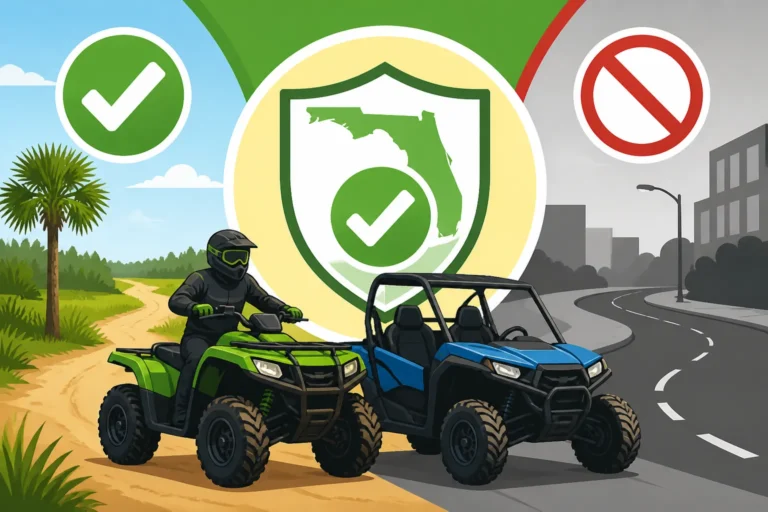
The challenge for side-by-sides wanting to hit the pavement is that Florida has very specific laws. Most side-by-sides, as manufactured, are not street legal. They can, however, often be converted to a specific class of vehicle known as a Low-Speed Vehicle (LSV). An LSV is a four-wheeled vehicle with a top speed greater than 20 mph but not greater than 25 mph. This distinction is vital because true "street legal" status, like a car, usually requires adherence to Federal Motor Vehicle Safety Standards (FMVSS) from the factory, which is incredibly difficult and expensive to achieve for an aftermarket conversion. For most side-by-side owners, the practical path to road access involves converting their machine to an LSV, which then allows them to operate on roads where the posted speed limit is 35 mph or less. This is often the most realistic option, as explored further in [Is a UTV Street Legal in Florida?].
Why Street Legal Conversion is Rarely a Simple Swap
The idea that you can just add a few lights and mirrors and suddenly be street legal is a common misconception that often leaves riders scratching their heads, or worse, facing fines. Many enthusiasts imagine a straightforward process, but the reality is much more nuanced, especially if you're aiming for full street legality beyond the LSV classification. For a vehicle to be truly "street legal" like a car, it needs to meet a vast array of safety standards that an off-road side-by-side was simply not designed to meet. This includes crashworthiness, emissions, and intricate braking system requirements that are well beyond what an aftermarket conversion can typically address. It’s why you almost never see a fully converted side-by-side operating like a regular car on highways.
Instead, the practical and attainable goal for most side-by-side owners in Florida is to convert their machine into a Low-Speed Vehicle (LSV). This designation comes with its own set of equipment requirements, but they are far more achievable than trying to meet full automotive standards. The process of [Turning a Side-by-Side Into a Florida LSV] involves adding specific safety features that allow it to operate legally on certain public roads. Even then, an LSV has limitations, such as a maximum speed of 25 mph and restrictions on the types of roads it can use. Understanding these distinctions from the outset will save you a lot of headache and ensure you invest your money into modifications that actually lead to legal road use. Don't fall into the trap of thinking a few cheap add-ons will suffice; proper conversion means adhering to specific legal criteria.
Essential Equipment for LSV Conversion and Associated Costs
Now that we understand the legal framework, let's talk about the actual items you'll need to install and the costs involved. This is where your budget truly takes shape, and where quality choices can significantly impact both your wallet and your safety. Trying to cut corners here can not only compromise your ability to pass an inspection but also put you at risk on the road.
Lights, Signals, and Horn: Making Yourself Seen and Heard
To be recognized as an LSV and safely operate on public roads, your side-by-side needs to be equipped with a comprehensive lighting and signaling system. This isn't just about having lights; it's about having the right kind of lights that meet specific standards. You'll need properly functioning headlights (with high and low beams, just like a car), tail lights, brake lights that activate when you apply the brakes, and turn signals for indicating lane changes or turns. Additionally, a horn is absolutely mandatory for warning other drivers and pedestrians. Finally, a white light to illuminate your license plate from 50 feet away is also required.
The cost for these components can vary wildly depending on whether you opt for basic, universal kits or higher-end, model-specific kits that integrate more seamlessly. A basic kit might just include separate lights, while a more comprehensive solution could feature integrated light bars or housings that look more factory-installed. Installation can range from a few hours for a simple plug-and-play kit to much longer if you're wiring everything from scratch or custom-mounting components. Many reputable brands, like SuperATV, offer complete street legal conversion kits that bundle these items together, which can sometimes be more cost-effective than buying each part individually. Remember, these aren't just cosmetic additions; they're vital safety features. You can learn more about general requirements in [Florida ATV Lights and Equipment for Road Use].
Windshield, Wipers, and Mirrors: Visibility and Safety
Just like any other road-going vehicle, clear visibility is non-negotiable for an LSV. This means equipping your side-by-side with a proper windshield, windshield wipers, and a full complement of mirrors. The windshield isn't just for blocking wind; it needs to be made of safety glass or a similar DOT-approved material that won't shatter dangerously in an impact. Plexiglass or thin plastic panels might be fine for off-road protection, but they won't cut it for street legal status. Depending on your side-by-side's model, you might find specific aftermarket windshields designed to fit perfectly.
Pairing that windshield with a functional wiper system is crucial for maintaining visibility in Florida's notorious sudden downpours. You might opt for a simple manual wiper, or if your budget allows, an electric wiper system can offer more convenience and effectiveness. Finally, you'll need at least one rearview mirror (either mounted on the dash or overhead) and two side mirrors, one on each side, to give you a clear view of traffic behind and beside you. Quality mirrors reduce blind spots and significantly enhance safety on the road. The combined cost of these items, especially if you opt for a robust, DOT-approved glass windshield and an electric wiper kit, can be a significant part of your overall conversion budget.
Seatbelts and DOT-Approved Tires: Critical Safety Upgrades
These two components are not just about compliance; they are fundamental to the safety and legal operation of your side-by-side as an LSV. First, every occupant of your side-by-side must be secured by a seatbelt. If your machine came with off-road harnesses, those might be acceptable, but standard automotive-style three-point seatbelts are often preferred or required for LSV conversion, offering better protection in certain types of collisions. You'll need to ensure you have enough seatbelts for the maximum number of passengers your vehicle is designed to carry, and that they are securely mounted to the frame.
Second, your tires are a major point of consideration. Those aggressive knobby tires that excel in mud and sand are typically not DOT-approved for street use. DOT-approved tires have a specific tread pattern, construction, and speed rating designed for consistent road contact, better handling on pavement, and increased durability at road speeds. Replacing your off-road tires with a full set of DOT-approved radial tires is a non-negotiable expense. This can be a substantial cost, as you're looking at four or more new tires, plus mounting and balancing. Brands like SuperATV offer a range of DOT-approved tires specifically designed for side-by-sides, ensuring you meet the legal requirements without sacrificing too much off-road capability if you still plan to hit the trails. Choosing the right tires is not just a legal formality; it profoundly impacts your machine's handling characteristics and safety when operating on paved surfaces.
Other Potential Requirements and Accessories
While lights, mirrors, windshields, seatbelts, and DOT tires cover the major components, there are other smaller, but equally important, items that might be required or highly recommended for your LSV conversion in Florida. A functional speedometer and odometer are crucial for legal operation, allowing you to monitor your speed and track mileage. Most modern side-by-sides come with these as standard, but ensure they are accurate. A parking brake is also typically required to prevent unintended movement when parked.
You might also need additional reflectors on the sides and rear of the vehicle to enhance visibility, especially in low light conditions. Some custom builds or older machines might require a VIN verification if there are any questions about the vehicle's identity or history; you'll want to know [Who Can Verify an ATV VIN in Florida?]. While not strictly a "conversion cost," it’s worth noting that if you buy certain aftermarket accessories, like a lift kit or larger tires, you might need to reconsider your gearing or clutch setup to maintain comfortable road performance at LSV speeds. Reputable aftermarket suppliers like SuperATV offer a wide range of accessories that might complement your conversion, but always check the legal requirements before purchasing anything. These additional items, while seemingly minor, can add up, so factor them into your overall budget.
Administrative Fees and the Titling Process
Beyond the physical parts and labor, you'll encounter a layer of government-mandated fees and bureaucratic steps that are essential for legally operating your converted side-by-side on Florida roads. These aren't just one-time expenses; some are recurring, forming part of the ongoing cost of ownership. Overlooking these administrative hurdles can derail your entire conversion project, so it's vital to budget for them accurately.
Titling and Registration as an LSV
Once your side-by-side physically meets the LSV requirements, the next crucial step is to get it properly titled and registered with the Florida Department of Highway Safety and Motor Vehicles (FLHSMV), typically through your local county tax collector's office. This process is different from titling a standard ATV or UTV, as you're now registering it as a specific class of on-road vehicle. You will face an initial title application fee to establish the vehicle's legal ownership and classification. This fee is usually a fixed amount, but it’s a necessary hurdle.
In addition to the titling fee, you'll need to pay annual registration fees. Unlike a simple off-highway title, an LSV registration is renewed periodically (usually annually) and includes a license plate that must be displayed. This recurring fee is part of the ongoing cost of operating your street-legal side-by-side. If you're purchasing a side-by-side with the intent to convert it, or if it's a private sale, you'll also be responsible for Florida sales tax, which is calculated based on the purchase price. This can be a significant amount, so be sure to factor it into your initial acquisition budget. Understanding the full scope of [Florida UTV Titling for Side-by-Sides Over 55 Inches] and the associated sales tax ([Florida Sales Tax When You Title an ATV]) is essential to avoid surprises.
Insurance Requirements for Street Legal Operation
A major difference between an off-road side-by-side and a converted LSV is the legal requirement for insurance. In Florida, if your side-by-side is registered as an LSV, it falls under the same general insurance requirements as other motor vehicles. This means you must carry Personal Injury Protection (PIP) and Property Damage Liability (PDL) insurance. This isn't optional; it's a legal mandate to protect yourself and others in the event of an accident.
The cost of this insurance will vary widely based on factors such as your driving record, the value of your side-by-side, your location, and the specific insurance provider you choose. It's an ongoing expense that needs to be factored into your monthly or annual budget, separate from the initial conversion costs. This can be a significant addition to your ownership expenses, especially if you haven't previously insured an on-road vehicle. Always get quotes from several insurance companies to find the best rates, and make sure they understand you are insuring an LSV-converted side-by-side. The specific details of [LSV Registration and the Insurance It Triggers] will give you a clearer picture of these obligations.
Inspection and Certification
While Florida does not have a statewide annual safety inspection program for motor vehicles, the initial process of getting your converted side-by-side legally recognized as an LSV may involve some form of inspection or verification. When you present your vehicle for titling and registration as an LSV, the Department of Highway Safety and Motor Vehicles (or the county tax collector acting on their behalf) will need to verify that it meets the definition of an LSV and has all the required safety equipment. This often includes a physical check of the VIN (Vehicle Identification Number) to ensure it matches your paperwork, and a general visual inspection to confirm the presence of headlights, tail lights, turn signals, mirrors, a windshield, seatbelts, and DOT-approved tires.
Sometimes, if there are questions about the vehicle's origin, or if it's a custom-built machine, a more thorough VIN verification might be required. This isn't typically a pass/fail mechanical inspection like some states have, but rather a compliance check to ensure your machine fits the LSV category. It’s important to have all your paperwork in order and your vehicle clearly displaying all the required components to make this process as smooth as possible. Any discrepancies or missing components could lead to delays and additional trips to the tax collector’s office.
Labor and Hidden Costs of Conversion
It’s easy to focus on the sticker price of parts, but the labor involved in transforming an off-road machine into a street-legal LSV can be a substantial, and often underestimated, portion of the total cost. Whether you're a seasoned mechanic or someone who's never picked up a wrench, you need to account for the time, effort, and potential for unexpected complications that arise during a conversion project. Ignoring these factors can lead to budget overruns and a prolonged conversion timeline.
DIY vs. Professional Installation: Weighing the Savings
The choice between tackling the conversion yourself and hiring a professional shop is perhaps one of the biggest cost decisions you'll make. If you're mechanically inclined, have a good set of tools, and are comfortable with automotive electrical work, a DIY conversion can save you a significant amount in labor costs. You're primarily paying for the parts and your own time. However, this path comes with its own challenges: the time commitment can be extensive, especially if you're learning as you go, and mistakes can be costly. Wiring errors, improperly mounted components, or failing to meet a specific requirement can lead to redoing work, buying replacement parts, and delays in getting your vehicle on the road.
On the other hand, hiring a professional shop, especially one experienced in side-by-side conversions, offers peace of mind. They have the expertise, the right tools, and can often source parts efficiently. However, you'll be paying their hourly labor rates, which can add up quickly. These rates vary by region and shop reputation, but they are a fixed cost you need to budget for. A professional installation typically ensures the work is done correctly and efficiently, potentially saving you headaches down the line during the inspection or if issues arise. Weigh your own skills, available time, and patience against the convenience and expertise of a professional before making this critical decision.
Unexpected Issues and Upgrades
Even with the best planning, conversion projects can sometimes uncover hidden problems or necessitate additional upgrades that weren't initially obvious. For instance, adding a full suite of lights, wipers, and a horn can put a strain on your side-by-side's existing electrical system. You might find that your stock alternator or battery isn't quite up to the task of powering all the new accessories, especially if you already run other electrical components like a sound system or winch. This could lead to an unexpected cost for an upgraded battery, a higher-output alternator, or additional wiring and relays.
Furthermore, while you're focused on legal compliance, you might realize that certain aspects of your side-by-side's off-road setup aren't ideal for pavement. For example, some heavily modified suspensions designed for extreme articulation might feel overly soft or unstable at LSV speeds, leading you to consider suspension adjustments or upgrades for better road handling. Similarly, frame modifications might be necessary if you're trying to integrate a custom windshield or roll cage extension that doubles as a mounting point for lights. These "scope creep" items can quickly inflate your initial cost estimate, so it's always wise to build in a contingency budget for unforeseen circumstances. A realistic approach means acknowledging that a conversion isn't always a straight line from point A to point B.
The Financial Snapshot: Putting it All Together
Bringing all these potential expenses into one clear picture is vital for any side-by-side owner considering a street legal conversion in Florida. Without a comprehensive understanding of the cost ranges, it's easy to underestimate the investment and find yourself facing unexpected bills. Let's break down the general financial outlay you can expect.
Estimated Cost Ranges for a Typical LSV Conversion
The total cost to convert a side-by-side to an LSV in Florida can vary significantly based on the starting condition of your machine, the specific components you choose (basic vs. premium), whether you do the work yourself or hire a professional, and even your local administrative fees. Here's a general breakdown to give you a clearer idea:
| Category | Item | Estimated Low Cost | Estimated High Cost |
|---|---|---|---|
| Parts & Equipment | Headlight & Taillight Kit | Low hundreds | High hundreds |
| Turn Signal & Horn Kit | Low hundreds | Mid hundreds | |
| DOT-Approved Windshield | Mid hundreds | Low thousands | |
| Windshield Wiper (Manual/Electric) | Low hundreds | Mid hundreds | |
| Mirrors (Rearview & Side) | Low tens | Low hundreds | |
| DOT-Approved Tires (Set of 4+) | Mid hundreds | Mid thousands | |
| Seatbelts (per occupant) | Low tens | Mid hundreds | |
| Misc. (Reflectors, license plate light) | Low tens | Low hundreds | |
| Labor | Professional Installation (if needed) | Low hundreds | Low thousands |
| Administrative Fees | Initial Title Application Fee | Low tens | Low tens |
| Annual Registration Fee | Low tens | Low tens | |
| Sales Tax (on purchase price) | Varies widely | Varies widely | |
| Insurance | Annual PIP/PDL Insurance | Low hundreds | Low thousands |
| Unexpected | Electrical upgrades, suspension tune | Low hundreds | Mid hundreds |
Note: These are estimated ranges. Specific prices will vary by brand, model, and market conditions. Always check current figures with providers and state agencies.
As you can see, the overall investment can range from a few thousand dollars on the lower end, primarily for basic parts and DIY labor, to well over several thousand dollars if you opt for premium components, professional installation, and account for ongoing insurance and fees. For instance, a quality set of SuperATV DOT-approved tires and a comprehensive light kit alone can represent a significant portion of this budget.
Why the Investment Can Be Worthwhile (or Not)
Deciding whether to invest in a Florida side-by-side street legal conversion, specifically to an LSV, comes down to a personal cost-benefit analysis. For many riders, the ability to legally transition from their off-road adventures directly onto designated public roads, like those in a neighborhood or for quick runs to local stores, significantly enhances their machine's utility and convenience. Imagine not having to trailer your side-by-side just to get to a nearby trail system or to grab some ice from the corner store. This extended utility means more opportunities to enjoy your machine and integrate it into your daily life, making the initial investment feel worthwhile.
However, it's crucial to remember the limitations. As an LSV, your side-by-side will still be restricted to roads with posted speed limits of 35 mph or less, and it will have a top speed of 25 mph. This means no highway cruising or even major arterial roads in many urban areas. For some, these limitations might negate the perceived benefits, especially if their primary goal was unrestricted road travel. You'll need to consider [Florida Low-Speed Vehicle Rules for Side-by-Sides] carefully. If your local riding areas are primarily accessed via high-speed roads, or if you rarely leave your private property, the significant financial outlay for conversion, plus ongoing insurance and registration, might not be justified. It’s about balancing the freedom and convenience of limited road access against the financial and operational restrictions that come with an LSV conversion.
Ultimately, the cost of making your side-by-side street legal in Florida, primarily through LSV conversion, is a substantial investment, often reaching several thousand dollars once all parts, labor, administrative fees, and initial insurance costs are factored in. However, by understanding these costs upfront, doing your research, and making informed decisions about parts and installation, you can navigate the process with confidence. This isn't a small undertaking, but for many Florida riders, the added convenience and expanded use of their beloved side-by-side make every penny worthwhile. Always remember to check with your local county tax collector and current Florida statutes, as rules and fees can change.
Disclaimer
This article is for general informational purposes only and does not constitute professional advice. Laws, prices and regulations vary by location and change over time. Consult a qualified professional for guidance on your specific situation.