Unpaved Roadway: How the Statute Defines It
It's incredibly frustrating when you're just trying to enjoy your ATV or UTV in Florida, but the rules about where you can and can't ride on roads feel like a tangled mess of legal jargon. You hear whispers about "unpaved roadways" and wonder if that sandy path near your property counts, or if the graded dirt road leading to your favorite fishing spot is fair game. This guide is here to untangle the legal definition of an "unpaved roadway" in Florida, helping you understand exactly what the statute says and how it impacts your riding adventures.
The Core Definition of an "Unpaved Roadway" in Florida Statute
Florida's beautiful, diverse landscape includes countless miles of unpaved surfaces, from sugar sand tracks to graded lime rock roads. For ATV and UTV riders, understanding the precise legal definition of an "unpaved roadway" is paramount, because it directly dictates where you can legally operate your machine outside of designated off-road parks. Misinterpreting this can lead to costly citations, impoundment, or worse, dangerous situations. The state statutes are clear, but often require a bit of translation for the average rider just looking to have some fun.
What Chapter 316.2123 Specifically Says
Florida Statute 316.2123 is the key piece of legislation that governs the use of all-terrain vehicles and utility vehicles on public roads in the state. This statute specifically outlines what conditions must be met for an off-highway vehicle (OHV) to be operated on certain roadways. It’s crucial to understand that it doesn't open up all roads to ATVs and UTVs, but rather carves out very specific exceptions for unpaved surfaces. The statute defines an "unpaved roadway" as a county road, or a municipal street, that has not been paved with asphalt or concrete. This might sound simple, but the nuances are critical for riders.
This definition clarifies that we're talking about established public infrastructure, not random trails or private property. A path worn through a field by years of use, for example, would almost certainly not qualify as an "unpaved roadway" under this statute, even if it's dirt. It must be recognized and maintained (even if minimally) as a county road or a municipal street by the relevant governmental authority. This distinction is often a source of confusion, as many riders might assume any dirt path is fair game, leading them into legal trouble when they encounter law enforcement. [Florida's Unpaved Road Rule for ATVs Explained] dives deeper into the specific parameters.
Differentiating from Paved Streets and Highways
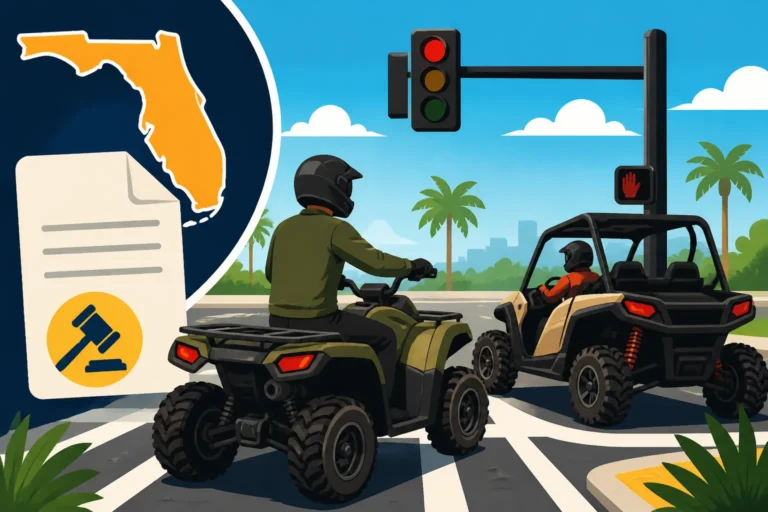
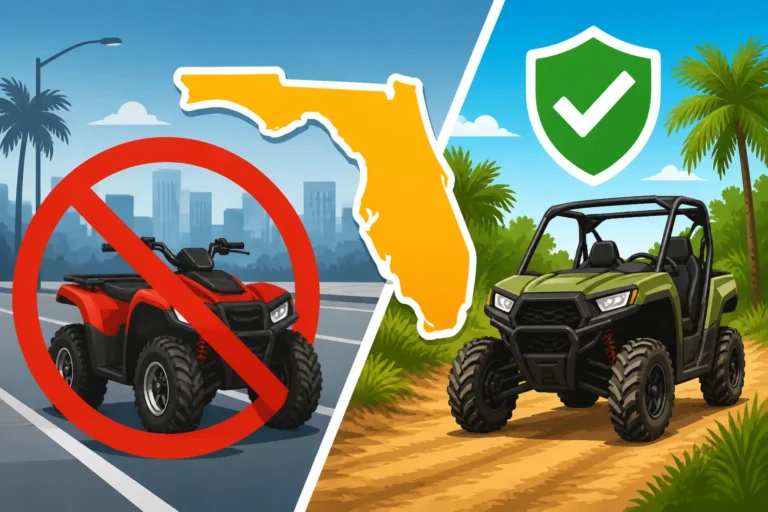
One of the biggest frustrations for ATV and UTV enthusiasts in Florida is the stark difference in rules between off-highway vehicles and traditional street-legal vehicles. Simply put, ATVs and UTVs are not designed or intended for paved road use, and Florida law strongly reflects this. The "unpaved roadway" definition is a specific carve-out from the general prohibition of OHVs on public roads, and it’s critical not to blur these lines. If a road has a hard surface, whether it's blacktop, concrete, or even old brick, it falls outside the "unpaved roadway" definition, and your ATV or UTV generally cannot be legally operated there.
This clear distinction means that even if a paved road is in terrible condition with potholes everywhere, it's still considered a paved surface in the eyes of the law. You can't just decide it's "unpaved enough" to ride your quad on it. The legislative intent is to keep off-highway vehicles primarily off high-traffic, high-speed paved thoroughfares, where their design makes them less safe and more of a hazard to other motorists. Understanding this fundamental difference is the first step in staying on the right side of the law and avoiding dangerous encounters on the pavement.
The Practical Implications for ATV Riders
For you, the rider, the statutory definition of an unpaved roadway means you need to be acutely aware of the road surface beneath your tires and the official designation of that road. It’s not enough for a road to simply look unpaved; it needs to be an actual public county road or municipal street that lacks an asphalt or concrete surface. This has huge practical implications for planning your rides. You can't just take the most direct route across town if it involves any stretch of pavement, even if it's just a few yards. This often means trailering your machine to a riding area, or carefully planning routes that stick exclusively to designated unpaved public access roads.
This definition also impacts the kind of modifications you might consider for your machine. While some riders modify their ATVs with SuperATV aftermarket parts to enhance off-road performance, they need to remember that even these upgrades don't magically make a paved road legal. The focus must always remain on compliance with the unpaved roadway definition. Knowing this rule helps you make informed decisions about where you ride and how you prepare your machine, preventing unexpected interactions with law enforcement and ensuring your riding remains enjoyable and within legal bounds.
Common Misconceptions and Gray Areas
Even with a clear statutory definition, the real world often presents scenarios that aren't quite black and white. Many riders fall into traps because they operate under assumptions or misunderstandings about what constitutes a legal "unpaved roadway" for ATV and UTV use. It’s not just about the surface itself, but also about the context, ownership, and local regulations that can add layers of complexity. This section aims to clear up some of those common gray areas that can trip up even experienced riders.
Dirt Roads vs. Trails vs. Private Property
One of the most persistent misconceptions is the idea that any dirt surface is fair game. This simply isn't true. Florida's definition of an "unpaved roadway" specifies a county road or municipal street. This is a crucial distinction. A designated off-road trail within a state forest, for example, might be unpaved and open to OHVs, but it's not an "unpaved roadway" in the sense of the statute that allows limited road use. Similarly, riding on private property, even if it has dirt roads, is only legal with the landowner's explicit permission, and those roads are certainly not public unpaved roadways.
The challenge comes when distinguishing between a legitimate unpaved county road and what might just be an access path or a property line easement. Many rural areas have extensive networks of dirt tracks. Some are officially maintained county roads, while others are informal paths or part of private land. The onus is on the rider to know the difference. When in doubt, it’s always best to assume it’s not a public unpaved roadway unless you have clear confirmation from local county or city maps or signage. This caution can save you from trespassing charges or illegal road use citations.
The Role of County Ordinances
While the state statute provides a foundational definition, Florida's counties often have the authority to further regulate ATV and UTV use within their borders. This means that a county can, through its own ordinances, be more restrictive than state law. For example, while state law might allow ATVs on unpaved county roads, a specific county could pass an ordinance prohibiting ATVs on all county roads, or only allowing them on certain designated ones. This local control can be incredibly frustrating for riders, as the rules can literally change as you cross a county line. [Florida Counties That Designated ATV Roads] can offer more insight into how this plays out.
This patchwork of regulations requires riders to do their homework. Before heading out to a new area, it's a really good idea to check the local county's ordinances regarding OHV use on public roads. What's perfectly legal in Marion County might be strictly prohibited in Putnam County, even if the roads look identical. The "unpaved roadway" definition might be consistent statewide, but the permission to ride on them can vary greatly by local jurisdiction. Ignoring these local rules can lead to the same penalties as violating state law.
"Maintained" vs. "Unmaintained" Unpaved Roads
Another common point of confusion revolves around the maintenance status of an unpaved road. Does an unpaved road still count if it's barely passable, overgrown, or hasn't seen a grader in years? The state statute doesn't explicitly define a minimum level of maintenance for an "unpaved roadway." However, the key phrase "county road or municipal street" implies that it is still recognized as public thoroughfare, even if it's less traveled or appears neglected. The challenge here is proving its status.
If a road has been officially abandoned by the county or municipality, or if it was never formally adopted as a public road to begin with, then it likely would not qualify, regardless of its unpaved nature. A road that once was a county road but has since been effectively swallowed by wilderness due to lack of use and maintenance could become a gray area. Ultimately, if you encounter an unpaved path that seems ambiguous, err on the side of caution. Law enforcement will rely on official maps and records to determine if it's truly a public unpaved roadway, and your "it looks like a road to me" defense might not hold up.
Equipment and Rider Requirements for Unpaved Roadway Use
Just because a road is unpaved and falls under the statutory definition doesn't mean you can just hop on your ATV or UTV and go. Florida law imposes specific requirements on both the machine itself and the operator when riding on any public roadway, even the unpaved ones. These rules are in place for safety, for you and for others who might be using the same road. Ignoring these requirements isn't just a minor oversight; it can lead to tickets, accidents, and serious legal repercussions.
Required Safety Gear
Safety is paramount, and Florida law mandates certain protective gear for riders on public unpaved roadways. The most critical piece of equipment is a helmet. For any rider under 16 years of age, a U.S. Department of Transportation (DOT) approved safety helmet is absolutely mandatory. While adults aged 16 and over are not always required to wear a helmet on an ATV (depending on the vehicle's classification and specific circumstances), it is always highly recommended for obvious safety reasons. Many serious injuries could be prevented simply by wearing a helmet. [Florida ATV Helmet Law for Riders Under 16] provides detailed information on this topic.
Beyond helmets, eye protection is also a critical requirement, especially when riding on dusty unpaved roads. Goggles or a face shield on your helmet are essential to protect your eyes from debris, insects, and the sun. It's easy to dismiss these items, but a sudden stone chip to the eye at speed can cause a crash faster than you can react. Proper footwear, like sturdy boots that cover the ankles, and long pants and sleeves are also highly advisable to protect against scrapes, impacts, and sun exposure, even if not explicitly mandated by statute for all situations on unpaved roads.
Machine Equipment for Legal Road Use
Your ATV or UTV isn't just an off-road toy; if you're taking it on a public unpaved roadway, it needs to meet certain basic equipment standards, much like any other vehicle. Crucially, your machine must be equipped with at least one headlight and one taillight. These aren't just for night riding; they are essential for visibility during daylight hours, especially when dust is kicked up or weather conditions are poor. You need to be seen by other vehicles, whether they are ATVs, trucks, or cars. Many stock machines, especially older ones, might not have these up to par, so a pre-ride check is essential.
In addition to lights, working brakes are obviously non-negotiable. Your machine must be capable of safe stopping. A functional exhaust system that isn't excessively loud is also important to avoid noise complaints and potential local ordinance violations. While turn signals and rearview mirrors are generally not explicitly required for ATVs on unpaved roads under the same statutes that apply to cars, having them can significantly increase your safety and awareness, especially if you’re riding in areas with other vehicle traffic. Consider upgrading with SuperATV lighting kits or mirrors to ensure maximum visibility and safety on these shared roads. [Florida ATV Lights and Equipment for Road Use] discusses these requirements more thoroughly.
Driver's License and Age Restrictions
Here's another point of frequent misunderstanding: operating an ATV or UTV on a public unpaved roadway in Florida generally requires a valid driver's license if you are 16 years of age or older. This isn't like riding on private land where a license isn't necessarily needed. When you're on a public road, even an unpaved one, you are considered a vehicle operator, and standard licensing rules apply. [Do You Need a Driver's License for an ATV in Florida?] explores this in detail.
For riders under 16, the rules are even stricter. A minor cannot operate an ATV or UTV on a public unpaved roadway unless they are under the direct supervision of a licensed adult (age 18 or older) who is within sight. Furthermore, the minor must have completed an approved ATV safety course. This is not just a recommendation; it's a legal requirement designed to ensure young riders have the necessary skills and understanding of safety before operating these powerful machines on public access points. Ignoring these age and license rules is a quick way to encounter legal trouble.
Where You Can and Cannot Ride (Even on Unpaved Roads)
Understanding what an "unpaved roadway" is is only half the battle. The other half is knowing which unpaved roadways you can actually ride on. Not all unpaved surfaces are created equal when it comes to legal ATV and UTV access in Florida. There are layers of jurisdiction, ownership, and designation that dictate whether your machine is welcome, even on a dirt road that perfectly fits the statutory definition.
Public Land vs. Private Land Access
The fundamental distinction always comes down to ownership. The state statute's definition of "unpaved roadway" applies to public county roads and municipal streets. This means you generally cannot just ride your ATV on any unpaved surface that isn't explicitly part of this public road network. Private land, even if it contains extensive unpaved roads, is off-limits unless you have the express permission of the landowner. This might seem obvious, but many riders get into trouble by assuming that if a dirt road looks like a public road and is easily accessible, it must be public.
This is a particular issue in rural Florida, where sprawling ranches, timber operations, and large agricultural properties have complex networks of private dirt roads that often intersect or run parallel to public ones. Signs indicating "Private Property" or "No Trespassing" should always be heeded. Even if a gate is open, it doesn't grant permission. Always verify ownership and permission before venturing onto any non-designated unpaved surface that isn't clearly a public county road or municipal street.
Designated vs. Non-Designated Unpaved Roads
Even among public unpaved roadways, there's another layer of complexity: designation. While state law allows for operation on unpaved county roads and municipal streets, counties and cities can (and often do) pass ordinances that either restrict or specifically designate certain unpaved roads for OHV use. This means that while the state might allow it broadly, your local county could have "opted out" of this provision, or only permitted OHVs on a handful of clearly marked roads. [Florida Counties That Designated ATV Roads] further illustrates this localized approach.
The best practice is to look for clear signage. If an unpaved road is open to ATVs and UTVs, the county or municipality will often have signs indicating this, sometimes with speed limits or specific hours of operation. Conversely, if you see "No ATVs" or "No Off-Road Vehicles" signs, you absolutely must comply. Just because an unpaved road fits the state's technical definition doesn't automatically mean it's open to OHV traffic in every county at all times. Always prioritize local signage and ordinances over a general interpretation of state law.
Exceptions for Agricultural and Emergency Use
Like many traffic laws, there are specific, limited exceptions to the rules regarding ATV and UTV use on unpaved roadways. One of the most common and important exceptions is for agricultural purposes. Farmers and ranchers often rely on ATVs and UTVs as essential tools for managing their land and livestock. Florida law recognizes this, allowing the operation of OHVs on public unpaved roadways for agricultural purposes, provided they are equipped with necessary safety features like lights and a slow-moving vehicle emblem. This is not a carte blanche to joyride; it’s a specific exception tied to legitimate farming or ranching activities.
Similarly, there are exceptions for emergency personnel or utility workers operating ATVs and UTVs in the course of their duties. Law enforcement, fire rescue, or utility crews might need to use these vehicles to access remote unpaved areas during emergencies or for maintenance work. These are highly specific, job-related exemptions and do not apply to recreational riders. Understanding these narrow exceptions is important, but never mistake them for broad permissions for general riding.
Penalties and Enforcement for Violating Unpaved Road Rules
It's tempting to think that a small deviation from the rules on a quiet dirt road won't lead to any trouble, but that's a risky gamble. Florida law enforcement, including county sheriffs and state troopers, are increasingly vigilant about illegal ATV and UTV road use. The penalties for violating the unpaved roadway rules can range from a minor citation to severe consequences like machine impoundment, making your riding experience much more costly and stressful than it needs to be.
Common Citations and Fines
If you're caught operating your ATV or UTV illegally on a paved road, or on an unpaved road where it's not permitted, you're likely to receive a traffic citation. These citations are typically non-criminal infractions, similar to a speeding ticket, but they come with fines that can add up quickly. A common citation might be for "Operating an Off-Highway Vehicle on a Public Roadway," which can carry a base fine plus court costs and administrative fees. If you're also found to be lacking required safety gear (like a helmet for a minor), or if your machine isn't equipped with proper lights, you could face additional citations, multiplying your costs.
These fines are designed to be a deterrent, and they can certainly put a damper on your wallet. While specific amounts can vary by county and the nature of the violation, it's not uncommon for a single incident to result in hundreds of dollars in fines. And remember, these citations go on your driving record, which can impact your insurance rates or even lead to points on your driver's license if the infraction is severe enough. It’s far cheaper and less stressful to know and follow the rules from the outset. [Florida ATV Ticket Cost for Illegal Road Riding] can give you an idea of the potential financial hit.
Machine Impoundment and Other Consequences
The financial hit of fines is one thing, but the potential for your ATV or UTV to be impounded is a far more significant consequence that can leave you stranded and facing a massive headache. Law enforcement has the authority to impound machines that are being operated illegally on public roads. This means your prized quad or side-by-side could be towed away, and you'll be responsible for hefty towing and storage fees, in addition to any fines. Getting your machine back from impound can be a lengthy, frustrating, and expensive process.
Beyond impoundment, repeat offenses or particularly egregious violations (like reckless driving or operating under the influence) can lead to more severe charges, including criminal penalties. If you're a minor, illegal operation can involve parental notification, mandatory safety courses, or even juvenile court proceedings. The ripple effect can impact future driving privileges and your ability to legally ride. It's crucial to understand that law enforcement takes illegal road use seriously, not just for compliance, but for the safety of everyone sharing Florida's roads.
How to Stay Compliant and Ride Responsibly
The best defense against penalties and unwanted encounters with law enforcement is proactive compliance and responsible riding. First and foremost, educate yourself thoroughly on Florida's state statutes regarding OHV use and, just as importantly, check the specific ordinances of any county or municipality where you plan to ride. Websites for county tax collectors or sheriff's offices often have this information, or you can call for clarification. Always assume an unpaved road is not open unless you have clear confirmation or signage.
Invest in the necessary safety gear and ensure your machine is properly equipped. Things like quality DOT-approved helmets, eye protection, and functional headlights/taillights are non-negotiable. If you're looking for upgrades, SuperATV offers a range of durable and compliant accessories that can enhance both safety and performance. Always carry your driver's license (if applicable) and any required safety course certificates. And finally, when you are on an approved unpaved roadway, ride courteously, be aware of other traffic, and adhere to posted speed limits. Responsible riding is the key to enjoying Florida's fantastic unpaved roads for years to come.
Disclaimer
This article is for general informational purposes only and does not constitute professional advice. Laws, prices and regulations vary by location and change over time. Consult a qualified professional for guidance on your specific situation.