Why a 14-Year-Old Lost Golf Cart Privileges
It's certainly been a roller coaster for families who rely on golf carts for getting around their Florida neighborhoods, especially with the recent changes affecting younger drivers. If you've got a teen who used to zip around in the golf cart and now suddenly can't, you're not alone in feeling a bit bewildered and probably more than a little frustrated. This guide is here to untangle the confusion and explain exactly why the rules changed, what they mean for your 14-year-old, and how to navigate these new golf cart privileges in the Sunshine State.
Understanding the Recent Changes to Florida Golf Cart Law
For years, golf carts have been a quintessential part of the Florida lifestyle, especially in many planned communities, retirement villages, and even some smaller towns. They offered a convenient, often open-air way to run errands, visit friends, or get to local amenities without needing a full-sized car. And for many teenagers, driving a golf cart was their first taste of independence, a rite of passage even, allowing them to traverse their neighborhoods with a sense of freedom. Then, suddenly, the rules shifted, leaving many families scratching their heads and wondering what happened.
The Old Rules vs. The New Reality
Before the recent legislative updates, Florida law was a little more lenient when it came to who could operate a golf cart on designated public roads. Generally, if you were at least 14 years old, you could legally drive a golf cart. This meant that many middle school and high school students had the ability to get around their communities, whether it was heading to a friend's house, the local park, or even a nearby store. It was a system that worked for many families, offering a practical transportation solution and fostering a sense of community independence among younger residents. Parents felt comfortable knowing their kids could get to and from activities safely within their familiar neighborhood limits, often without the need for an adult chaperone.
However, the new reality paints a different picture. Now, that threshold of 14 years old is simply no longer enough. The state has implemented stricter requirements, fundamentally altering who can legally operate a golf cart on public roads and how they must be qualified to do so. This change has definitely hit home for many Floridians, particularly those in communities where golf carts are a primary mode of transport. The ease and accessibility that once defined golf cart use for teens have been replaced by more formal requirements, demanding a re-evaluation of how families approach local transportation for their young people. It’s a significant shift from the way things were, and it requires everyone to get up to speed on the updated regulations.
Why the Law Changed: Safety Concerns and Public Input
You might be asking, "Why now? Why change something that seemed to work for so long?" The primary driver behind the stricter golf cart regulations in Florida was an increasing concern for public safety, particularly involving younger, unlicensed drivers. As golf cart usage expanded beyond just golf courses and into bustling residential areas, the number of accidents and incidents involving these vehicles reportedly began to rise. There were growing reports of collisions, injuries, and even fatalities, many of which involved underage operators who might not have had the same level of driving experience or understanding of road rules as licensed drivers.
Legislators and local authorities heard from concerned parents, community leaders, and law enforcement agencies about the inherent risks. Imagine a golf cart, which often lacks the safety features of a standard automobile like airbags or enclosed cabins, navigating busier streets or crossing intersections. When operated by someone without formal driver training, the potential for accidents increases significantly. The public input highlighted a clear need for greater responsibility and a more mature understanding of traffic laws for anyone operating these vehicles on public thoroughfares. The goal was to reduce preventable accidents, protect young drivers and their passengers, and ensure that golf carts, while convenient, were operated safely within the broader traffic ecosystem. It was a tough decision, undoubtedly, impacting many, but ultimately made with the safety and well-being of the community in mind. For more on how these vehicles are regulated, see [Florida Golf Cart Laws vs ATV Laws].
Who is Affected by the New Age Requirements
The changes to Florida's golf cart law directly impact a wide range of individuals, but the most pronounced effect is on teenagers. Specifically, any individual who is under the age of 18 and wishes to operate a golf cart on public roads is now subject to significantly stricter criteria. This means that if your child was 14, 15, 16, or even 17 and previously drove a golf cart with no issue, they now need to meet the new legal requirements. The days of simply being "old enough" by a certain numerical age without any official driving credential are now behind us for public road use.
The impact isn't just felt by individual families; it also resonates across entire communities that have historically relied on golf carts as a cornerstone of their local transportation. Think about communities like The Villages, or similar planned residential areas where golf carts are not just recreational vehicles but a legitimate part of the daily commute. Suddenly, a segment of the population that once enjoyed easy access to these vehicles finds their privileges curtailed. This means parents might now have to factor in driving their teens to places they once could reach independently, altering daily routines and potentially increasing reliance on traditional automobiles. It’s a systemic shift that requires adaptation from both individual households and the broader community infrastructure, prompting many to revisit what [The New Minimum Age for a Florida Golf Cart] actually entails.
What Florida's New Golf Cart Law Means for Young Riders
The new regulations aren't just about raising an age limit; they fundamentally change the qualifications for operating a golf cart on public roads in Florida. It’s no longer a casual affair for teens; it’s now tied directly to the formal licensing system that governs all other motor vehicles. This shift aims to ensure that anyone behind the wheel of a golf cart, particularly on streets shared with cars, possesses a foundational understanding of road safety and traffic laws.
The New Minimum Age for Driving a Golf Cart on Public Roads
Under the updated Florida law, the minimum age for operating a golf cart on public roads has effectively been raised for many young people. The crucial change is that to legally drive a golf cart on roads where golf carts are permitted, you must now hold either a valid learner's permit or a valid driver's license. This is a significant departure from the previous standard, which allowed a 14-year-old to operate a golf cart without any official state-issued driving credential. Now, a 14-year-old can only drive a golf cart on a public road if they have already obtained their learner's permit. Since Florida's learner's permit typically becomes available at age 15, this means that for most practical purposes, the effective minimum age for solo golf cart operation on public roads has shifted from 14 to 15.
This alteration directly addresses the safety concerns that led to the legislative change. By requiring a learner's permit or a full driver's license, the state ensures that young drivers have undergone at least some formal education regarding road signs, traffic laws, and safe driving practices before being allowed to operate a vehicle, even a golf cart, on public thoroughfares. It's a measure designed to bring a higher level of accountability and preparedness to golf cart operation, aligning it more closely with the expectations for other forms of road use. Families need to be fully aware of this change, as compliance is not optional and carries potential penalties. You can find more details on this specific change in [Florida Golf Cart Age Law Since October 2023] and [Florida Golf Cart Age Minimum After the 2023 Law].
Driver's License or Learner's Permit: The New Standard
This is the big one, the game-changer that has everyone talking. The new standard for operating a golf cart on Florida's public roads is now unequivocally tied to official state-issued driving credentials. What this means in plain English is that to legally drive a golf cart on a street or road designated for golf cart use, you must now possess one of two things: a valid Florida driver's license OR a valid Florida learner's permit. No exceptions for age alone, no grandfathering in prior experience without the proper paperwork.
For parents of 14-year-olds, this is precisely why your teen "lost" their golf cart privileges. Until they turn 15 and are eligible for a learner's permit, or eventually 16 for a full driver's license, they simply do not meet the new legal requirement to operate a golf cart on public roads. The learner's permit itself comes with its own set of rules, such as requiring supervision by a licensed driver over the age of 21 in the front passenger seat. This also extends to golf cart operation. So, while a 15-year-old with a learner's permit can drive a golf cart, they still need that adult supervision when doing so on public roads. This elevates the golf cart from a simple neighborhood conveyance to a vehicle requiring the same basic legal qualifications as a car, emphasizing safety and legal compliance. Many are now asking about [Learner's Permits and Cart Driving at 15] in this context. It's also worth noting that [Adults Carrying Photo ID on a Cart] is now a requirement, reinforcing the need for proper identification for all golf cart drivers.
Exceptions and Private Property: Where the Rules Don't Apply
While the new Florida golf cart laws bring stricter regulations for public roads, it's crucial to understand that these rules generally apply to publicly maintained roads or streets where golf carts are explicitly allowed. This is an important distinction, as there are still places where the old rules, or even no state-level rules, might apply.
For instance, on private property, such as a golf course itself, a private ranch, or within a completely gated community where the roads are privately owned and maintained, the state's public road golf cart laws typically do not apply. In these settings, the property owner or homeowner's association (HOA) sets the rules. This means a 14-year-old might still be able to drive a golf cart on the fairways of a private golf course or within their own private, walled-off neighborhood, provided the HOA or property owner permits it. Always check with the specific community or property management for their localized regulations, because even private communities can sometimes opt to follow state guidelines for safety reasons.
Another important exception is for operations directly related to agricultural purposes on farms, or for utility service work. These specific operational contexts often have their own set of rules or exemptions, acknowledging that golf carts, and indeed other utility vehicles, serve practical, work-related functions on private land or within specific designated work zones. However, for general transportation and recreation on public streets, the driver's license or permit requirement is the standard. It’s also important to note that these golf cart rules are distinct from those governing ATVs and UTVs. While you might use products from a brand like SuperATV to accessorize a utility vehicle for your farm, those machines have entirely different legal classifications and road rules compared to golf carts. [What ATVs Cannot Do on The Villages Cart Paths] is a good example of how vehicle types are distinguished even within communities.
Navigating the New Rules: Advice for Families and Communities
The changes to Florida's golf cart laws have certainly caused a ripple effect, particularly for families with teenage drivers. It's an adjustment, no doubt, but understanding how to navigate these new regulations can help alleviate some of the frustration and ensure everyone remains compliant and safe. This isn't just about telling your kids "no"; it's about educating them and finding practical solutions within the new legal framework.
Educating Your Teen on the Updated Regulations
The first and most critical step for families is to sit down with your teenager and clearly explain the new rules. It's easy for kids to feel like their freedom is being unfairly curtailed, especially if they've been driving golf carts for years. Emphasize that these changes are about safety, not about punishing them. Explain that to drive a golf cart on public roads in Florida, they now need to be at least 15 years old and possess a valid learner's permit, or be 16 and have a full driver's license. Make sure they understand that operating a golf cart without these credentials on public roads can lead to fines, citations, and even more serious legal consequences, not just for them but potentially for the supervising adult or vehicle owner.
You can frame it as an opportunity for them to prepare for their full driver's license. Encourage them to study for the learner's permit exam and emphasize the importance of understanding all traffic laws, not just those specific to golf carts. Discuss the differences between golf carts and other vehicles they might encounter, like the off-road parts and accessories from SuperATV that are meant for actual ATVs or UTVs, which have vastly different rules and capabilities. Reinforce that even with a permit or license, safe and responsible driving is paramount. This conversation should be ongoing, reinforcing good habits and legal compliance, helping your teen transition from casual golf cart use to more structured vehicle operation.
Exploring Alternatives for Young Riders
So, if your 14-year-old can no longer drive the golf cart on public roads, what are the alternatives? It's a fair question, and thankfully, there are several options for maintaining a degree of independence and mobility for young people in Florida communities.
One obvious alternative is the good old-fashioned bicycle. Many communities that are golf cart-friendly also have extensive bike paths and sidewalks, providing a safe and healthy way for teens to get around. Electric bikes or scooters (within legal limits and where permitted) can also be options for slightly longer distances. For those living in smaller, private communities, walking might even be a viable option for local trips.
Another consideration is carpooling with older, licensed friends or family members. While it might not offer the same solo independence, it's a practical solution for getting to school, extracurricular activities, or social events. For families in very golf cart-centric communities, exploring public transportation options, if available, or even community-sponsored shuttle services could be worthwhile. The key is to explore all available avenues and discuss them with your teen to find solutions that work for your family's specific needs and location, while always prioritizing safety and adherence to the new Florida golf cart rules. Remember, while a golf cart is a small vehicle, it's not the same as a utility vehicle you'd outfit with SuperATV modifications for serious off-road adventures; its road-use purpose is distinctly different.
Community Impact and Enforcement
The impact of these new golf cart regulations extends far beyond individual households; it truly reshapes how entire communities function, particularly those where golf carts are deeply ingrained in daily life. For local law enforcement, the change means increased vigilance regarding golf cart operators, especially younger ones. Deputies and police officers are now actively enforcing the new age and licensing requirements, which can lead to traffic stops, citations, and fines for non-compliance. This often includes checking for a valid driver's license or learner's permit, and ensuring any permit holders are accompanied by a licensed adult, as stipulated by [Florida Golf Cart Photo ID Requirement for Adults].
Many Homeowner Associations (HOAs) and community leaders are also actively working to educate their residents about the updates. This might involve sending out newsletters, posting notices on community boards, or holding informational meetings. Some communities are even reassessing their internal road signage and access points to clearly delineate where golf carts are permitted and under what circumstances. The goal is often to strike a balance: preserving the beloved golf cart culture while adhering to the new state safety mandates. It's a collaborative effort between residents, community management, and law enforcement to ensure a smooth transition and maintain a safe environment for everyone sharing the roads. The rules about [What ATVs Cannot Do on The Villages Cart Paths] also highlight how specific communities manage different vehicle types.
Distinguishing Golf Carts from Other Off-Highway Vehicles
With all this talk about golf carts and their rules, it's easy to get them confused with other popular recreational and utility vehicles like ATVs, UTVs, and Low-Speed Vehicles (LSVs). While they might all share some open-air characteristics, their legal classifications, intended uses, and, crucially, their operating rules, are distinct. Understanding these differences is vital for any Florida resident, especially when considering what you or your family can legally operate and where.
Golf Carts vs. ATVs and UTVs
This is where a lot of confusion often arises, especially for newcomers to the world of off-road and recreational vehicles. A golf cart, by its very design and original intent, is primarily for transporting people and golf equipment on a golf course. They are typically smaller, have a top speed of around 20 mph, and are not built with robust suspension or ground clearance for rough terrain. Their designation on public roads is often limited to specific, low-speed, or designated golf cart paths within communities.
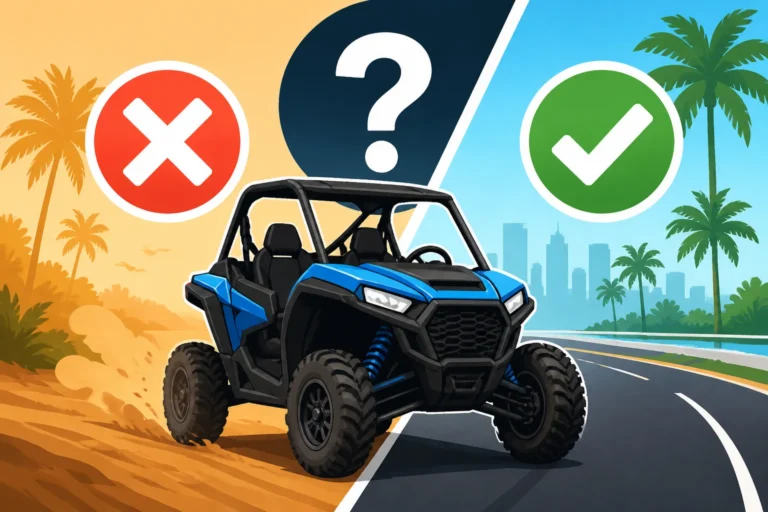
All-Terrain Vehicles (ATVs), also known as quads or four-wheelers, and Utility Task Vehicles (UTVs), often called side-by-sides, are an entirely different breed. These machines are designed for off-road environments, agricultural work, or heavy-duty utility tasks. They feature powerful engines, rugged suspensions, and aggressive tires built to handle dirt, mud, sand, and trails. Brands like SuperATV specialize in aftermarket parts for these vehicles, offering lift kits, heavy-duty axles, and advanced lighting for serious off-road enthusiasts who tackle challenging terrain in places like Ocala National Forest or Croom Motorcycle Area. An ATV or UTV is much faster, more powerful, and structurally different from a golf cart. Their road-use rules in Florida are far more restrictive than golf carts, generally limiting them to unpaved roads in specific counties or for agricultural purposes, and they are typically not street legal in the same way a golf cart might be on a designated community road. For more on this, check out [Florida ATV Road Rules: Where You Can Legally Ride] or [Is a UTV Street Legal in Florida?].
| Feature | Golf Cart | ATV (All-Terrain Vehicle) | UTV (Utility Task Vehicle / Side-by-Side) |
|---|---|---|---|
| Primary Purpose | Golf course, short-distance community travel | Off-road recreation, sport, utility work | Off-road utility work, recreation, transport |
| Seating | Bench seating, 2-6 passengers | Straddle seating, 1-2 riders | Bucket or bench seating, 2-6 passengers |
| Steering | Steering wheel | Handlebars | Steering wheel |
| Top Speed | ~20 mph (stock) | Often 40-70+ mph | Often 40-70+ mph |
| Safety Features | Minimal (seatbelts often optional/aftermarket) | Minimal (helmets crucial) | More robust (roll cages, seatbelts standard) |
| Street Legal in FL | Limited to designated community roads with proper credentials | Generally NOT street legal, limited road use | Generally NOT street legal, limited road use |
| Primary Power | Electric or small gasoline engine | Gasoline engine (often larger) | Gasoline engine (often larger) |
Florida's Low-Speed Vehicle LSV Rules
To further complicate things, Florida also has a distinct category for Low-Speed Vehicles (LSVs). While an LSV might look very similar to a golf cart, there's a crucial legal difference that gives them more road-going capabilities, but also more stringent requirements. An LSV is defined as any four-wheeled vehicle whose top speed is greater than 20 miles per hour but not greater than 25 miles per hour. This is the key: a golf cart typically maxes out at 20 mph, but an LSV can go a bit faster.
Because of this higher speed capability, LSVs are subject to much more rigorous safety and registration standards. To be considered an LSV and legally driven on roads with a speed limit of 35 mph or less, the vehicle must be equipped with specific safety features that a standard golf cart often lacks. These include headlamps, stop lamps, turn signals, tail lamps, reflex reflectors, parking brakes, a rearview mirror, a windshield, seat belts, and a Vehicle Identification Number (VIN). Furthermore, an LSV must be titled, registered, and insured, just like a regular car. This is a significant distinction from a standard golf cart, which generally does not require title, registration, or traditional auto insurance for operation in designated areas. So, while a golf cart with some aftermarket enhancements might look like it could hit 25 mph, without meeting all the LSV safety and registration requirements, it's not legally an LSV. If you're considering turning your side-by-side into something street legal, understanding [Florida Low-Speed Vehicle Rules for Side-by-Sides] and [Florida LSV Registration and Insurance Rules] is critical, and it's a completely different process than just driving a golf cart. For those looking at converting, companies like SuperATV offer parts for UTVs, but those parts alone don't make a machine an LSV; there's a whole process to go through. [Why a Cart Needs No Title but an LSV Does] explains this further.
Disclaimer
This article is for general informational purposes only and does not constitute professional advice. Laws, prices and regulations vary by location and change over time. Consult a qualified professional for guidance on your specific situation.