Florida’s Golf Cart Age Change Explained
If you're a Florida resident, especially one living in a golf cart-friendly community, you've probably felt the shift in how things are done lately. There's been a fair bit of confusion and even frustration about who can legally drive a golf cart on public roads, particularly among parents and younger drivers. This guide is here to untangle the details of Florida's golf cart age change that went into effect recently, helping you understand the new rules, who they impact, and what you need to do to stay on the right side of the law.
Understanding the Previous Golf Cart Age Rules in Florida
For many years, Florida had a pretty straightforward approach to golf cart operation on designated public roads. It was a simpler time, and the rules often reflected the laid-back, community-centric lifestyle that golf carts embodied for so many.
Before October 1, 2023: The 14-Year-Old Rule
Before the recent change, the rule of thumb was that anyone 14 years old or older could operate a golf cart on public roads that were approved for golf cart use. This meant it was a common sight to see teenagers, sometimes even younger-looking kids, zipping around neighborhoods, running errands, or heading to the community pool. It was part of the charm and convenience for many families, offering a sense of independence to younger family members in a relatively safe, low-speed environment.
This old rule was a huge draw for communities like The Villages, where golf carts are practically a primary mode of transportation. Families loved the freedom it offered, allowing children to participate more actively in their community life without needing a full driver's license. It fostered a unique culture where golf carts were more than just a means to play 18 holes; they were integral to daily life, from school drop-offs to grocery runs.
Why the Change? Public Safety Concerns
So, with such a well-established tradition, why did Florida decide to change things up? The simple answer boils down to public safety. As Florida's population grew and golf cart usage exploded beyond the golf course and into residential streets, so too did concerns about accidents. There was a noticeable increase in incidents involving golf carts, sometimes with serious injuries, especially when younger, less experienced drivers were at the helm.
Many communities began advocating for stricter regulations. They saw a growing disconnect between the casual, almost toy-like perception of golf carts and the very real dangers they posed when sharing roads with cars, bicycles, and pedestrians. This push for enhanced safety, driven by local incidents and a statewide trend of increased golf cart accidents, ultimately led lawmakers to re-evaluate the age and licensing requirements for operating these vehicles on public roadways. It was a direct response to a changing landscape, where golf carts had moved from niche recreation to mainstream transportation in many parts of the state.
The Big Change: What Happened on October 1, 2023?
The landscape for golf cart operation on Florida's public roads shifted significantly with the implementation of a new law. This wasn't just a minor tweak; it was a substantial revision aimed at enhancing safety and aligning golf cart usage more closely with other vehicle regulations.
The New Minimum Age Requirement
Effective October 1, 2023, the rules for who can legally drive a golf cart on Florida's public roads became much stricter. Gone are the days of a 14-year-old freely navigating designated streets. Under the new law, a person must now be at least 15 years old and possess a valid learner's permit, or be 16 years old and have a valid driver's license, to operate a golf cart on public roads or streets. This [Florida Golf Cart Age Law Since October 2023] marks a clear pivot towards requiring a foundational level of driving knowledge and experience, even for low-speed vehicles.
This change means that if you're 15, you need to have passed your learner's permit test and be carrying that permit with you. If you're 16 or older, a standard driver's license is the requirement. It's a significant step that brings golf cart operation more in line with the responsibilities associated with driving other motorized vehicles, albeit at lower speeds. Many families who previously relied on their younger teens to run quick errands or get around their communities have had to adjust their routines and expectations.
The Role of HB 519 and its Impact
This significant legislative change didn't just appear out of thin air. It was a direct result of House Bill 519, which was passed by the Florida Legislature and signed into law. The bill specifically amended Section 316.212 of the Florida Statutes, which governs the operation of golf carts. The intent behind HB 519 was explicitly to address the rising concerns over golf cart-related accidents and fatalities, many of which involved underage or inexperienced drivers.
The impact of HB 519 has been profound. It created a more uniform standard across the state, ensuring that regardless of whether you're in a sprawling retirement community or a quiet suburban neighborhood, the same age and licensing requirements apply to golf cart drivers on public roads. For parents, this meant having conversations with their previously golf cart-driving 14-year-olds about the loss of those privileges, as covered in detail in [Why a 14-Year-Old Lost Golf Cart Privileges]. For communities, it prompted a review of their local ordinances and signage to reflect the new state mandate. The bill effectively elevated the perceived responsibility of operating a golf cart, emphasizing that it's a vehicle that requires proper training and authorization, much like any other on Florida's roads.
Who Is Affected by Florida's New Golf Cart Age Law?
The new golf cart age law in Florida has cast a wide net, impacting various groups within communities that rely on these convenient vehicles. It's not just about the driver; the changes have ripple effects across families, businesses, and the very fabric of community life.
Teenagers and Young Adults
Undoubtedly, the most directly affected demographic are teenagers and young adults who previously enjoyed the freedom of driving a golf cart on public roads. Prior to October 1, 2023, a 14-year-old could legally operate a golf cart in designated areas. Now, that same 14-year-old finds themselves suddenly sidelined, unable to drive until they turn 15 and obtain a learner's permit, or until they are 16 with a full driver's license. This change means many young people who used golf carts for transportation to school, friends' houses, or extracurricular activities have had their independence curtailed.
The shift can be particularly frustrating for those who were just a few months shy of their 15th or 16th birthday when the law changed. They've grown up seeing older siblings or friends drive carts, only to find the rules changed right as they were about to gain that privilege. For those who are 15, the path is now clear: get that learner's permit. For the 16-year-olds, it means having their full driver's license. The age restriction combined with the need for a permit or license has fundamentally altered how younger residents navigate their golf cart-friendly towns, bringing the state's [Learner's Permits and Cart Driving at 15] guidelines into sharp focus for a new context.
Parents, Guardians, and Communities
The impact extends far beyond the individual driver to parents, guardians, and the broader community. Parents now bear the responsibility of ensuring their minor children comply with the new age and licensing requirements. This might mean driving their kids more often, arranging carpools, or investing in other forms of transportation. For families who live in golf cart-centric neighborhoods, it might necessitate a significant adjustment to daily routines, especially if they relied on younger children for quick trips to a community center or a neighbor's house.
For communities themselves, particularly those where golf carts are a staple—think retirement communities or planned developments like The Villages—there's been a period of adaptation. HOAs and community managers have had to update their internal rules, communicate the changes to residents, and potentially adjust infrastructure if they previously catered to a younger golf cart-driving population. The overall aim is to foster safer streets for everyone, but the transition has required collective effort and understanding, prompting many discussions about [Florida Golf Cart Photo ID Requirement for Adults] to ensure compliance at all ages.
Golf Cart Rental Businesses and Tourism
Another significant group feeling the impact are golf cart rental businesses, especially those operating in popular tourist destinations or near large retirement communities. Previously, rental companies might have had more flexible age policies, perhaps requiring renters to be 18 or older with a valid ID, but not necessarily a full driver's license for everyone. Now, they must strictly adhere to the state's new requirements, which means ensuring all operators on public roads meet the 15-year-old (with learner's permit) or 16-year-old (with driver's license) minimum.
This could affect their customer base, particularly families visiting Florida who might have planned to rent a cart for their younger teens to drive. Rental agreements and insurance policies also need to be updated to reflect these new legal mandates. While the change primarily targets public road use, it also influences how these businesses operate and market their services, potentially leading to adjustments in their fleet offerings or additional verification steps during the rental process. Tourism boards and local chambers of commerce have also had to communicate these updates to visitors, ensuring a smooth and compliant experience for everyone enjoying Florida's unique golf cart culture.
Navigating the New Requirements for Golf Cart Operation
Understanding the new rules is one thing, but actually implementing them in your daily life or within your community requires a bit more practical knowledge. It's about ensuring everyone who gets behind the wheel of a golf cart on a public road is properly authorized.
Driver's License or Learner's Permit Mandate
The most direct implication of the new law is the strict mandate for appropriate licensing. If you are 15 years old and wish to operate a golf cart on a public road in Florida, you absolutely must possess a valid learner's permit. This isn't just about having applied for one; it means you've passed the written exam, received your permit, and have it on your person while driving. For those 16 years of age or older, a full, valid driver's license is required. There are no exceptions for age-eligible drivers based on presumed experience or familiarity with the vehicle.
This means if you're pulled over by law enforcement while driving a golf cart on a designated public road, you'll be expected to produce this documentation. Just like driving a car, operating a golf cart now carries the expectation of being a licensed operator. This is a critical point for parents to convey to their teens, emphasizing that the days of casual, unlicensed golf cart driving on public streets are over. It's about treating the golf cart with the same respect for licensing requirements as any other vehicle on the road.
Proof of Age and Identification
Beyond the license or permit itself, the new law implies a need for all golf cart operators to be ready to prove their age. While adults typically carry their driver's license anyway, which serves as both proof of licensing and age, younger drivers with learner's permits will need to ensure they have that physical permit with them. For any driver, regardless of age, being able to readily show identification to law enforcement is now a non-negotiable aspect of operating a golf cart on Florida's public roads.
This requirement helps law enforcement officers quickly verify compliance with the age mandate. For adults, it simply reinforces the good habit of always carrying identification. For younger drivers, it's a new level of responsibility that mirrors what they'll encounter when they eventually drive a car. Communities that host large numbers of golf carts, such as those that might have seen kids on their way to school, are now reinforcing the message that all drivers must carry [Florida Golf Cart Photo ID Requirement for Adults] to prevent issues. It's a small but significant step towards greater accountability on shared roadways.
What About Private Property and Gated Communities?
A common area of confusion often arises concerning private property and gated communities. It's important to clarify that Florida's state law primarily governs the use of golf carts on public roads or streets. This means that the new age and licensing requirements generally do not apply to the operation of golf carts exclusively on private property, such as a large farm, a personal estate, or within the confines of a completely private, fenced-off community with no public access.
However, many gated communities or planned developments in Florida have roads that, while appearing private, are actually dedicated to public use or fall under a complex jurisdiction that involves public access easements. In such cases, if a golf cart is being operated on a road within a gated community that is considered a "public road" by Florida statute, then the state's age and licensing requirements will absolutely apply. Always check with your specific community's HOA or local law enforcement to understand the precise classification of your roads. Just because a road is behind a gate doesn't automatically make it exempt from state traffic laws, a point often debated in places like [What ATVs Cannot Do on The Villages Cart Paths]. When in doubt, it's always safer and wiser to assume the state laws apply and ensure all operators are properly licensed.
Comparing Golf Carts, LSVs, and ATVs Under Florida Law
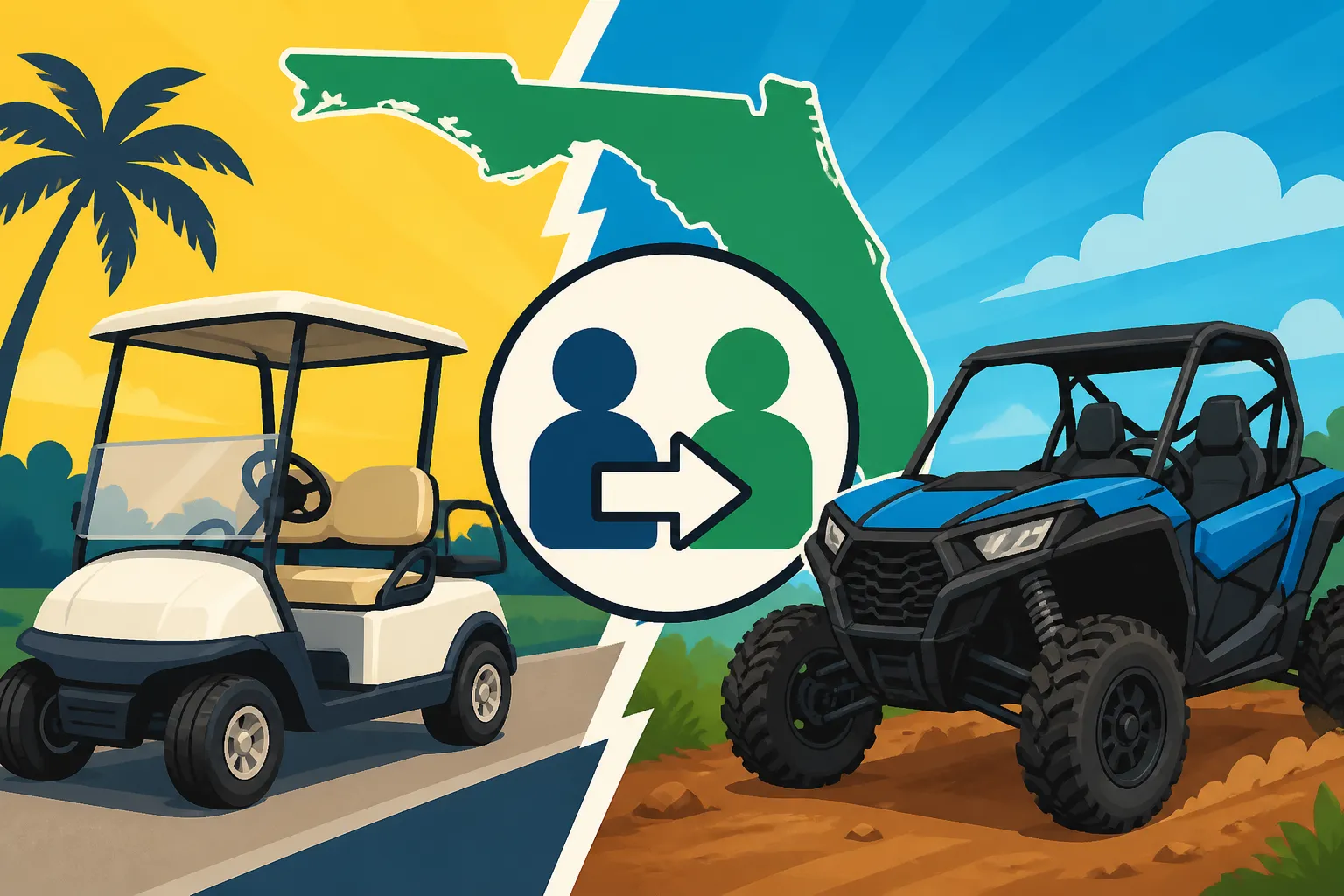
It's easy to lump all small, open-air vehicles into one category, but Florida law makes very distinct differences between golf carts, Low-Speed Vehicles (LSVs), and All-Terrain Vehicles (ATVs) or Utility Task Vehicles (UTVs). Understanding these distinctions is critical, especially when considering the age and licensing requirements for each.
Golf Carts vs. Low-Speed Vehicles (LSVs)
This is where a lot of people get tripped up. While they might look similar, especially if a golf cart has been "upgraded," golf carts and Low-Speed Vehicles (LSVs) are governed by entirely different sets of rules in Florida.
Golf Carts:
- Definition: Generally defined as a motor vehicle designed and manufactured for operation on a golf course for sporting or recreational purposes, not capable of exceeding 20 miles per hour.
- Road Use: Can only be operated on public roads or streets that have been designated by a local governmental entity for golf cart use, and where the posted speed limit is 25 mph or less.
- Registration/License Plate: Not required to be registered or licensed with the state, nor do they carry a traditional license plate.
- Insurance: Not legally required for operation on designated golf cart paths or roads.
- Driver Age: As of October 1, 2023, 15 years old with a learner's permit, or 16 years old with a driver's license.
Low-Speed Vehicles (LSVs):
- Definition: A four-wheeled electric vehicle whose top speed is greater than 20 miles per hour but not greater than 25 miles per hour.
- Road Use: Can be operated on any street or road where the posted speed limit is 35 mph or less. This gives them much broader road access than golf carts.
- Registration/License Plate: Must be registered and titled with the Florida Department of Highway Safety and Motor Vehicles (DHSMV) and carry a valid license plate. This also involves meeting federal safety standards.
- Insurance: Mandatory to carry personal injury protection (PIP) and property damage liability (PDL) insurance, just like a car.
- Driver Age: Must possess a valid driver's license. No learner's permit allowance.
The key differences lie in speed, where they can be driven, and the requirements for registration, insurance, and licensing. Some people attempt to modify their golf carts to achieve higher speeds or add features like turn signals, essentially trying to [Turning a Side-by-Side Into a Florida LSV] but with a golf cart. While aftermarket parts from places like SuperATV can certainly enhance performance or add accessories to various off-road vehicles, converting a golf cart into a legal LSV is a very specific process that requires the vehicle to meet strict federal safety standards and state registration rules. It's not just about adding a speedometer; it's a complete reclassification that often means the original golf cart wasn't built to be an LSV. It's crucial to understand these distinctions to avoid legal trouble, as covered in [Florida LSV Registration and Insurance Rules].
Why an ATV is Not a Golf Cart (and Vice Versa)
Moving further afield, an All-Terrain Vehicle (ATV) or a Utility Task Vehicle (UTV) (often called a side-by-side) is an entirely different beast from a golf cart or LSV under Florida law.
- Intended Use: ATVs and UTVs are primarily designed for off-road use, recreation, and utility work on unpaved terrain. Golf carts are for low-speed travel, typically on paved, designated community roads or golf courses.
- Construction: ATVs usually have handlebars and a saddle seat, while UTVs have a steering wheel and side-by-side seating, often with roll cages and seatbelts. Golf carts are open-air, steering wheel-controlled, and much lighter duty.
- Road Legality: With very few exceptions (like crossing a highway or using specific unpaved county roads under strict conditions), [Florida ATV Road Rules: Where You Can Legally Ride] generally prohibit ATVs and UTVs from being driven on public paved roads in Florida. They are considered off-highway vehicles.
- Titling: ATVs and UTVs must be titled in Florida if they are operated on public lands or are new to the state, but they do not receive a traditional license plate for road use. Golf carts and LSVs have their own unique titling/registration requirements.
- Driver Age/License: While there are age restrictions and safety course requirements for minors to ride ATVs on public lands, the concept of a "driver's license" for ATV operation on roads is largely irrelevant because they aren't street legal in the same way. [Florida ATV Road Use Needs a Licensed Driver] typically only applies to the limited circumstances where ATVs are permitted on public roadways, which usually requires a full driver's license for the operator.
Trying to use an ATV as a street-legal golf cart alternative is a non-starter in Florida. The laws, equipment requirements, and designated uses are fundamentally different. Just because it has four wheels doesn't mean it's interchangeable. A clear understanding of these categories prevents accidental violations and ensures you're operating the right vehicle in the right place.
The Villages and Peachtree City Examples
To really illustrate the practical implications of these distinctions, let's look at real-world examples.
The Villages, Florida: This massive retirement community is famous for its extensive network of golf cart paths and designated golf cart-friendly roads. For decades, golf carts have been the primary mode of transportation for many residents. The new age law for golf carts had a direct impact here, particularly on visiting grandchildren or younger residents who previously had more freedom. Now, even within the highly integrated golf cart infrastructure of The Villages, anyone under 16 without a driver's license (or under 15 without a learner's permit) cannot operate a golf cart on the public roads that crisscross the community. This change meant a significant adjustment for families accustomed to the prior, more lenient rules. [What ATVs Cannot Do on The Villages Cart Paths] further highlights the strict separation of vehicle types.
Peachtree City, Georgia: While not in Florida, Peachtree City offers a strong comparative example of a community that fully embraced alternative vehicle transportation but with different regulatory frameworks. This city boasts over 100 miles of multi-use paths, primarily for golf carts, which are often used by all ages for daily commutes. Their local ordinances and state laws have evolved uniquely. While Peachtree City is often looked at as a model for golf cart communities, Florida's recent legislative action demonstrates that each state and locality tailors its rules based on its own safety concerns and demographic needs, showing that the model isn't one-size-fits-all.
These examples underscore that even in communities where alternative vehicles are central to daily life, state laws—and their changes—have real and immediate consequences for how residents and visitors can navigate.
Here's a comparison table to help keep these distinctions clear:
| Feature | Golf Cart | Low-Speed Vehicle (LSV) | All-Terrain Vehicle (ATV) |
|---|---|---|---|
| Top Speed | Up to 20 mph | 20-25 mph | Varies widely, often much higher than 25 mph |
| Primary Use | Golf courses, designated community roads | Street-legal, on roads up to 35 mph | Off-road recreation, utility work |
| Road Legality | Designated roads (25 mph limit) | Roads up to 35 mph limit | Limited public road access (unpaved, crossings) |
| Driver Age Requirement | 15 w/ learner's permit, or 16 w/ driver's license | Valid driver's license (any age) | Varies for off-road; licensed driver for limited road use |
| Registration/Plate | Not required | Required (title, plate) | Required for public land use (title only) |
| Insurance | Not required for designated roads | Required (PIP/PDL) | May be required for public land, not for road use |
| Safety Equipment | Basic (lights, brakes) | More extensive (headlights, tail lights, turn signals, seat belts, windshield, VIN) | Varies (headlights, tail lights often standard) |
Common Misconceptions and Clarifications
Even with clear laws, misunderstandings can easily spread, especially in close-knit communities or among those unfamiliar with the specifics of Florida's statutes. Let's clear up some common points of confusion.
"My HOA Says It's Okay"
One of the most persistent myths is that a Homeowners Association (HOA) rule can somehow supersede state law regarding golf cart operation on public roads. This is simply not true. While your HOA certainly has the authority to set rules for private roads within your community or common areas, they cannot grant permission to operate a golf cart in a way that violates Florida state law on public roads. If a road within your gated community is deemed a public thoroughfare by the state, then state laws, including the new age and licensing requirements, apply there, regardless of what your HOA documents might say.
Many residents assume that because they pay HOA fees, all roads are private. This isn't always the case. Some community roads are dedicated to the county or municipality, or they have public access easements. Law enforcement will enforce state law, not HOA rules, on these roads. So, if your 14-year-old is driving a golf cart on a road that's technically public within your HOA, they are subject to the same penalties as someone driving illegally on a county road. Always defer to state law when it comes to vehicle operation on any road that isn't exclusively private property.
Understanding the "Unpaved Roadway" Exception
Another area of confusion often revolves around the concept of an "unpaved roadway." Florida law does provide specific, limited circumstances where ATVs (and sometimes UTVs, depending on their classification) can be operated on certain unpaved county or municipal roads. However, this exception is not a blanket permission for golf carts or ATVs to roam freely, and it comes with its own strict set of conditions.
For ATVs, the rules for unpaved roads are specific: they generally require the operator to be a licensed driver, the road must be an "unpaved roadway" that is not otherwise maintained by the county or municipality, and the vehicle must be operated during daylight hours. This is a very narrow exception, often applicable to designated recreational trails or specific rural access roads, and it's distinct from the rules for golf carts. A golf cart's limited use is tied to specific designated golf cart paths or roads with a 25 mph speed limit, regardless of whether they are paved or unpaved. You cannot simply assume an unpaved road is fair game for your golf cart just because an ATV might have limited access to it. The rules are different for each vehicle type, a point reiterated in discussions about [Florida's Unpaved Road Rule for ATVs Explained].
Enforcement and Penalties
Florida law enforcement takes these regulations seriously, and violations can lead to real consequences. Operating a golf cart on a public road without meeting the age and licensing requirements can result in citations, fines, and potentially even the impoundment of the golf cart. For minors, this could also impact their future driving privileges. For instance, if a 14-year-old is caught driving illegally, it could show up on their driving record when they apply for a learner's permit or driver's license, possibly delaying their ability to drive legally.
The penalties for illegal golf cart operation often mirror those for other traffic infractions. Depending on the severity and frequency of the violation, fines can add up, and repeat offenses can lead to more serious repercussions. It's not just a slap on the wrist; it's a legal offense. The goal of enforcement is public safety, ensuring that all operators on Florida's roads, whether in a car, an LSV, or a golf cart, are qualified and compliant with the law. Ignorance of the law is not an excuse, and authorities are well within their rights to enforce these rules. Information on broader [Florida Penalties for Illegal ATV Road Riding] can offer insight into the seriousness of off-highway vehicle infractions, a gravity that now extends more directly to golf cart operations on public roads for non-compliant drivers.
Disclaimer
This article is for general informational purposes only and does not constitute professional advice. Laws, prices and regulations vary by location and change over time. Consult a qualified professional for guidance on your specific situation.